

Norway warns against TikTok, YouTube and Snapchat
The government presents consolidated screen-time guidance for children and young people. For the first time, the authorities name specific services as risks. But the list is no clean bill of health for those left off it – the Norwegian alternative Hudd, for instance, is no safer for being Norwegian.
September 14, 2026 -September 15, 2026 Updated below
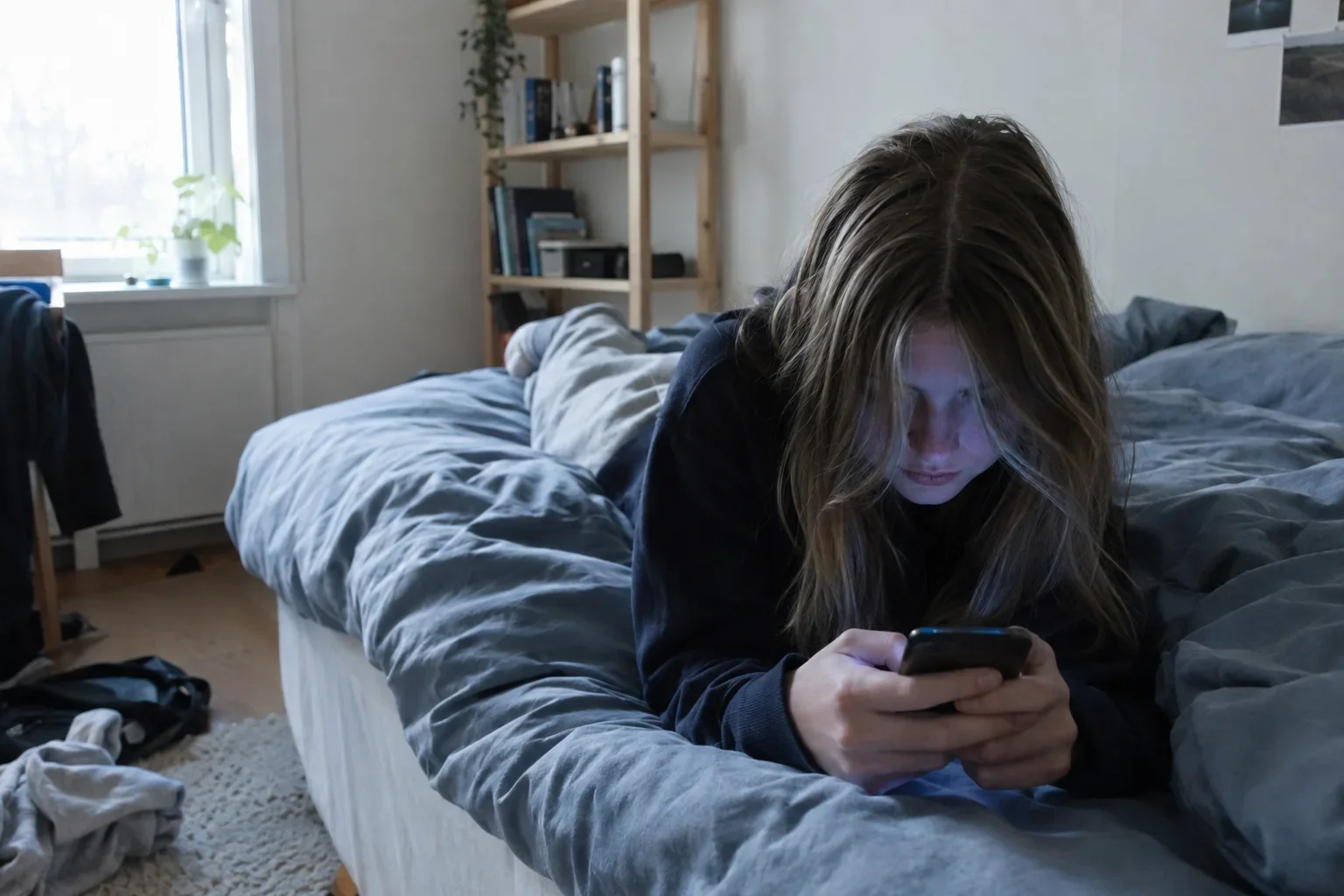
Image by AI/S&P
Warns Against TikTok, YouTube and Snapchat
On Monday 14 September, the Norwegian government presented consolidated recommendations on children's and young people's screen use. For the first time, the authorities name specific services when describing risk.
The recommendations have been drawn up by the Norwegian Directorate of Health, the Directorate for Children, Youth and Family Affairs, the Directorate for Education and Training and the Norwegian Media Authority, with the Police contributing to the evidence base. They build on the Directorate of Health's screen advice from January this year, but now cover the whole of a child's digital life — not just leisure time.
Prime Minister Jonas Gahr Støre describes making the digital sphere safe for children and young people as a main priority, pointing to an age limit for social media, investment in printed textbooks and an expectation that mobile phones are out of the classroom. Minister of Children and Families Lene Vågslid justifies the consolidation on the grounds that advice and information have previously been spread across different agencies and sectors.
What is new is the level of precision. The time limits are largely the same as before, but the recommendations have become far more concrete about algorithms, social media, smartphones and digital risks, and risks such as addictive design, harmful content, recruitment into crime and contact risk are tied to specific services such as TikTok, YouTube and Snapchat.
The risks the authorities describe
For the 13–18 age group, a maximum of 1.5–3 hours of screen time per day outside school is recommended. Bufdir describes apps, social media and games as designed to hold the user for as long as possible, with endless scrolling, rewards, "streaks" and notifications. It further states that certain platforms increase the risk of digital abuse and of children coming into contact with criminal networks, harmful online environments or people pretending to be someone else. The sale of narcotics is linked to closed groups on Snapchat and to encrypted apps such as Signal, Telegram and WhatsApp, and to platforms such as Discord, Chatroulette, Roblox and Fortnite.
Children aged 13–15 are particularly exposed to sexual exploitation, according to Kripos. Parents are advised to ensure that young people observe the age limits and to restrict use on platforms such as TikTok, Snapchat, Instagram, Facebook and WhatsApp.
The Norwegian alternative Hudd is not safe because it is Norwegian
The list of named services consists of American and Chinese platforms. It is a natural inference for parents that the problem lies in the origin — and that a Norwegian service with real names, BankID and no advertising is the answer. That inference does not hold.
Hudd is a Norwegian social medium with a 15-year age limit and marketing that emphasises safety and verified identity. Across several articles, Samfunn og Politikk has documented a number of questionable aspects of the Hudd app:
Users are identified via Vipps or BankID, with name and address drawn from the National Population Register. Name and postal town are displayed with every activity in the service and cannot be hidden. On the international platforms, the most important protection for a user is precisely the option to remain anonymous behind a chosen username.
Users cannot close the comment field or delete comments on their own posts, that makes it hard to control what appears on their own profile.
Hudd claims that verified identity is a safety feature. It is not, unless the people one encounters in the application have good intentions.
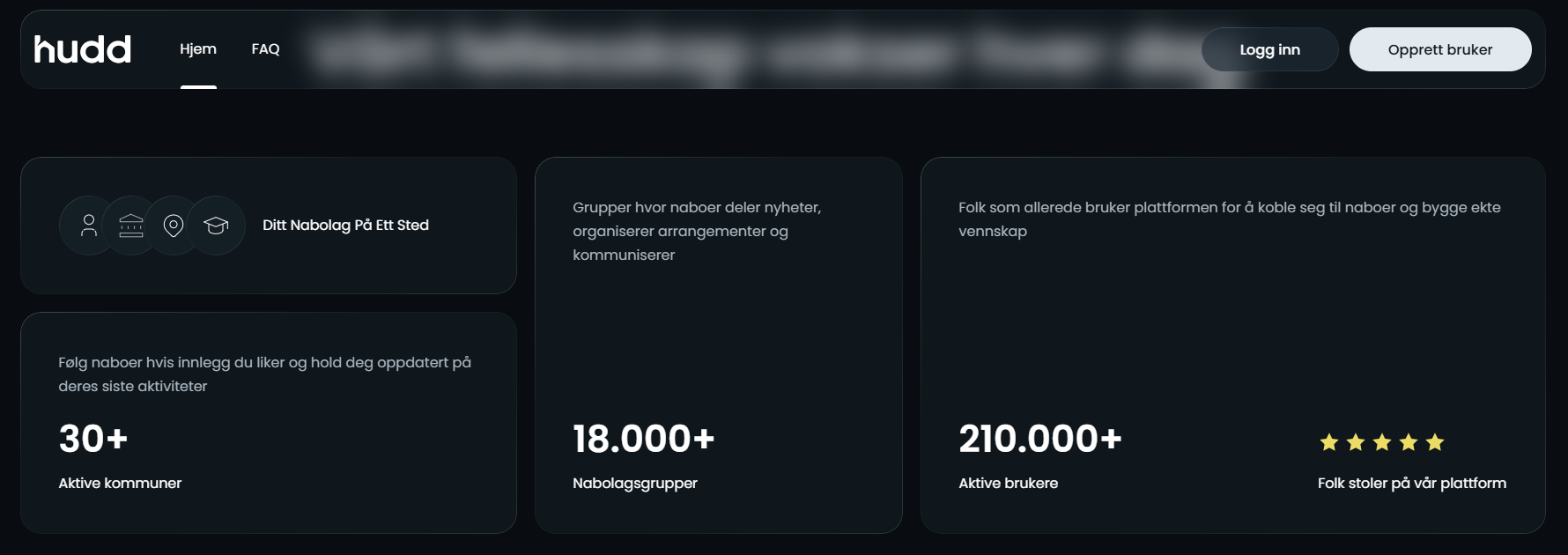
The group structure is largely invisible from the outside. Hudd states that it has more than 18,000 neighbourhood groups. A count carried out by S&P on Sunday 6 September found 1,611 groups visible from the outside. Measured against Hudd's own figure, that is barely nine per cent. More than 90 per cent of the groups exist in a hidden layer whose content and members no outsider, and no parent, can see. The authorities' warning against closed groups on Snapchat concerns precisely this type of functionality in social media. Hudd has not responded to S&P regarding the hidden groups.
In the group type "Public and closed", the member list has been visible to non-members on Hudd. Members of exposed and vulnerable groups concerning faith, illness, substance use and sexual orientation were publicly exposed in the application with their identity and postal town. Hudd has informed S&P that this was intended and that the user had given consent.
The service is marketed as advertising-free. At the same time, Hudd has carried an advertisement for, and has sent at least three newsletters containing, a third-party offer of two cinema tickets to users who complete a credit application. Hudd has informed S&P this will not happen again.
What parents should be aware of
The authorities' recommendations name the services that are large enough to have been the subject of international research and supervision. Absence from the list is not a clean bill of health. Less well-known services have not been through comparable supervision and research measured against the requirements in the authorities' recommendations.
Be aware that social media marketing themselves as safe — in this case Hudd — are not necessarily safe in the broad sense that makes a social medium safe.
Updated September 15, 2026
The day after this announcement was published, Hudd has launched a new website. They now omit informing about the large number of groups on Hudd, therefore the article is updated with a screenshot from the website as it appeared when this article was published on 14 September.
RELATED ARTICLES
Hudd markets itself as the safe alternative to social media, but harbours a vast dark digital layer
A security flaw in the Norwegian social media platform Hudd exposed users in vulnerable groups
Flop for Hudd, the Norwegian social medium that was to become a safe alternative to X and Facebook
Cyberattacks can have consequences for you, you should consider and secure your digital privacy
SOURCES
Norwegian Government
The government launches new recommendations on screen use for children and young peopleBufdir
The authorities' recommendations on screen use for children and young peopleHUDD
About Hudd (original website)
Content on Society and Politics is based on reliable sources and actual events, providing a news-oriented perspective.
Learn more about S&P >