
China supports Russia with minerals and restrict western defense industry
Europe does not possess enough mineral resources to defend itself. The population is not informed that the tense geopolitical situation is driven by a long-standing struggle over access to minerals.
September 9, 2025 | INTERNATIONAL POLITICS
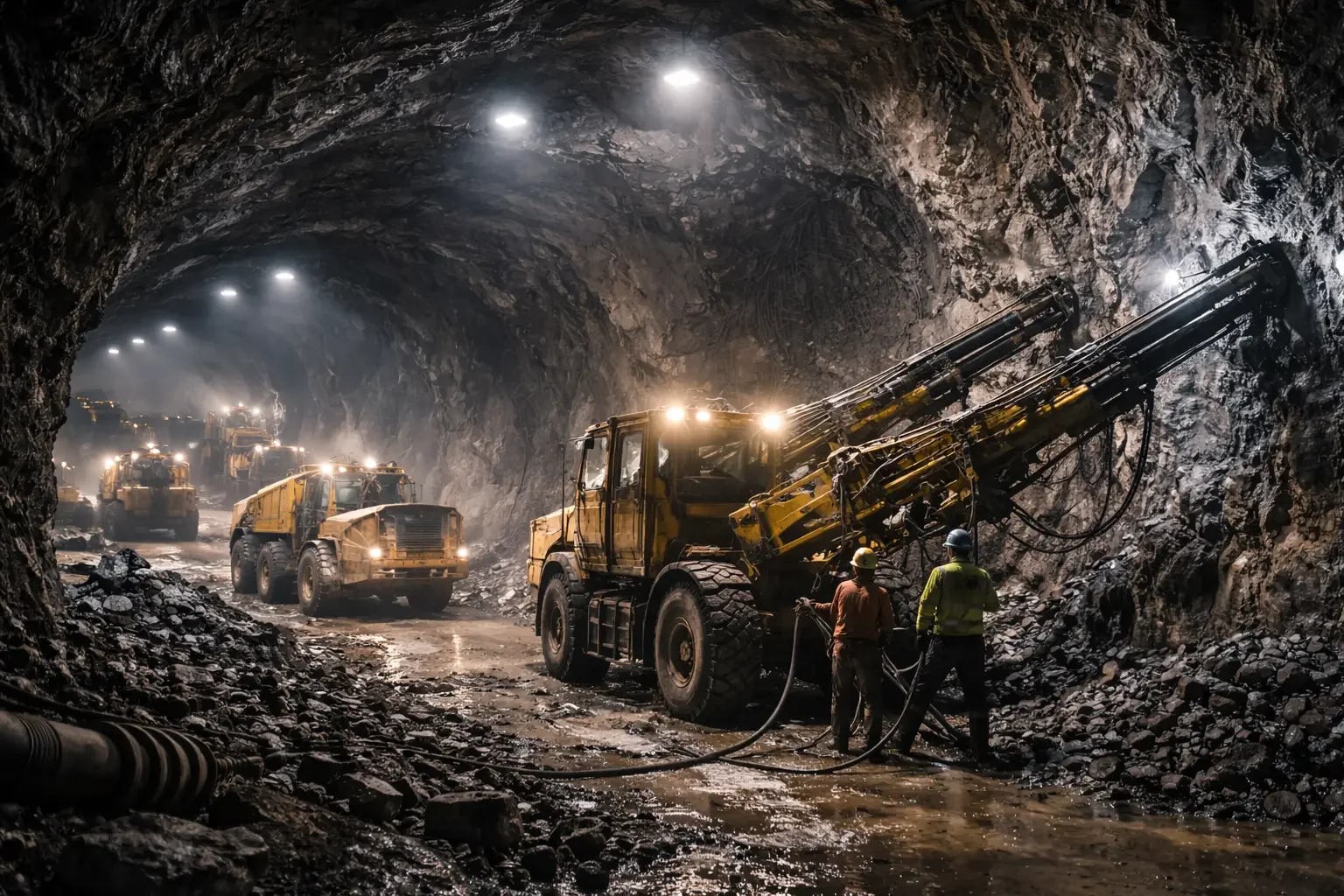
Image by AI/S&P
Mineral shortage
There are not enough mineral resources on the European continent (including Norway) for Europe to be able to defend itself. Minerals are critical for weapons production and directly affect Europe's defence security. The tense geopolitical situation has been triggered by a years-long struggle over minerals.
China covers around 80% of Europe's mineral needs — less for some minerals, more for others. This puts Europe in a very difficult position. China, Russia and North Korea have just strengthened their alliance, which creates an even more strained situation for Europe.
China supplies Russia with minerals
China delivers substantial quantities of minerals, as well as products derived from them, to Russia's defence industry in order to support the war against Ukraine. Russia has access to minerals itself, but extraction and processing are very resource-intensive. The mineral requirements for defence materiel cannot be compared with the needs of, for example, the car industry — a car has a long service life. Most weapons have a short service life, and in a war the need for minerals will increase substantially.
China sanctions minerals to the West
At the same time as China delivers minerals to Russia both directly and indirectly through components and other materiel, China has imposed restrictions on mineral supplies to Western defence industry. This slows production in the arms industry that supplies weapons to Ukraine. In other words, China is using minerals as a geopolitical weapon.
Trump's hunt for minerals
China's near-monopoly on minerals has triggered Trump's hunt for minerals and tariffs. The US has secured new mineral suppliers through agreements with Ukraine and Congo, while new mining projects have been launched on American soil and seabed mining is being planned. In August, Trump again sent representatives to Greenland to assess mineral extraction.
The war over the minerals in Ukraine
The EU's and Norway's involvement in Ukraine is a risky business, to put it mildly. The considerable support and effort for Ukraine is due to Ukraine's mineral resources. Russia has occupied areas of Ukraine with significant mineral resources, and preventing Russia from expanding further into Ukraine and gaining control over all the mineral resources is critical for the EU. This became even more critical after Trump secured a minerals agreement with Ukraine on 30 April, which gives the US first right to around 50% of Ukraine's minerals. The EU must secure the rest.
Nevertheless, we must take into account that access to minerals on the European continent is limited. Here it is a matter for the EU of securing every last gram. The EU's goal is to be 35% self-sufficient by 2030, the bulk of which is to come from recycling. When this plan was drawn up in 2023, no calculation was made of what the need would be in a war. It is therefore uncertain how self-sufficient the EU will actually be in a wartime situation — the real share will be much lower than the under 20% they have now and the target of 35% by 2030.
China can cut off mineral supplies to the EU
If Russia and the EU come into direct confrontation, China will stop mineral deliveries to the EU entirely. Even if minerals were reprioritised away from other industry, it would not amount to much without deliveries from China. The EU is thus dependent on supplies of both minerals and weapons from outside. In a wartime situation, deliveries from other Eastern countries and Africa would be highly exposed to being cut off by China, Russia and North Korea. These supplier countries would in any case not be able to extract enough; increasing production is both time- and resource-intensive.
In reality there is only one security option for the EU, and that is NATO. We have seen this year that Trump has consolidated the US as NATO's absolute ruler, which leaves little prospect of Europe managing in a war against Russia/China without Trump's goodwill.
There is only one option: NATO. This year has shown that Trump has consolidated the U.S. as NATO’s dominant power. There is no possibility that Europe could manage a war without Trump’s support. No matter how one looks at it, the numbers do not add up. It is not possible—neither now nor in the long term—for the EU to become capable of defending itself. These are the realities the current government downplays.
SOURCES
Eurostat
International trade mineralsAl Jazeera
EU presses China over exports of rare earth elements and Ukraine warNewsweek
China quietly supplies minerals to Russia’s war machine in UkraineEuromaidan Press
China cuts rare minerals, stalling US weapons — and threatening Ukraine’s fight for survivalBusiness & Human Rights Resource Centre
China supplying key chemicals for Russian missiles, RFE/RL investigation findsMilitarnyi
China supplies Russia with critical raw materials for weapons productionOrganized Crime and Corruption Reporting Project (OCCRP)
China becomes Russia’s lifeline for critical war mineralsU.S.-China Economic and Security Review Commission
China’s position on Russia’s invasion of UkraineGeopolitical Intelligence Services
The new geopolitics of mineralsCentre for Strategic & International Studies (CSIS)
China’s new rare earths export restrictionsThe Wall Street Journal
China is choking supply of critical minerals
Content on Society and Politics is based on reliable sources and actual events, providing a news-oriented perspective intented for further debate. To access the article’s author and the related debate, membership on Hudd is required.
