
Minerals top the agenda for both the Parliament and Donald Trump
On the same day Prime Minister Støre meet the U.S. president in Washington, a hearing on a minerals act has taken place in the Norwegian Parliament. The framework for control over Norway’s mineral resources has been set by the EU and endorsed by the Labour Party.
April 24, 2025 | INTERNATIONAL POLITICS
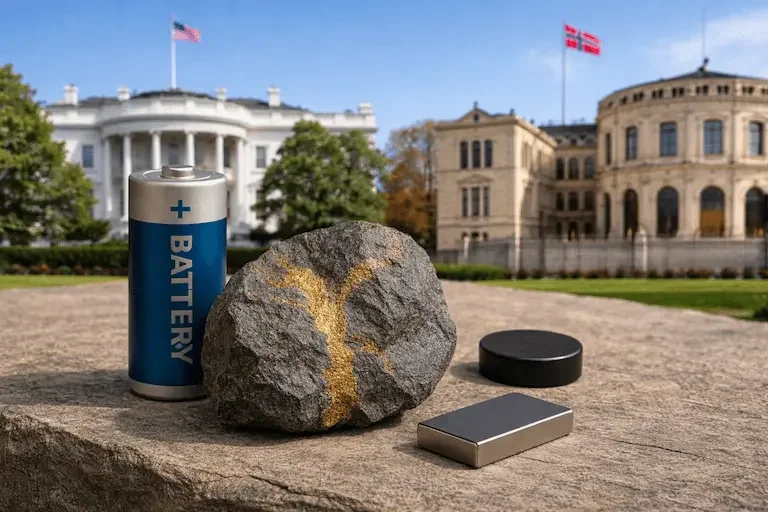
Image by AI/S&P
Trump cares about critical minerals, not diplomacy
Norwegian media have still not conveyed the real backdrop ahead of today’s meeting between Store, Stoltenberg and Trump. The two continue to frame Norwegian and European support for Ukraine as a matter of sovereignty, without being challenged by critical questions. Neither opposition politicians, the press, nor experts in Norway appear to have grasped that the country is involved in the struggle over minerals. Instead, attention remains on Store and Stoltenberg’s diplomatic skills, as if that is where Trump’s interest lies.
In Norway, few have yet recognised that the United States needs minerals to reclaim trade power from China, and that Trump has used peace negotiations to pressure Ukraine into a minerals agreement. Zelenskyj has resisted in an impressive manner and has received backing from the EU, EOS/EFTA and the United Kingdom.
Even fewer have noted that Europe has a greater continental need for Ukraine’s minerals than the United States does—because Europe lacks mineral resources comparable to those of Russia, China and the U.S. Ukraine holds lithium and other rare earth elements that are otherwise not commercially viable elsewhere on the European continent. These are minerals essential for the production of defence materiel, meaning that support for Ukraine is fundamentally a defence and security issue for Europe. Norway possesses substantial mineral deposits, making it an important partner.
Store’s pledge of mineral supplies to the United States
Norway entered into a declaration of cooperation on mineral development with the Biden administration last year. Store also wrote the following in his letter congratulating Trump after the November presidential election:
Being one of the largest suppliers of critical minerals to the U.S., with the largest-proven deposit of rare earth elements in Europe, Norway is committed to deliver sustainable and secure supply chains for advanced US manufacturing.
However, this was before Trump took office and launched a trade war aimed at securing Western control over minerals. Now, a resource-poor EU is competing to secure access to Norwegian minerals. This places Store in a difficult position vis-a-vis the United States, as Trump is likely to interpret the congratulatory letter as a commitment to Norwegian mineral deliveries.
Proposing to transfer control over Norwegian minerals to the EU
The situation became even more striking when, less than a month ago on 28 March, the government issued a press release stating that the Labour government is working to implement the EU’s Critical Raw Materials Act (CRMA) into Norwegian law. This was a premature and unusual announcement, likely intended as a signal to Trump and the United States that the government intends to reserve Norwegian minerals for the EU’s internal market. It is plausible that this constitutes the real reason the U.S. president sought an early meeting with the Norwegian prime minister.
Hearing on a new minerals act
Earlier today, a hearing on a new minerals act was held in the Storting. The consultation document (Proposition 71 L) refers to the EU regulation Critical Raw Materials Act (CRMA), which entered into force in 2024. The CRMA has been designated as EOS-relevant by the EU. The document states:
It is currently under consideration in both Norway and the other EOS/EFTA countries whether the legal act should be incorporated into the EOS Agreement and implemented in national legislation. If the CRMA is incorporated into the EOS Agreement, it will have economic and administrative consequences for Norwegian public administration and industry.
Notably, this issue was not raised by any parties during today’s hearing. In light of statements made this spring by Store and Stoltenberg, and the Labour Party’s approach to the EU, there is reason to believe that they seek to incorporate the CRMA into the EOS Agreement—something that would result in Norway losing control over its mineral resources. Store and Stoltenberg’s mineral strategy may be challenged by Trump today.
An undemocratic process
It is difficult not to see the connections—so where are the opposition and the Norwegian press? There may be a lack of expertise, but that is not sufficient when such fundamental issues for Norway are at stake. As a result, the security policy dimension is neither adequately illuminated nor debated.
Norwegian media have portrayed Store and Stoltenberg in a manner that allows them to handle matters of major importance without sufficient scrutiny, in ways that can be described as undemocratic. This may steer Norway in a direction that lacks public support. Norway is not in a position to engage in high-stakes manoeuvring, as the EU is currently not capable of defending the country militarily.
It is doubtful that information will emerge about what is discussed in the closed part of today’s meeting with Trump. Society and Politics will nevertheless continue to follow developments closely.
RELATED ARTICLES
SOURCES
Stortinget (Norwegian Parliament)
Hearing on new Minerals ActRegjeringen (Norwegian Government)
Consultation documentRegjeringen (Norwegian Government)
Støre’s congratulatory letter to TrumpRegjeringen (Norwegian Government)
The Government will incorporate the EU’s regulations on critical raw materials into the EEA AgreementEuropean Comission (European Commission)
EU Critical Raw Materials Act (CRMA)
Content on Society and Politics is based on reliable sources and actual events, providing a news-oriented perspective intented for further debate. To access the article’s author and the related debate, membership on Hudd is required.
