Geopolitical Manoeuvre:
The Peace Prize Goes to Machado
It could have been lifted from a Dan Brown thriller: sudden twists, hidden motives and power disguised as virtue. The Nobel Committee’s 2025 Peace Prize decision has all the intrigue of fiction – except this story is real.
October 12, 2025 | INTERNATIONAL POLITICS
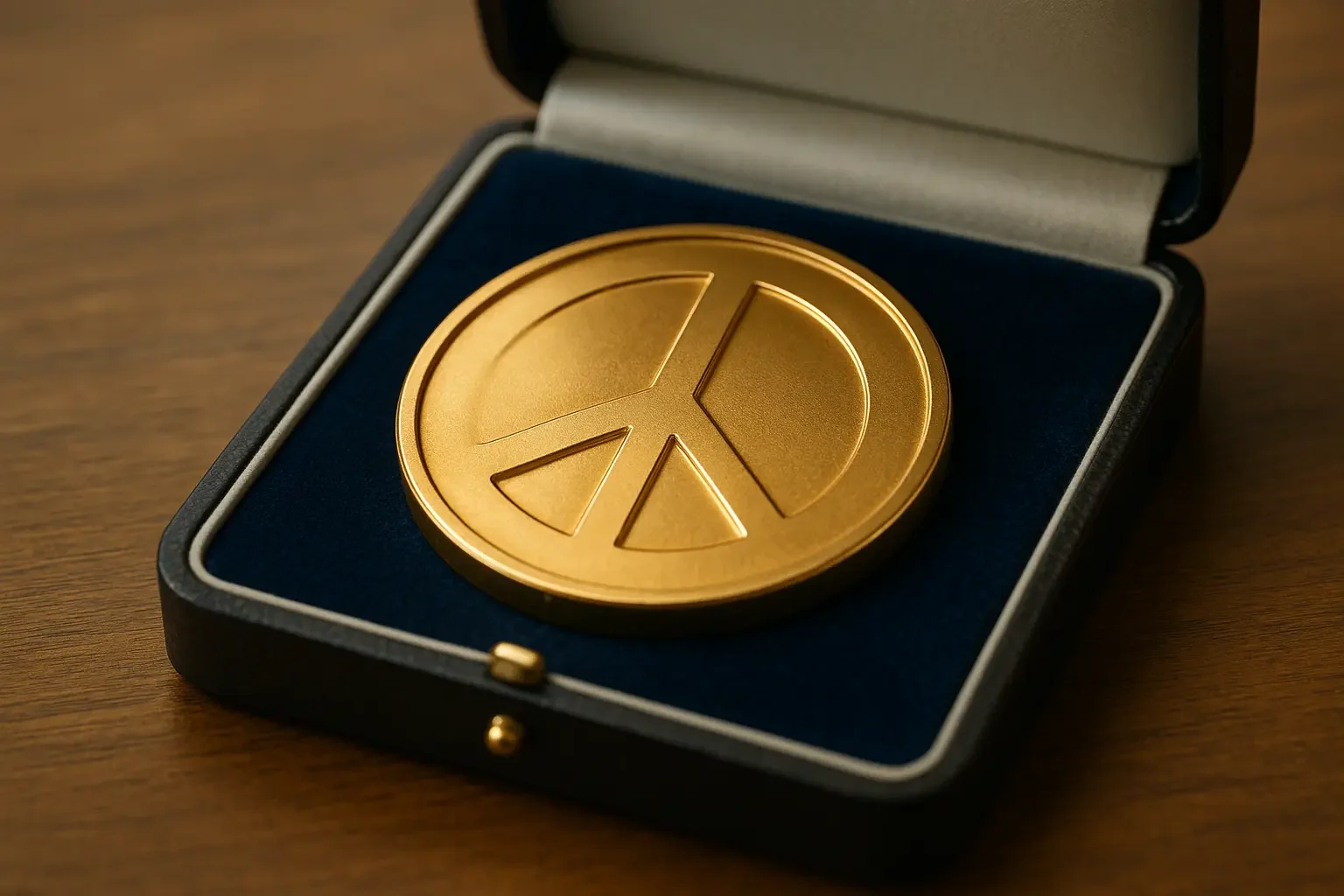
Image by AI/S&P
The 2025 Nobel Peace Prize was Friday awarded to Maria Corina Machado. The Nobel Committee stated that she received the prize for her tireless work to secure democratic rights for the people of Venezuela, and for her struggle for a just and peaceful transition from dictatorship to democracy.
Expectations for this year’s Peace Prize were high. US President Donald Trump had repeatedly claimed that he deserved the prize, while the opinion-forming elite disagreed.
Machado was an unexpected winner. Until Thursday, Yulia Navalnaya led the betting odds on Polymarket with 72.8%. Navalnaya is the widow of the late Russian opposition leader Alexei Navalny. Shortly after midnight on Friday, Maria Corina Machado’s odds were only 3.75%. A few hours later, and just before the winner was announced, the odds had risen to 72.8%. This raised questions of a possible leak from the Nobel Committee, but on Saturday the Committee suggested it may have been due to espionage.
The Nobel Committee claims to be politically independent, despite several factual circumstances suggesting otherwise. The Peace Prize is the world’s most prestigious award and carries great political weight. The prize receives strong backing from the Norwegian authorities. All of official Norway — the government, parliament, and the royal family — stand firmly behind the Peace Prize, both as participants and hosts of the award celebrations.
Political influence permeates the entire nomination process. Politicians are among the few groups qualified to nominate candidates. The Committee is appointed by politicians in the Norwegian Parliament, and most members have political backgrounds. Many politicians have been nominated, and many have won the Peace Prize. Throughout history, the Committee has also engaged in politics when interpreting Alfred Nobel’s will in an expanded sense. Nobel refers to individuals who have initiated or mediated peace between nations, as well as those who have contributed to disarmament. The Committee has repeatedly broadened this intent to include people involved in national conflicts. The Peace Prize carries great political significance for the laureate, but it can also have unintended political effects on their opponents. The Committee actively engages in politics when it intervenes in domestic conflicts and chooses sides.
In fact, the much-debated Peace Prize awarded to Barack Obama in 2009 was more consistent with Nobel’s will than many earlier prizes. He received it for his extraordinary efforts to strengthen international diplomacy and cooperation between peoples. The controversy surrounding Obama’s award suggests that over the years the Committee may have helped reshape public perception of what Alfred Nobel intended – and who is considered a worthy laureate.
The following year, in 2010, the prize went to the Chinese human-rights activist Liu Xiaobo, an opponent of the Chinese dictatorship. The award had major consequences for Norway. China refused to accept the Norwegian government’s explanation that the prize is politically independent and unrelated to the Norwegian state. China broke off diplomatic relations with Norway and imposed sanctions on Norwegian imports, which hit Norwegian industries hard. It took several years to repair the relationship.
Back to this year’s winner, Maria Corina Machado. In light of the geopolitical situation and Trump’s own candidacy, the choice of Machado appears politically motivated. It would have been extremely difficult to give the prize to Russian candidate Yulia Navalnaya, as Putin would have perceived that as a provocation. Norway shares both a border and maritime areas with Russia, and tensions are already high. Although the Nobel Committee claims independence, it cannot ignore the fact that the Peace Prize is perceived politically and has the potential to spark conflict. It is reasonable to believe that Nobel foresaw such situations when he drafted his will. Perhaps he would have been disappointed by some of the awards and the friction they created.
There has been strong resistance and aversion to Donald Trump’s candidacy. His achievements for peace were not considered significant, and as a leader he is perceived as divisive and domineering (divide et impera). The opinion-forming elite argue that Trump contributes to polarisation both nationally and internationally, and therefore does not fulfil Nobel’s intention to promote fraternity between nations. In other words, the complete opposite of Obama.
Donald Trump, by virtue of being the President of the United States, is Norway’s most important ally. This is because Norway lacks the capacity to defend itself against Russia without US military support. Aligning closely with the EU, as the Norwegian government has done this year, has little effect on defence capability. It must also be noted that the government does not have democratic backing for this; the majority of Norwegians oppose EU membership. The EU is unable to defend either Norway or Europe, as there are too few mineral deposits on the European continent to produce sufficient weapons. The government has not explained its EU strategy, and the Norwegian press has not raised the issue. The Nobel Committee’s decision clearly resonates with the EU’s awarding of the Sakharov Prize to Maria Corina Machado and Edmundo González Urrutia last year.
Trump has still not personally confirmed that he supports Article 5 of the NATO Treaty. Instead, he promises weapons from the United States through trade agreements. Despite the Norwegian government’s claim to have a good relationship with Trump, it is likely strained after the government failed to negotiate a trade agreement with the US. It is known that Trump raised the Peace Prize in a conversation with Finance Minister Jens Stoltenberg. The government has also confirmed that Norwegian minerals and American weapons are part of the ongoing talks. Nevertheless, the Norwegian government plans to grant the EU control over Norway’s mineral resources. The EU’s Critical Raw Materials Act is expected to come before the Norwegian Parliament later this term.
Both members of the Nobel Committee and Prime Minister Jonas Gahr Støre have repeatedly claimed that Norwegian interests are not a topic for the Committee’s work, and that there is no dialogue between the government and the Committee. It is arguably irresponsible if the government failed to promote the country’s interests diplomatically, as is natural in any other situation where national security is at stake. Norwegian opposition politicians and the domestic press turn a blind eye to this, presumably out of a misplaced desire to protect the Peace Prize as Norway’s most valuable brand.
There has been great global interest in this year’s Peace Prize. The opinion-forming elite abroad have been just as skeptical of Trump’s candidacy as those in Norway. It has not gone unnoticed that Trump promotes his own candidacy in a highly untraditional way, which has likely fueled opposition.
A few days before the winner was announced, Trump succeeded in negotiating a peace plan between Hamas and Israel, and only hours before the announcement, the parties signed a peace agreement aimed at securing peace in Gaza. Given historical experience, the agreement is seen as fragile, yet several commentators have acknowledged that it qualifies for the Peace Prize. Even Norway’s prime minister and members of the Nobel Committee have expressed more positive views, referring to a new nomination process next year. This year’s nomination committee was, quite literally, saved by the bell – it is entirely plausible to say it was too late for Trump this year.
When the choice fell on Maria Corina Machado, it suggested a political maneuver by the Nobel Committee. They had to choose a candidate who would reduce the risk of diplomatic tension between Norway and Trump. The Venezuelan politician deserves the prize for her efforts to promote democracy. Furthermore, she and Donald Trump share the same goal: to overthrow the country’s dictator and crush the criminal cartel. Machado supported Trump’s military strikes on Venezuelan vessels transporting narcotics to the United States, a move for which he was criticized elsewhere. To top it off, Machado was appointed by US Secretary of State Marco Rubio, who, as senator in 2024, had endorsed her nomination. Machado’s candidacy came as a gift from the universe and solved a complex political puzzle.
For the Nobel Committee, events could hardly have unfolded better. It is like written in a plot by Dan Brown. After the announcement on Friday, the first official statement came from the White House, which said that by its decision, the Nobel Committee had shown that it places politics above peace. This can be interpreted in several ways, but if we interpret it as referring to Machado as a national politician rather than a mediator of peace between nations, it makes sense. Machado then wrote on X: “I dedicate this prize to the suffering people of Venezuela and to President Trump for his decisive support for our cause!” A few hours later, Trump publicly commented on the prize when asked by a TV reporter. He said that he had achieved the most important peace agreement ever (Gaza) and mentioned eight other peace initiatives he claimed had succeeded. Threats of trade sanctions are among the tools he mentioned. Trump said that Machado had called him to inform him that she accepted the prize in his honour. He further emphasised that this year’s Peace Prize was for 2024, when he himself had been occupied with the election campaign. Trump concluded by saying that he was happy to have saved lives through his peace initiatives.
Signals from Trump suggest that he has come to terms with not winning this year’s Peace Prize, and the Norwegian public can breathe a little easier. Still, it is likely only a postponement. Norway should urgently enter into a trade agreement with the United States to ensure American support should Russia attack. If such an attack were to occur without an agreement in place, Trump could hold all the bargaining cards, and Norway would have to accept his terms. The EU would be powerless in such a situation.
While the future is uncertain, the most plausible scenario is that Trump will receive the Peace Prize next year, provided that the Gaza peace deal is implemented. Norway will probably have to sign a trade deal with USA - voluntarily or not - that includes both Norwegian minerals and American weapons. In that case, the Norwegian government would have squandered the opportunity Trump offered to establish a mutually beneficial agreement. Trump loses nothing by waiting – he gains more leverage. It could become a replay of Ukraine. The worst-case scenario is that the Norwegian Parliament does not acknowledge the danger, adopts the EU’s Critical Raw Materials Act, and Norway loses Trump’s support — leaving the country at the mercy of Russia.
In this intricate game, one question remains: who matches Dan Brown best – Jonas Gahr Støre, Donald Trump, or Vladimir Putin?
SOURCES
The Nobel Peace Prize
The Winner Announcement 2025The Nobel Peace Prize
Winner 2025 Marina Corina MachadoThe Nobel Peace Prize
All winnersAljaseera
Who is Maria Corina MachadoThe Guardian
The White House commenting on the AnnouncementSBS News Australia
Trump comments on the Nobel Peace PrizeNorwegian TV2
Norwegian Prime Minister Støre commentsNew York Times
Nobel Committee chair Jørgen Watne Frydnes commentsEuropean Parlament
Sakharov Prize 2024 goes to Venezuelan Machado and UrrutiaThe Guardian
Suspicious surge in bets for the Nobel Peace PrizeNew Your Times
Espionage towards the Nobel Peace PrizeEuropean Union
Critical Raw Materials ActSociety and Politics
Sovereignty over Norway’s mineral resources
Content on Society and Politics is based on reliable sources and actual events, providing a news-oriented perspective intented for further debate. To access the article’s author and the related debate, membership on Hudd is required.
