

PETITION
Sovereignty over Norwegian Minerals
This is a petition to ensure that the Norwegian public has democratic transparency and influence over Norwegian mineral resources.
The government is actively working to incorporate the EU mineral regulation CRMA into the EEA Agreement. The stated priority of the Labour-led government, as chair of the EFTA Standing Committee (the body that prepares the incorporation of EU legal acts into the EEA Agreement), is to accelerate the integration of EU legislation.
The government has not presented an impact assessment explaining the consequences of incorporating CRMA into the EEA Agreement. This petition explains how the mineral regulation will affect sovereignty over mineral resources, and how Norwegian mineral resources are central to the geopolitical contest over minerals.
CRMA is the most far-reaching EU legislation ever adopted. Through the regulation, the EU will gain control over Norwegian mineral projects and control the supply chain through several different mechanisms. Norway has, through the Oil Fund, a unique opportunity to finance its own mineral extraction — an advantage that will be lost if CRMA is incorporated. This will significantly affect Norwegian ownership, Norwegian jobs, Norwegian value creation and Norwegian capital interests. The Norwegian welfare model will consequently be affected, with implications for future generations. Furthermore, the geopolitical importance of minerals is decisive for national security.
More than 1.5 million eligible voters have not had the opportunity to vote on EU membership through a referendum, and no one has had the opportunity to vote on the EEA. The democratic principles of transparency and influence are a prerequisite for Norwegian democracy and sovereignty — in this case, they are decisive for Norway’s future.
CONTENT
VERSION 1 - April 28, 2025
VERSION 8.1 - May 26, 2026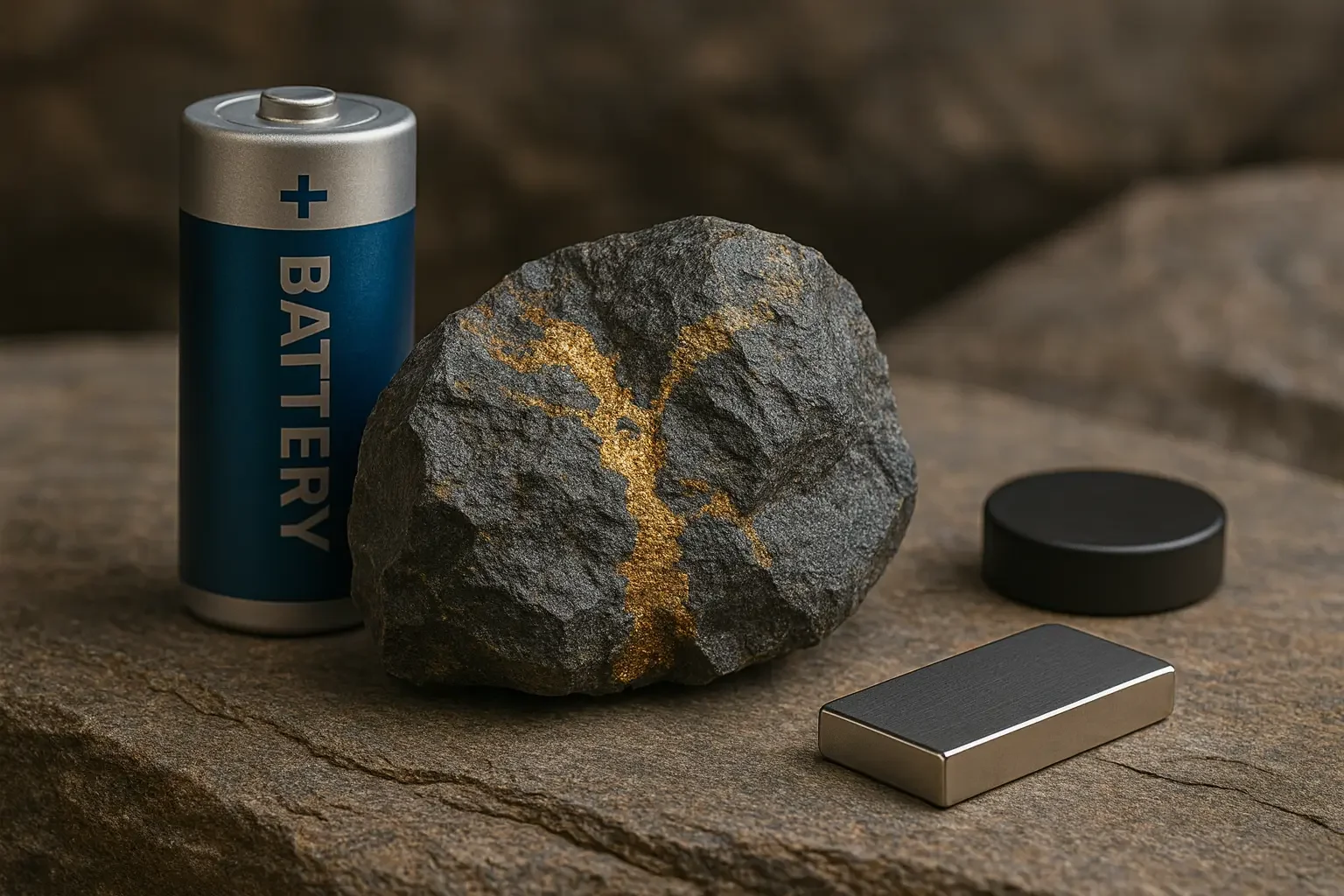
1. Norwegian Mineral Resources
1.1 Mineral Deposits
Norway possesses some of the world’s most strategically valuable mineral resources. The Fen Field in Telemark is Europe’s largest deposit of rare earth elements and among the world’s largest outside China. In March 2026, the resource estimates were nearly doubled — from 8.8 million tonnes in 2024 to 15.9 million tonnes — placing Norway among the three largest countries in the world in terms of known rare earth reserves. The Fen Field also contains significant deposits of thorium as a by-product. According to Teknisk Ukeblad (Engineering Weekly), the theoretical energy potential of the thorium deposit is 70 times greater than the energy in all the oil and gas extracted from the Norwegian continental shelf since 1971.
In addition to the Fen Field, Norway has further mineral deposits on land and on the seabed, particularly in the northern regions. Norway is already the EU’s largest supplier of two critical raw materials, aluminium and silicon. There is strong reason to believe that additional large deposits will be discovered when targeted exploration is initiated.
Properly managed, Norwegian mineral resources could become the country’s next great commercial success — and in time replace revenues from oil and gas. Just as the oil and gas industry has financed the Norwegian welfare state and built the values in the Oil Fund, the mineral industry can lay the foundation for Norwegian prosperity for generations to come. The prerequisite is that the resources are managed in Norway’s interest, with national control over extraction, value creation and returns.
1.2 Mineral Extraction
Norway currently has three metal mines in operation: Rana Gruber, which extracts iron ore; Titania, which extracts ilmenite ore; and Sibelco Nordic, which extracts olivine and nepheline syenite. In 2025, Nordic Mining opened the first new mine in over 30 years at Engebofjell in Vestland, extracting rutile and garnet. Nordic Mining has a permit to deposit mine waste in the Forde Fjord, a case currently before the Supreme Court after the Borgarting Court of Appeal ruled in 2025 that the permit is invalid and in conflict with the EU Water Framework Directive.
New projects are under development that will be affected by the EU’s mineral regulation CRMA, which this mineral petition concerns. Rare Earths Norway (REN) is working to develop the Fen Field in Telemark, Europe’s largest deposit of rare earth elements, described in more detail in section 1.1. In the course of this process, REN has received 15 million NOK in support from the EU and is negotiating directly with the EU Critical Raw Materials Board. The project was not approved in the first CRMA round, but has been nominated to the Minerals Security Partnership and encouraged to reapply. This illustrates how the EU is already in dialogue with Norwegian mineral companies, building relationships that will grant it influence when CRMA is formally incorporated into Norwegian law. In April 2026, the state took over planning responsibility for the Fen Field from Nome municipality, after the municipality itself requested this to ensure faster progress and financing. Minister of Trade and Industry Cecilie Myrseth confirmed that state planning means that objections cannot be raised or appeals made against zoning decisions. All the major parties supported the takeover, but the Centre Party (Sp) and the Red Party (Rodt) emphasised that this is insufficient — a state-owned mineral company must also be established. Without state ownership, foreign companies, either directly through CRMA approval or through acquisition, could gain ownership of Norwegian rare earth deposits.
Nussir has received approval for a copper mine in Repparfjorden in Finnmark, but the project is controversial because the mine waste is planned to be dumped in the fjord, threatening one of Norway’s most important salmon rivers and Sami reindeer herding interests. A ruling against seabed disposal in the Forde Fjord would directly affect the legality of Nussir’s permit.
Norgraph in Arendal has received approval to process graphite from Greenland, a mineral that is critical for the production of electric vehicle batteries.
Both Nussir and Norgraph have been approved as CRMA strategic projects, meaning the EU has already positioned itself to gain control over Norwegian and Greenlandic mineral processing through its financing mechanisms — well before the Storting has passed a resolution on CRMA incorporation into Norwegian law.
Grangex owns the Sydvaranger mine in Kirkenes, one of Europe’s largest iron ore fields, but is struggling with financing. As recently as 22 May 2026, the company threatened to enter negotiations with Chinese actors unless the Norwegian state contributes 400 million NOK. According to the Norwegian Police Security Service (PST), China is one of the greatest state security threats to Norway and is using precisely such acquisitions and investments in Northern Norway to position itself in the Arctic regions.
Norge Mineraler is planning one of the largest mineral projects ever in Eigersund, with a resource estimate of 3.2 billion tonnes of apatite, ilmenite and magnetite. The project met massive local opposition and was rejected by the municipality in January 2025. The company is also struggling with financing.
The number of mining rights granted by the Directorate of Mining increased from an average of 230 per year in the period 2013–2023 to around 1,300 in 2024, reflecting the dramatic increase in interest in Norwegian mineral resources. The interest comes largely from foreign companies — Swedish, Australian, British and Canadian — raising questions about national control over strategic resources.
1.3 The EU’s Need for Norwegian Minerals
The EU has very few mineral deposits within its own territory. For certain critical minerals, up to 98 percent is imported from China — a dependency that has become an acute security policy vulnerability since China openly supports Russia in the war against Ukraine. The EU is in practice unable to produce sufficient defence equipment, green technology or advanced industry without access to minerals from external sources.
The EU’s mineral situation is critical. The European Court of Auditors recently warned that the EU’s work to diversify its mineral supply has so far yielded limited results. The stockpiles of critical minerals in Europe are so low that the actual figures are classified for security reasons — but analysts estimate that reserves will last only a few weeks in a crisis situation. By comparison, the US has, through Project Vault, built up strategic reserves equivalent to one year’s consumption. The EU is now planning its first coordinated mineral stockpile. As recently as 20 May 2026, it became known that the EU has drawn up a shortlist of tungsten, rare earth elements and gallium for its first joint mineral reserve. This is an acknowledgment that the 2030 targets in CRMA do not protect Europe against the supply risks that already exist today.
Norway is, in this context, one of Europe’s very few realistic alternatives to Chinese dominance. The Fen Field has, as mentioned, large deposits of rare earth elements — minerals that are critical for the production of permanent magnets used in wind turbines, electric vehicles and military equipment. Norway already supplies aluminium and silicon to the EU market, and the seabed in the northern regions is assumed to contain further large deposits.
This is the background for why the EU, through CRMA, is actively seeking control over Norwegian mineral projects. For the EU, this is not merely a question of trade policy — it is about securing supply chains that are critical to European defence capability and industrial survival. Norwegian mineral resources are therefore not merely a commercial question for Norway, but a strategic question for all of Europe.
2. The EU’s Mineral Legislation – CRMA
2.1 EU Critical Raw Materials Act
The EU Critical Raw Materials Act (CRMA) is a binding legal act called a regulation. It is the strictest form of EU legislation and must be incorporated into the national legal system exactly as written. It replaces Norwegian law from the moment it is accepted — in contrast to a directive, which allows a flexible and adapted approach whereby the country can adjust its own legislation. For that matter, a directive (such as the electricity market directive ACER) often ends up, over time, in the strictest form of legislation, which is a regulation.
Through the CRMA regulation, Norway is obliged to explore for minerals and identify areas for mineral extraction, as well as to facilitate processing industry — all in order to meet the EU’s production targets. Norway commits to exploration and mineral extraction without an upper limit on scope.
The document Understanding the Strategic Projects under CRMA states:
“This will effectively prioritise mineral exploration, which could potentially allow area changes or override protected areas if they are identified as potential mineral areas.”
2.2 The EU’s Intention with CRMA
The EU Critical Raw Materials Act was adopted in December 2023. It states that by 2030 the EU shall extract 10 percent, process 40 percent and recycle 25 percent of its mineral needs. The first target thus concerns exploration for and extraction of 10 percent of its own needs. The next target — to process 40 percent — means in practice that 30 percent of the raw materials for processing must come from outside the EU. The final target is to recycle 25 percent through recycling. This means the EU aims to be 35 percent self-sufficient in minerals by 2030.
Through CRMA, the EU will ensure prioritised and rapid decision-making processes. The application and decision-making process will be moved from member states in the EU/EEA to the EU centrally and the Critical Raw Materials Board. Already 15 months after CRMA was adopted in the EU, the first 47 mineral projects were launched — of which Norway has received two, as described in section 1.2 above. The projects can be expected to be implemented as soon as the Storting has adopted CRMA, without further application and decision-making processes from Norwegian authorities.
The EU’s mineral situation has worsened following recent events, and it can therefore be expected that the EU will introduce new and stricter measures to put pressure on member states to explore for, extract and process minerals in new land areas.
2.3 New Norwegian Minerals Act Adapted to CRMA
A new Norwegian Minerals Act was adopted by the Storting on 20 June 2025 and enters into force on 1 July 2026, Proposition 71 L (Minerals Act). It has been adapted to CRMA so that it will not conflict with the regulation. Under section 2.2.2 “EU Law” on page 17 of the legislative proposal, it states:
“CRMA has been marked as EEA-relevant by the EU. It is now under consideration in both Norway and the other EEA EFTA states whether the act should be incorporated into the EEA Agreement and implemented in national legislation. If CRMA is incorporated into the EEA Agreement, it will have economic and administrative consequences for Norwegian public administration and business.”
On 28 March 2025, the government confirmed in a press release that it is not merely considering, but is actively working to incorporate CRMA into the EEA Agreement and Norwegian law.
The adopted Minerals Act contains no provisions on the ownership of businesses. Such a provision would have been natural and was called for by, among others, the Industrial Municipalities during the hearing in April 2025. The omission is not accidental — ownership provisions are not compatible with CRMA. Furthermore, the Act contains a provision on the right to expropriate property from landowners (compulsory purchase).
To be entirely clear: if the EU regulation is incorporated, Norway cannot have its own legislation that conflicts with the regulation. This is pursuant to Article 7a of the EEA Agreement.
Despite the fact that CRMA has not yet been formally incorporated into the EEA Agreement, the government has actively worked to facilitate this. The new Minerals Act is already adapted to CRMA. Two Norwegian companies, Nussir and Norgraph, have already received approval as CRMA strategic projects and are only waiting for CRMA to be formally incorporated into the EEA Agreement to begin production, likely without further processing by Norwegian authorities. The Fen Field was rejected in the first CRMA round precisely because Norway is still a third country, but this will change when incorporation is completed.
2.4 Decision-Making in Brussels
CRMA covers exploration for, extraction and processing of minerals on the Critical Raw Materials list. The list consists of 34 critical and 17 strategic minerals and is updated at regular intervals. Critical minerals are minerals that are important for the EU’s economy and where there is a risk of supply disruption. Strategic minerals are a subset that are particularly important for the green transition, digitalisation and defence.
Decisions on mineral production under CRMA are made by designating Strategic Projects. In this way, the EU, through CRMA, can secure control over Norwegian mineral production. Companies can apply for strategic project status for minerals from both lists mentioned above.
Companies wishing to extract mineral fields, process or recycle minerals can apply directly to the EU to become a Strategic Project. Note that there is no requirement that the company be Norwegian — no special advantages are given to Norwegian businesses.
Norway cannot restrict or refuse a company from applying to the EU. Through the application process, the decision on Norwegian mineral production is moved from Norwegian authorities to the EU Critical Raw Materials Board in Brussels. The decision-making process is prioritised, resulting in short processing times — the first application round took 14 months and resulted in 60 approved strategic projects, of which 47 were in EU countries and 13 in third countries. A new application round was conducted in January 2026.
If the application is approved, the company receives financing support through the EU in exchange for commitments to supply minerals. The project must comply with Norwegian law, but as noted above, Norwegian law cannot conflict with CRMA. This means the EU has first right of selection for both mineral projects and the minerals subsequently produced. If a project is not CRMA-approved, mineral production can be extracted under Norwegian law and Norwegian sovereignty.
2.5 The EU’s Financing Model
The CRMA regulation’s control mechanism is not limited to the legal decision-making process described in section 2.3. The EU has additionally built up a financial system that in practice secures control over Norwegian mineral resources through capital dependency.
Through the RESourceEU Action Plan, adopted in December 2025, the EU has set aside at least 700 million euros from the Innovation Fund for mineral projects in 2026, in addition to a new CRM financing hub and coordinated EU instruments such as InvestEU. The Commission has also launched a new approach to project financing that explicitly links funding to securing EU offtake agreements — meaning that financing is conditional on the minerals being delivered to the EU market.
This is not neutral support. When a Norwegian mineral project receives EU financing, it comes with obligations concerning mineral deliveries to the EU, integration into the EU’s strategic project list, and subjection to the EU’s decision-making process. Financing is the instrument the EU uses to secure control over resources without owning them directly.
The model presupposes that Norwegian mineral projects are dependent on foreign capital. Here lies a crucial difference from the oil and hydropower success stories: Norway established state-owned companies financed by Norwegian capital and thereby secured national control over the returns. Norway today has, through the Oil Fund, a unique opportunity to do the same with minerals — without being dependent on external financing.
A state-owned Norwegian mineral company financed by the Oil Fund would not need EU capital and therefore falls outside the EU’s financial control mechanism. This is likely the real reason why such a model is incompatible with the government’s EU approach — not because a state-owned mineral company is in direct conflict with the CRMA legal text, but because it undermines the financial model the EU has built to secure control over Norwegian resources. See Chapter 5 for a more detailed account of a state-owned mineral company.
2.6 The Mechanisms that Give the EU Sovereignty
Supporters of EU cooperation will claim that CRMA does not deprive Norway of sovereignty over its own mineral resources, and they are correct that the word “sovereignty” does not appear in the legal text. Sovereignty comes as a consequence of which laws apply, who makes the decisions, and the structural obligations that follow from the system.
The electricity market directive ACER case is an illustrative example. When the Storting in 2018 voted to incorporate the EU’s third energy market package and join the energy agency ACER, the decision was presented as “having limited impact” and being mainly administrative. 120 Labour mayors and the LO trade union confederation protested, but the majority prevailed. In retrospect, it has become clear that Norway in practice lost national control over key aspects of energy policy. The EU Court of Justice ruled in 2023 that ACER had expanded authority to make binding decisions. It is worth noting that ACER is still “only” a directive, yet the consequences proved far more far-reaching than the public was led to expect. CRMA is a regulation — the strictest form of EU legislation. The Storting’s Energy and Environment Committee put it aptly in another context: “Even if each individual legal act does not constitute a major transfer of sovereignty to supranational bodies, the legal acts collectively contribute greatly to this.” This is precisely the crux of the mineral case.
CRMA does not contain a single provision that deprives Norway of sovereignty — it is the sum of mechanisms that leads to this outcome.
CRMA moves the application process from Norwegian authorities to the EU Critical Raw Materials Board in Brussels. There is no requirement that the company be Norwegian, and Norwegian businesses are given no special advantages. The application form requires the applicant to describe their strategy for securing buyers of the minerals, where the EU has sovereignty. Approved projects commit to delivering minerals to the EU market as a condition for financing. Norwegian law may not conflict with the regulation.
These mechanisms are reinforced by associated EU regulations. The Net-Zero Industry Act (NZIA) introduces “resilience criteria” in public procurement that in practice favour European supply chains. The Corporate Sustainability Due Diligence Directive (CSDDD) requires large companies to map and control their entire supply chain, which in practice favours EU-based subcontractors. The Foreign Subsidies Regulation can restrict the participation of companies that receive state aid from third countries. And if the minerals are to be used in defence production, EDIP and SAFE require that subcontractors be established in the EU or EEA.
The financing regime around CRMA reinforces this further. CRMA created no new financing pool but functions as a framework that gives strategic projects prioritised access to the EIB, InvestEU, the Innovation Fund and IPCEI. The EIB describes its mineral strategy as support for the European Union’s critical raw materials value chain, with the aim of strengthening European supply security, European processing and European industrial capacity. A Norwegian mineral project with involvement from suppliers outside the EU’s internal market will appear less attractive for EIB and EU financing — not because it is explicitly prohibited, but because it does not contribute to the EU’s strategic autonomy. The paradox is that it weakens Norwegian autonomy.
The EU often avoids explicit requirements for European subcontractors because WTO rules and EEA rules make such requirements legally sensitive. Instead, terms such as “resilience”, “strategic autonomy”, “de-risking” and “trusted partners” are used, which in practice function as a structural filter against non-European supply chains. In practice, this limits the market size and trade potential for EU/EEA countries.
There is therefore no single point in CRMA that one can point to and say “here Norway loses sovereignty”. Sovereignty is transferred through the sum of the application process, the financing mechanisms, the competition rules and the associated regulatory framework — layer by layer, without any individual element alone being decisive.
It is worth noting that Norway, through the EEA Agreement, has already committed to following the rules of the internal market in a number of areas. CRMA is, however, unique because the regulation for the first time directly links resource management — traditionally a core area of national sovereignty — to the EU’s supply security. It is this link that makes CRMA qualitatively different from other EEA legislation, and that makes the question of Norwegian sovereignty over mineral resources something far greater than a technical question of regulatory adaptation.
2.7 Environmental Protection and Indigenous Rights
This petition has not assessed environmental considerations, as that is a large topic that deserves its own account, but it is appropriate to note that mineral extraction is highly environmentally damaging — it pollutes more than anything we have seen in modern Norway. You can read more about environmental protection in the sources from the European Environmental Bureau and the Norwegian Society for the Conservation of Nature (Naturvernforbundet), where you will also find a statement from the Sami Parliament on indigenous rights. See Chapter 7, source group XIII — Environment and Indigenous Peoples.
3. The Critical Minerals Situation
3.1 The Need for Critical Minerals
Minerals are the raw materials that underpin modern technology, industry and energy production. Some minerals may be described as critical even if resources are available on the world market. This depends on where the resources are located, how economically viable they are, the degree to which environmental and labour standards are upheld, and who has the expertise, technology or financial means to extract the resources.
Silicon is an example of a critical mineral — it is a semiconductor refined into electronic data chips used in everything from mobile phones and data centres to artificial intelligence and military equipment. Car batteries are another example, where critical minerals such as lithium, cobalt and nickel form the core components of the battery cells.
The technology of the future requires enormous quantities of critical minerals — a demand further intensified by a doubling of energy needs resulting from artificial intelligence and the green transition. The data centres driving AI development are among the fastest-growing electricity consumers in the world; this energy is increasingly to come from renewable sources such as solar and wind, which are themselves dependent on critical minerals in the production of solar cells, wind turbines and batteries for energy storage. Minerals are thus a common prerequisite for both the digital and the green transition, driving global demand to historically high levels.
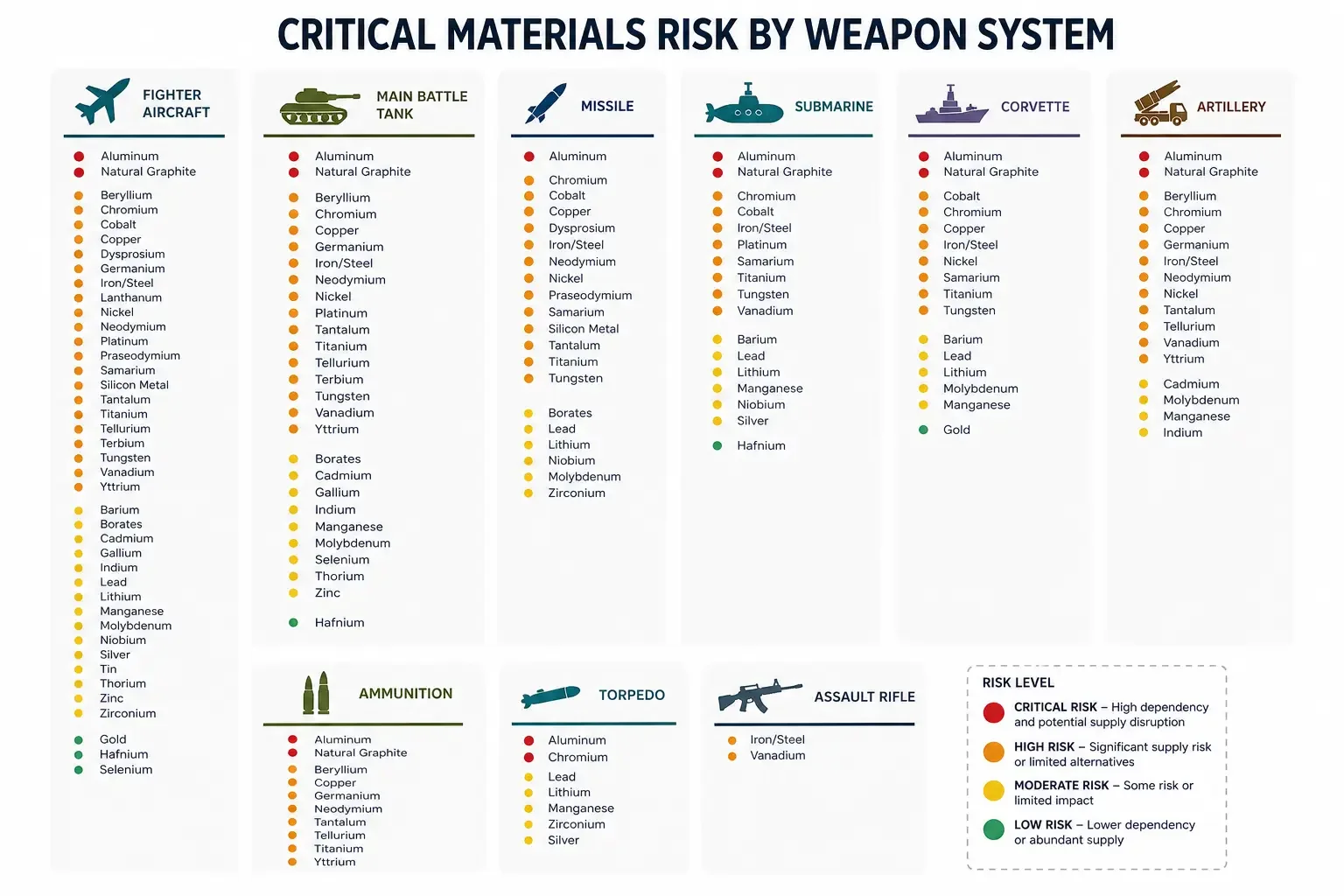
Minerals are also directly decisive for a country’s defence and security. Modern defence equipment — from fighter jets and tanks to missiles and submarines — depends on a range of critical minerals in its production. Many of these minerals are classified with critical or high supply risk, meaning that supply disruptions can cripple weapons production and thereby a country’s defense capability.
Source: S&P/AI
3.2 World Trade and Mineral Resources
To understand why minerals have become central to geopolitics, we must examine how world trade has developed, both economically and technologically.
According to the United Nations, the US led world trade in the year 2000 with a 12 percent share, Germany was second with 9 percent, while China was in seventh place with 4 percent. After the US and Germany competed for first place in the years that followed, China overtook them both in 2008. By 2020, China had captured world trade with 14.7 percent, the US had 8.1 percent, and Germany 7.8 percent.
While China developed enormously in the new economy that came with the internet, the historic trading powers stagnated. Simultaneously, new technology created greater demand for rare minerals, of which China has large resources. China had been building its mineral industry strategically since the 1960s — through deliberate protectionism, price dumping and control over processing technology — and became through this strategy the world’s leading trading nation and the dominant actor in global mineral supply.
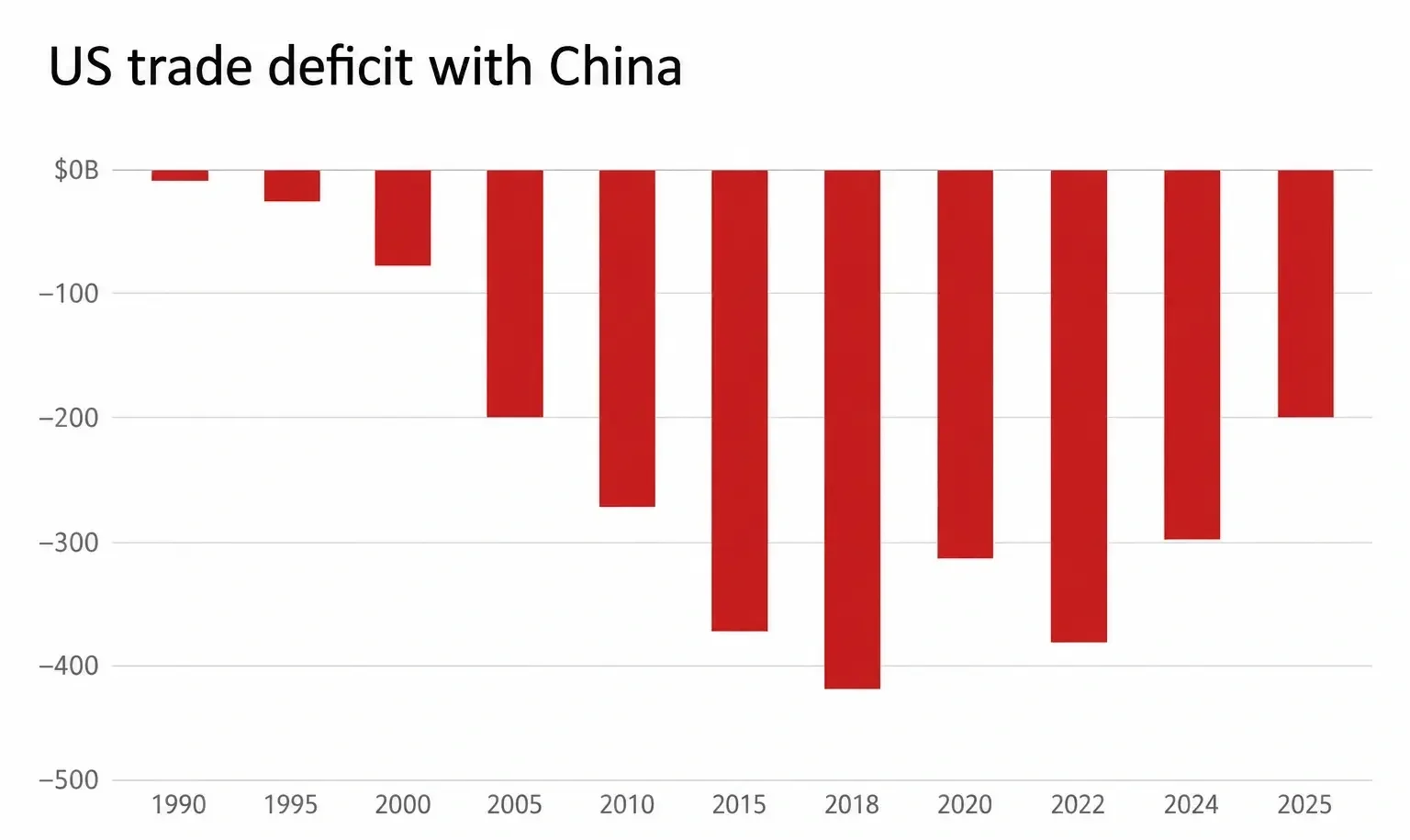
The US trade deficit with China grew dramatically after the year 2000 and is a direct result of developments in world trade, see graph below. Trump responded with protectionist trade policy and the introduction of comprehensive tariffs against China in spring 2025, reaching as high as 145 percent. American imports from China fell sharply, delivering an immediate effect on the trade deficit. In May 2025, a temporary 90-day agreement was reached whereby the US reduced tariffs to 30 percent and China to 10 percent.
Source: U.S. Census Bureau
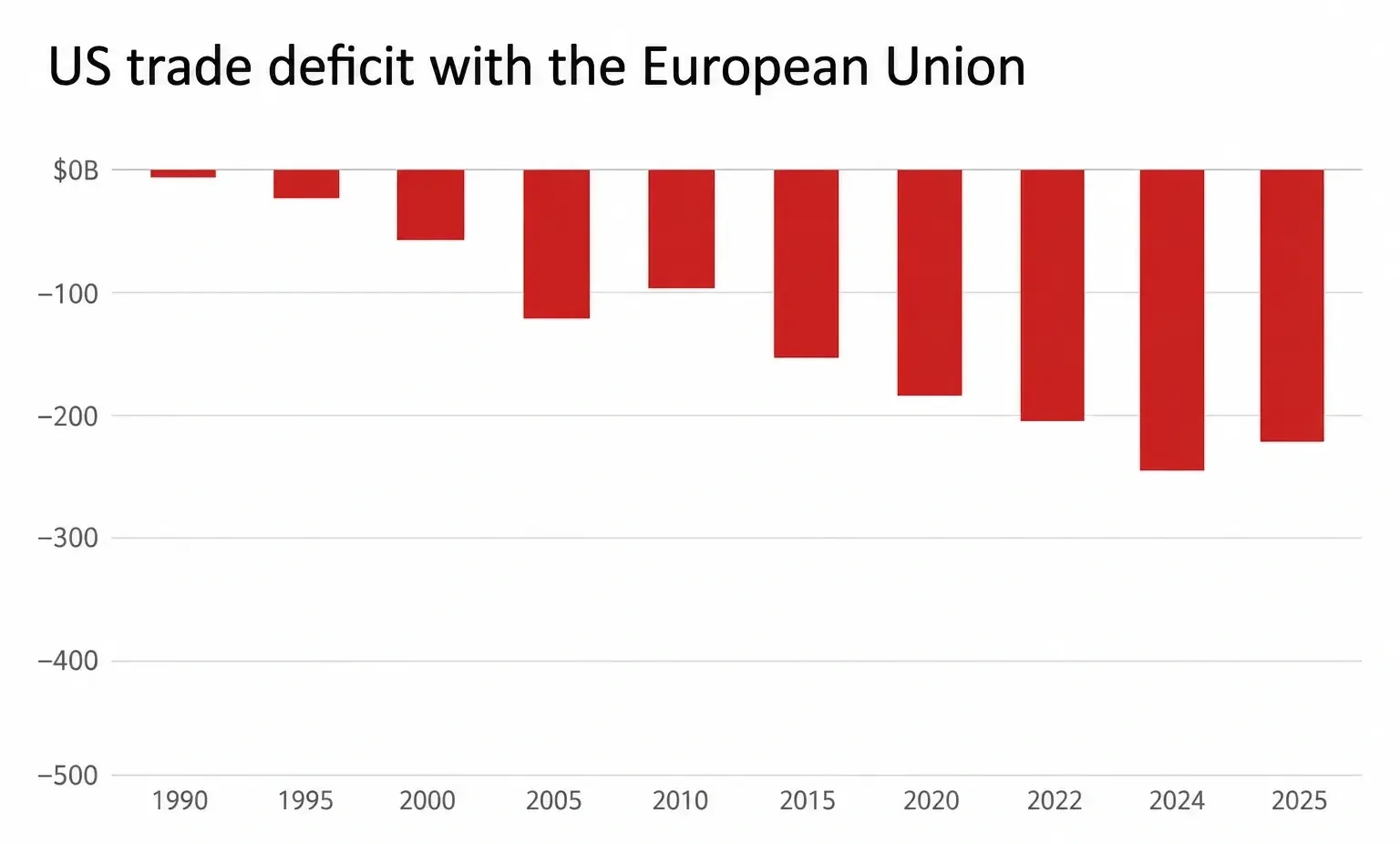
The US also has a significant trade deficit with the EU, see the graph below. Trump’s tariffs were therefore not limited to China — they were used as a tool to pressure trading partners to the negotiating table. The EU signed the Turnberry Agreement with the US in July 2025 under the pressure of tariffs, but subsequently delayed implementation. The European Parliament froze the process twice, in January and February 2026, before adopting its mandate for negotiations with the Council in March 2026. On the night of 20 May 2026, the Council and Parliament reached agreement on a joint text, with strict conditions requiring the US to fulfil its obligations before EU tariff reductions take effect. The final decision in plenary is expected in mid-June 2026. Norway was subject to 15 percent tariffs when negotiations failed to conclude within the 2025 deadline. The Labour government has still not concluded a new trade agreement with the Trump administration — something we will return to in Chapter 4.
Source: U.S. Census Bureau and Eurostat
3.3 The Battle for Minerals
As described in section 3.2, China has built a dominant position in world trade through strategic control over critical minerals. The battle for minerals is fundamentally about world power — those who control the minerals control industry and the production of technology, green energy and defence equipment, and thereby also geopolitical and military strength in the decades to come. China has over decades practised a deliberate protectionist mineral policy, by withholding minerals from the market, imposing export duties and dumping prices to outcompete Western producers. Previous US presidents attempted to break this monopoly without success.
Donald Trump is an avowed protectionist with “America First” as his slogan. For Trump, the mineral contest is about two things: breaking China’s strategic monopoly and reducing the trade deficits that have cost American industry and jobs for decades.
The EU finds itself in a difficult position in this power struggle. As described in section 1.3, Europe is structurally dependent on Chinese minerals and has barely any reserves. This makes the EU vulnerable to pressure from both sides — from China, which uses minerals as a geopolitical weapon, and from the US, which demands that Europe choose sides. The situation was further complicated when Trump concluded a mineral agreement with Ukraine in May 2025, giving the US priority access to resources that the EU itself needs.
The Ukraine agreement was a turning point in the global mineral contest. Ukraine possesses some of Europe’s largest untapped deposits of critical minerals — lithium, titanium, cobalt and rare earth elements — resources located strategically in the middle of Europe and thus geographically accessible to European industry. For the US, the agreement was not only about securing minerals for its own industry, but about cutting the EU off from mineral supply chains on the European continent. For the EU, it was a serious signal: the US is willing to use minerals as a geopolitical instrument — even against its own allies. China, which had already invested heavily in Ukrainian industry, simultaneously lost influence over resources it had expected to have access to. The agreement thereby consolidated the US’s position as the dominant actor in the Western mineral supply chain and increased pressure on Europe to join the American strategy.
Greenland is central to the global geopolitical contest over minerals. The island possesses enormous untapped deposits of rare earth elements, graphite, copper, germanium and gallium. Greenland, which is not part of the EU, is not subject to CRMA, but entered into a bilateral strategic mineral agreement with the EU in 2023. In the first CRMA round, one Greenlandic project was approved as a strategic third-country project: the Amitsoq graphite project, which is processed by the Norwegian company Norgraph in Arendal (described in section 1.2). The US responded with a two-pronged strategy: the American state took direct ownership stakes in Greenlandic mineral projects, while American businesses positioned themselves through massive investments in Greenlandic mining companies. As with the Ukraine agreement, this is not only about securing mineral supplies for the US, but also about cutting the EU off from mineral sources. On 21 May 2026, the US opened a new consulate in Nuuk covering 3,000 square metres — a clear signal of permanent and escalating presence. Greenland’s mineral resources and Arctic location have drawn it into the geopolitical power struggle.
3.4 Minerals, Defence Security and NATO
The mineral contest had direct consequences for NATO and the transatlantic relationship. This was clearly demonstrated in spring 2025 when the Trump administration pressured Ukraine into a mineral agreement as a condition for military support. Zelensky demanded military security on par with NATO Article 5, but was compelled in May to sign a mineral agreement linked to a weapons deal with the US that only guaranteed future weapons deliveries. At the same time, Trump pressured the EU with high tariffs and threatened to withdraw the US from NATO. This led the EU to conclude the Turnberry Agreement with the US by the deadline of 31 July 2025.
The Greenland conflict escalated in parallel. Trump’s repeated statements about acquiring the island were long dismissed as rhetoric but gradually developed into a serious diplomatic problem. Greenland possesses, as described in section 3.3, enormous mineral deposits that the US is actively seeking to secure — and equally importantly, to deny to the EU. In January 2026, the EU had still not formalised the Turnberry Agreement and insisted on retaining control over European mineral resources through CRMA. It was in this context that Trump escalated the Greenland conflict with concrete threats to take control of the island, drawing NATO into a crisis.
On 4 February 2026, a breakthrough came. At a historic ministerial meeting in Washington attended by 54 nations, the US launched FORGE, the Forum on Resource Geostrategic Engagement. The US and EU signed a letter of intent on mineral cooperation, and pressure on Greenland was eased. Norway participated in the meeting as an observer but did not conclude an agreement. This is because Norwegian mineral resources are also central to the conflict between the US and EU — something we will return to in section 4. NATO Secretary General Rutte elevated the mineral breakthrough from the FORGE meeting to the Munich Security Conference the following week, where it was first and foremost presented as an Arctic solution to the NATO crisis.
Once the Greenland crisis had subsided, the US on 28 February 2026 launched an attack on Iran. The Strait of Hormuz was blocked, causing 20 percent of the world’s supply of oil and liquefied natural gas from the Middle East to be cut off. The US thereby gained control over a significant share of the world’s energy supply. The US simultaneously strengthened its strategic position through Abraham Accords 2.0 and the alliance in the Middle East, which provides control over the Suez Canal. In March, the US decided to establish a drone base in Morocco, which in time could give strategic control over the Strait of Gibraltar. The US thus controls the most important maritime transport routes connecting China and the Middle East to Europe.
Europe refused to support the American military operation against Iran, and some EU countries closed their military bases and airspace to American aircraft. Spain went furthest by refusing the US use of the Rota and Moron bases and closing Spanish airspace. The American administration interpreted this as a breach of NATO obligations, and the NATO crisis that had characterised the start of 2026 was reactivated.
On 24 April 2026, another breakthrough came: the US and EU presented a joint action plan for critical minerals — the Action Plan for Critical Minerals Supply Chain Resilience — signed by Secretary of State Rubio and EU Trade Commissioner Maros Sefcovic in Washington. The plan is a continuation of the letter of intent from the FORGE meeting on 4 February and is intended to lead to an actual agreement between the parties. However, the EU had still not formalised the Turnberry Agreement.
Shortly thereafter, on 26 April 2026, the EU adopted its 20th package of sanctions against Russia. This time, it included 27 Chinese companies that supply components of critical minerals to Russian weapons production. The US had long been pressing the EU to impose sanctions against China for its support of Russia in the war against Ukraine. China immediately responded to the sanctions with an official warning that all negative consequences of the sanctions policy would have to be borne by the EU alone.
Just days after this positive development in the conflict between the US and EU, German Chancellor Friedrich Merz stated that the US had been humiliated by Iran. Trump responded decisively, with the consequence that the US withdrew 5,000 soldiers from Germany. At the same time, the EU’s chief trade negotiator Sabine Weyand stepped down due to internal disagreements about the agreement framework with the US.
To move beyond letters of intent, Trump applied further pressure on the EU ahead of the G7 meeting in Paris on 6 May. He announced 25 percent tariffs on cars, because car batteries contain components of Chinese minerals that the US demands be phased out. The countries failed to reach agreement during the meeting, and Trump gave EU President von der Leyen a new and final deadline of 4 July.
On 18 May, the US ambassador to the EU, Andrew Puzder, published a diplomatically unusual op-ed in Politico warning of an impending confrontation if the EU does not yield.
On the night of 20 May, the EU Council adopted the Turnberry Agreement, more than ten months after it was originally signed — it is to be decided in Parliament in June. The conflict between the US and EU is in any case not over until there is a mineral agreement between the US and EU, as described in section 3.5.
Just the day after the Turnberry Agreement was adopted, the EU announced that it will propose lifting the sanction against Chinese components for car batteries — components that just weeks earlier had been sanctioned in the 20th sanctions package against Russia. European car manufacturers report that stocks will be empty within weeks. This illustrates the EU’s dilemma, which is about far more than the car industry: Europe lacks mineral resources, is reluctant to enter into mineral cooperation with the US, and is simultaneously dependent on imports of critical minerals from China — a state that actively supports Russia and can at any time restrict or halt deliveries. At the same time, Europe is vulnerable to the US, which through its control over key maritime transport routes can restrict Europe’s access to minerals from China.
3.5 The US Mineral Strategy
Pax Silica is a US-led multilateral initiative launched in December 2025 with the aim of securing Western technological leadership in competition with China. The initiative is coordinated by the US State Department under Under Secretary of State for Economic Affairs Jacob Helberg, and brings together allied nations around the development of AI infrastructure, semiconductors, critical minerals, energy and advanced manufacturing. The goal is to establish the industrial and technological capacity (supply chains) required to lead the development of artificial intelligence and other advanced technologies. Pax Silica is a political declaration, not a binding trade or investment framework, but promotes and facilitates investments and agreements between companies in the supply chain.
FORGE, the Forum on Resource Geostrategic Engagement, was launched at the Inaugural Critical Minerals Ministerial in Washington on 4 February 2026, led by US Secretary of State Marco Rubio with Vice President JD Vance as keynote speaker. 54 countries participated, including the European Commission. FORGE builds on the Minerals Security Partnership from 2022. FORGE is the Western response to China’s dominant trade position in critical minerals — a strategic and agreement-based framework built on bilateral agreements between the US and allies on mineral extraction, investments and supply commitments. A central element is guaranteed minimum prices, with two main purposes: to protect the mineral industry against Chinese price competition and to reduce the risk of bankruptcies in mineral projects, making investments more attractive. Countries entering bilateral FORGE agreements commit to prioritising mineral trade within the alliance over imports from China. Investments and ownership can be both state and private and are organised across the alliance.
Project Vault was launched two days before the FORGE meeting, on 2 February 2026. Project Vault is a comprehensive programme for strategic mineral reserves. The US has defined 60 raw materials as critical minerals and rare earth elements, and access to these has been declared a matter of national security. The legal basis was established through Proclamation 11001, signed by Donald Trump on 14 January 2026. The proclamation gives the president authority to control mineral imports through requirements for bilateral agreements with exporting countries, as well as the power to impose tariffs or exclude countries from the American market if such agreements are not in place.
As a direct consequence of Proclamation 11001, Project Vault is run by the US Department of Defense under Secretary of Defense Pete Hegseth. The programme is a public-private partnership worth 12 billion dollars, financed through the Export-Import Bank and private capital. Project Vault will build up strategic stockpiles of the 60 defined minerals for both the civilian industry and the defence sector. The goal is that the US, by summer 2026, will have established a national reserve equivalent to one year’s consumption, which will give Washington considerably greater strategic flexibility in any future mineral or trade conflict.
The Department of Defense has simultaneously taken direct ownership stakes in mining companies such as MP Materials, Lithium Americas and Trilogy Metals. This marks a new phase in which the American military invests directly in commercial mineral extraction as part of a national security strategy. By comparison, the EU’s mineral reserves are estimated to cover only a limited number of weeks in a serious crisis situation.
Together, Pax Silica, FORGE and Project Vault represent three different levels of US strategy. Through Pax Silica, Western allies are united around a shared commitment to technological leadership in AI, semiconductors and advanced industry. FORGE is the economic and legal framework for trade, investments and access to critical minerals between the US and allied nations. Project Vault is, by contrast, a purely American security and preparedness programme.
3.6 Members of the US Mineral Alliance
The US has in a short time built a broad Western network through Pax Silica and FORGE, both of which are presented in more detail in the chapter above.
FORGE
At the Inaugural Critical Minerals Ministerial on 4 February 2026, the US signed 11 new bilateral mineral agreements — with Argentina, the Cook Islands, Ecuador, Guinea, Morocco, Paraguay, Peru, the Philippines, the United Arab Emirates, the United Kingdom and Uzbekistan. This came in addition to 10 agreements concluded in the preceding months, including with Australia, Japan, South Korea, Saudi Arabia, Thailand, Malaysia and Cambodia. In total, the US has concluded 21 binding bilateral mineral agreements and is negotiating with a further 17 countries — including the EU.
Pax Silica
Pax Silica has 15 member countries: Australia, Finland, India, Israel, Japan, Norway, the Philippines, Qatar, South Korea, Singapore, Sweden, the United Arab Emirates, the United Kingdom and the US.
3.7 The EU Clings to CRMA and Works Against the US
Throughout the conflict with the US, the EU has been reluctant to join the American mineral strategy. The core of the resistance is that the EU wishes to retain control over European mineral resources through CRMA, and to continue free trade in critical minerals with China rather than joining a protected Western mineral market under American leadership.
This has been expressed in several ways. The EU delayed implementation of the Turnberry Agreement for over ten months. The European Parliament froze the process twice. When the EU finally adopted the agreement on the night of 20 May 2026, it announced the very next day that it would lift the sanction against Chinese battery components — a signal that the EU still prioritises access to Chinese minerals over its obligations to the US.
The EU has concluded both a letter of intent on mineral cooperation at the FORGE meeting on 4 February 2026, and a joint action plan for critical minerals on 24 April 2026. The US views these agreements, however, as prevarication — the EU signs letters of intent without following up with concrete commitments to phase out Chinese mineral components.
The EU has also argued that US tariffs and mineral agreements breach WTO rules on free and non-discriminatory trade. It is worth noting, however, that none of the countries that have concluded bilateral mineral agreements with the US — such as Australia, Japan and South Korea — have been accused of WTO violations. The WTO argument therefore appears more as a political defence than a genuine legal obstacle.
The US has warned of confrontation. The US ambassador to the EU, Andrew Puzder, published an official warning in Politico on 18 May 2026 that confrontation is inevitable if the EU does not fulfil its commitments. The warning is not empty rhetoric — the US has prepared itself legally and strategically over a long period. The Supreme Court ruled on 20 February 2026 that the president cannot use emergency powers (IEEPA) as the basis for tariffs. Trump responded the same day by shifting the legal basis to Section 122 of the 1974 Trade Act, a temporary import levy with an expiry date of 24 July 2026. To ensure continuity after this deadline, the administration has activated Section 301, which provides authority to designate the EU’s CRMA as a discriminatory trade barrier. Proclamation 11001 gives the president authority to control all imports of critical minerals. Section 232, which is permanent and based on national security, has already been used to impose tariffs on copper and metal derivatives. Together, these provisions give the US a legal arsenal for a full-scale confrontation. If the EU does not comply before the deadline Trump has set for 4 July, a significant escalation of the conflict can be expected.
4. Norway’s Choice
4.1 Norway’s Strong Position
Norway is already Europe’s largest supplier of aluminium, silicon, oil and gas. With the world’s largest deposit of rare earth elements, the mineral deposits represent not only a future resource, but have decisive strategic importance for Europe’s technological development.
As described in section 2.4, the Oil Fund gives Norway a unique opportunity to finance its own mineral extraction without being dependent on either the EU or the US. This is the same model that gave Norway national control over oil and hydropower resources, and that laid the foundation for the Norwegian welfare state.
It is precisely this combination — enormous mineral resources and unique financial capacity — that makes Norway a key country in the mineral contest between the US and EU. The US has explicitly pointed to Norway’s Oil Fund and mineral resources as decisive for the Western mineral cooperation. The EU, for its part, is seeking control over Norwegian mineral projects through CRMA and its financing mechanisms. In other words, Norway is not a passive bystander in this conflict, but the very core of it.
4.2 The Government’s Chosen Path
Norway’s position in the mineral conflict has largely been shaped by decisions made by the incumbent Labour government, without the Norwegian public having been given sufficient transparency or opportunity to influence the outcome.
Already in November 2024, Prime Minister Jonas Gahr Store promised Trump mineral deliveries in his congratulatory letter to Donald Trump, writing among other things that Norway is committed to delivering sustainable supply chains of critical minerals for advanced American manufacturing. This was a promise to the incoming president of mineral deliveries from Norway to the US. In January 2025, the government entered into a letter of intent on mineral cooperation with the Biden administration, and a joint report on mineral extraction in Norway and the US was published.
After Trump was inaugurated as president on 20 January 2025 and initiated the trade war with tariffs, the government reversed course and chose to prioritise the EU approach. As described in section 2.2, the government confirmed on 28 March 2025 that it is actively working to incorporate CRMA into the EEA Agreement — a strategic declaration that in practice signalled to Washington that Norway would follow the EU in the mineral conflict. The press release came just four days before Trump published the tariffs he had been signalling since January. What the Labour government saw as a smart move to protect Norwegian mineral resources from the US was probably interpreted by the Trump administration as a breach of trust.
In April 2025, Store and Finance Minister Stoltenberg were received by Trump at the White House — Norway was among the first countries to be granted an audience after the tariff announcements. This was likely no coincidence: the US wished to determine where the government actually stood on the mineral question. The meeting represented a unique opportunity to secure Norwegian mineral sovereignty through a bilateral agreement with the US, but Store and Stoltenberg did not seize this opportunity. The meeting produced no concrete results, and the American administration was left with the message that Norway was prioritising the EU approach over mineral cooperation with the US.
While the government chose the EU approach, Store and Stoltenberg communicated to the Norwegian public that Norway was among the countries that could be hardest hit by Trump’s tariff war and that the solution was closer cooperation with the EU. They also appealed to defence security and the need for European solidarity, without mentioning that minerals were the very core of the conflict — or that Europe is unable to defend Norway because Europe lacks critical mineral resources for weapons production. Nor was it mentioned that Norway’s mineral resources represented a unique negotiating position that the government chose not to utilise. This created fear and uncertainty in the Norwegian public and helped legitimise the EU approach as the only way out of the conflict.
The consequences of the government’s policy led to a failure to conclude a trade agreement with the US by the deadline of 31 July 2025, and the announced 15 percent tariff came into effect. In August 2025, the government chose to purchase frigates from the United Kingdom rather than the US — a decision the Trump administration likely interpreted as further confirmation that Norway does not prioritise its relationship with the US, either as a trading partner or a defence ally. In December 2025, extraction of minerals from the seabed was frozen for another four years as part of the budget agreement, thereby eliminating the last bargaining chip Norway had vis-à-vis Trump. The situation was further aggravated when the EFTA Court on 19 February 2026 ruled that the Norwegian continental shelf is covered by the EEA Agreement — a historic ruling that Norway had disputed for years. This means that EU legislation, including future mineral regulations, can also be applied to seabed minerals.
As described in section 2.5, the Storting voted down the proposal for a state-owned mineral company twice, and the new Minerals Act contains no ownership provisions. This has two dimensions: that Norwegian ownership interests are not prioritised, and that unwelcome foreign states may invest. The Swedish mining company Grangex is threatening Chinese ownership in Kirkenes if the state does not invest. The government has not presented a comprehensive impact assessment to the Storting or to the public on what the incorporation of CRMA will entail for Norwegian sovereignty over mineral resources.
The government’s mineral strategy and decisions may prove to be the most catastrophic in Norwegian post-war history, with serious consequences for Norwegian sovereignty, security and the future of the welfare state.
4.3 Pax Silica and the Relationship with the US
Even with a clear EU approach, the geopolitical situation has made it impossible for Norway to stand entirely outside the American mineral strategy. Norway’s geographical position in the Arctic, its mineral resources and US pressure in the northern regions have made some degree of rapprochement with the US unavoidable.
As described in section 3.5, Norway participated in the Inaugural Critical Minerals Ministerial on 4 February 2026 in Washington as an observer, but did not conclude an agreement. A number of countries signed binding bilateral FORGE agreements at the meeting, while the EU only concluded a letter of intent. For the EU, such a non-binding letter of intent has limited significance — the major European mineral deposits lie in non-EU member countries, Norway and Greenland. It is precisely access to these resources that is the core of the conflict between the US and EU.
At the Munich Security Conference on 14 February 2026, Prime Minister Store met Secretary of State Rubio, and the two confirmed agreement on mineral cooperation without elaborating on what that cooperation entailed.
On 6 May 2026, Norway’s Ambassador to the US, Anniken Huitfeldt, signed the Pax Silica declaration in Washington (Pax Silica is presented in section 3.5). Norway thereby became the 15th country to join the initiative. US Under Secretary of State Jacob Helberg explicitly highlighted that Norway’s Oil Fund combined with mineral resources is decisive for the initiative’s further development.
It is important to emphasise that Pax Silica is only a political declaration, not a binding trade or investment framework like FORGE. As long as the government’s plan is to incorporate CRMA into the EEA Agreement, Norway cannot conclude a mineral agreement with the EU — a veto would be required.
4.4 CRMA or FORGE
Norway finds itself in a situation where two incompatible strategies pull in opposite directions. As set out in Chapter 2, CRMA will cause Norway to lose sovereignty over Norwegian mineral projects. FORGE does not have corresponding mechanisms — Norway can participate in FORGE while simultaneously building the mineral industry under a state-owned mineral company.
CRMA favours the EU’s internal market, which is far smaller than the Western market in FORGE. From the perspective of a resource owner — which Norway is — it constitutes a trade risk in itself to develop a new industry based on only one contracting partner. The EU wishes to continue free trade with China and cites WTO rules that the WTO itself does not assert, while the real reason is that the EU’s internal market is too small to bear alone the transition costs of the new world trade order now forming, driven by the need for critical minerals. The transition is about liberating itself from China’s dumped mineral prices to a sustainable mineral market that serves all parties. Through FORGE, these transition costs are spread among the agreement partners, making it possible to guarantee minimum prices for mineral companies — something that is absolutely decisive for raising capital for an industry that would otherwise not be viable.
CRMA cannot offer the same sustainability protection as FORGE. The consequences of lacking such protection extend far beyond mining: the battery factory Morrow Batteries went bankrupt in 2026 because Norwegian battery production is not competitive in a market where Chinese producers operate with state subsidies, subsidised mineral components and an entirely different cost structure. All industries dependent on critical minerals face the same challenge.
CRMA and FORGE cannot operate in the same market — which explains the conflict between the EU and US. A Norwegian mineral project cannot simultaneously be bound by EU legislation and fulfil the conditions of FORGE. The choice between CRMA and FORGE is therefore a strategic and security policy crossroads that will define Norway’s position in the geopolitical landscape for generations to come.
It is worth noting that this choice has already been made by the government, without the Storting having voted on it and without the Norwegian people having been given sufficient transparency to grasp what is at stake. The government’s premature CRMA decision in March 2025, its lack of openness about the strategy and the absence of a CRMA impact assessment, are expressions of a desire to shield the matter from public debate.
4.5 National Security
In the National Security Strategy, presented by the government on 8 May 2025, no attempt is made to conceal the fact that NATO is decisive for Norwegian security and that the US is Norway’s most important ally. It is also acknowledged that the relationship between the US and EU is demanding. Yet the government chooses to grant the EU control over Norwegian mineral resources through CRMA, at a time when the US has consolidated its position as the dominant power in NATO.
As described in sections 1.3 and 3.4, Europe is 98 percent dependent on Chinese minerals — including for its defence industry — while China is actively supporting Russia in the war against Ukraine. The EU’s ambitions for strategic autonomy and its own defence capability may be realistic in the long term, but without secure access to critical minerals, the EU is in the meantime entirely dependent on defence support from the US. It is hardly the case that Russia will wait to attack until the EU is capable of defending itself. It will take 10 to 15 years to establish mineral extraction of significance on the European continent, and that includes the Norwegian, Greenlandic and Ukrainian mineral deposits.
Russia constitutes a real and ongoing threat to Norway and Norwegian sovereignty. Frequent hybrid violations from Russia — including drone activity, cyberattacks and intelligence operations — are not future scenarios, but daily reality. In this situation, it is decisive that Norway maintains a close and committed relationship with the US as its security guarantor. Granting the EU control over Norwegian mineral resources could, in the most extreme scenario, weaken the American willingness to defend Norway, on which Norway is entirely dependent.
4.6 Norwegian Resource Power Grants Freedom of Choice
Norway is in a historically unique position, comparable to 1969 when the oil adventure began. As described in sections 1.1 and 1.3, Norway possesses Europe’s largest deposit of rare earth elements and significant mineral resources on land and seabed. Combined with the world’s largest sovereign wealth fund, this gives Norway an opportunity that no other country in the world has: to develop a new major industry based on its own natural resources without being dependent on external capital.
Both the oil and hydropower industries demonstrate that this is something the Norwegian people are not only capable of, but also skilled at. Norway established Statoil and Statkraft as state-owned companies based on what was at the time limited Norwegian capital, and thereby secured national control over both the natural resources and the returns. The Norwegian welfare state is a direct result of this model. There are no technical or economic constraints preventing Norway from repeating this — on the contrary, the conditions are better than ever, given a highly educated population and the assets of the Oil Fund. The obstacle is purely political.
Norway does not need CRMA, as the need for capital is non-existent. Norway does not need CRMA, as the raw material is the most sought-after commodity of the future. FORGE offers a significantly larger market than the EU can offer. FORGE offers minimum prices that provide a sustainable industry, which is of great importance to the nation that actually owns the raw material. Norway has a need for defence against Russia — now and in the near future.
Norway is central to the geopolitical power struggle because of our resources — not because they are a burden, but because they are an asset. Norwegians are pioneers who over centuries have built Norway into a rich and sovereign state; now this must be secured for future generations. Norwegian mineral resources can build a bridge between the US and EU, and that is a role Norway should take.
5. Sovereignty Through a State-Owned Mineral Company
5.1 State-Owned Mineral Company – History and Status
The question of a state-owned mineral company has been put before the Storting three times. The Red Party (Rodt) brought forward the first proposal in June 2023; it was voted down in November 2023. In June 2024, it became known that the Fen Field is Europe’s largest deposit of rare earth elements — Rodt then joined forces with the Socialist Left (SV) and the Centre Party (Sp), and together they brought forward a new proposal in March 2025, but this proposal was again voted down in March 2025.
As described in section 1.1, the resource estimates for the Fen Field were nearly doubled in March 2026, placing Norway among the three largest resource holders of rare earth elements in the world. The Centre Party consequently brought forward a third proposal for a state-owned mineral company on 4 March 2026 — the proposal received important support from the Confederation of Norwegian Industry (Norsk Industri). On 26 March, the Standing Committee on Trade and Industry held a hearing, and in April, Minister of Trade and Industry Cecilie Myrseth stated that the Labour Party is reconsidering the proposal. As described in section 1.2, the state took over planning responsibility for the Fen Field from Nome municipality on 22 April 2026, whereupon the Centre Party and Red Party emphasized that this is insufficient without a state-owned mineral company.
The Standing Committee on Trade and Industry issued the following (interim) recommendation to the Storting on 26 May. It reads:
Recommendation from the Standing Committee on Trade and Industry on private members' bills concerning a state mineral company, increasing value creation and recycling in the minerals industry, and realising the Fen Field and expanding mineral industry in Norway.
Decision:
I. The Storting requests the government to investigate and put forward proposals on how the state can contribute further to the establishment and development of mineral projects and optimal resource utilization, including considering measures for efficient planning processes, as well as the establishment of a state mineral company or a mineral fund. The government is asked to report back on the status of this work in forthcoming budget propositions.
II. The Storting requests the government to carry out a comprehensive mapping and review of the value chain for critical minerals in Norway, from research and development, planning, extraction and processing, mass handling and recycling, in order to identify bottlenecks and possible measures to achieve more sustainable and socially beneficial mineral projects in Norway.
III. The Storting requests the government to return to the Storting with an assessment of how Norway should contribute to fulfilling the objectives of the EU's regulation on critical raw materials regarding increased recycling of critical raw materials, development of circular value chains and strengthened mapping of mineral resources.
The Storting is scheduled to vote on the recommendation on 2 June.
Norway has very good results with state-owned companies for resource extraction, and experience shows that state ownership ensures that the returns from natural resources benefit the whole of society. In this instance, however, a state-owned mineral company is not in itself a guarantee of Norwegian sovereignty — something we will return to in section 5.2.
5.2 State-Owned Mineral Company Clipped Under CRMA
A state-owned mineral company is an important step in the right direction for Norwegian sovereignty, but will be subject to EU legislation if CRMA is incorporated into the EEA Agreement. Under CRMA, a state-owned mineral company must compete on equal terms with private and foreign companies — no national preferential treatment or priority is granted. This is because such treatment would constitute a breach of EU state aid rules and competition law. Decisions on mineral projects will in any case be moved to the EU Critical Raw Materials Board in Brussels, as described in section 2.3. Any company can apply to the EU for mineral extraction on Norwegian soil, and a Norwegian state-owned mineral company must compete with these.
Furthermore, the EU will gain control over the minerals extracted, regardless of ownership — it determines the conditions for deliveries reserved for the EU’s internal market. This means Norway is cut off from choosing its own trading partners and is thereby bound even more tightly to the EU. From a market economy perspective, this is highly unfavourable — Norway is deprived of the right to sell its own raw materials to those offering the best terms. This includes security policy guarantees arising from mineral trade. Norway’s negotiating position will be severely weakened.
The situation for a Norwegian state-owned mineral company could be further damaged if the EU succeeds in joining FORGE without making changes to CRMA — something it is currently negotiating. In that case, Norwegian minerals would end up in the Western supply chain through the EU, on the EU’s terms, not Norway’s. This would constitute a total loss of sovereignty over Norwegian natural resources.
The only thing that secures Norwegian mineral sovereignty is that CRMA is not incorporated into the EEA Agreement. Norway can and should join FORGE on its own behalf, to secure Norwegian sovereignty and prosperity for future generations.
5.3 The Solution for Norway
Norway does not need to choose between being a good European neighbor and safeguarding Norwegian sovereignty. The solution is to keep CRMA outside the EEA Agreement and instead join FORGE directly. This is not a break with Europe — it is occupying a constructive role. A Norway with national control over its own mineral resources, financed by the Oil Fund through a state-owned mineral company, can become a far more important partner for Europe than a Norway where the EU holds control. Already from the first meeting between Donald Trump, Store and Stoltenberg in April 2025, Norway could have taken on the role of bridge-builder between the US and EU — but that would have required Norwegian statesmanship.
As described in section 4.6, a state-owned mineral company financed by the Oil Fund is fully compatible with FORGE. FORGE is a Western supply chain that offers both more customers than the EU and price guarantees that protect against bankruptcies. Norway can sell minerals to European industry within the FORGE framework, with minimum prices and supply guarantees, without ceding sovereignty to the EU. The point is to recognize that economic growth will stagnate if Norway operates within the competitive terms of China and the constraints of the EU’s internal market.
This is also the right choice from a security policy perspective. As described in section 4.5, the US is Norway’s most important security guarantor, and the Trump administration has made clear that future defense support is linked to bilateral trade and loyalty. Analysts consider this to be a systemic change in the US, not a personal one. A direct Norwegian accession to FORGE strengthens the transatlantic bond and Norway’s position as a credible and sovereign actor in the northern regions.
The prerequisite is that the Storting acts where the government fails, and compels the government onto a different course. The window is open, but it is likely closing this summer.
6. The Decision of the Century
Norway faces one of the most consequential decisions of modern times. The incorporation of CRMA into the EEA Agreement will affect sovereignty over Norwegian mineral resources and national security for generations to come. This is not a technical adaptation of regulations — it is a strategic crossroads that will define Norway’s standing in the world for future generations.
Those who come after us will inherit the consequences of what is decided now. At least 1.5 million eligible Norwegian voters have not had the opportunity to vote on EU membership through a referendum, nor on the EEA. The public has the right to decide whether Norway shall cede control over the country’s mineral resources — government and Storting have a responsibility to ensure that the democratic principles of transparency and influence are upheld.
Society and Policy calls on the Norwegian press to take this issue seriously and give it the space it deserves in the public sphere. A free and independent press is democracy’s most important tool. This is the moment when the press’s role in society is decisive, and Norwegian editors must make professional decisions that will stand the test of history.
Society and Policy calls on the Norwegian people to demand transparency on what the incorporation of CRMA actually entails, and to participate actively in the national debate this matter deserves.
Society and Policy calls on Norwegian politicians to raise their gaze — beyond the next election and into the future. This is greater than party politics; this is the moment to set personal ambitions aside and make decisions that will stand the test of history. Think of coming generations, of Norwegian sovereignty and of the Norwegian welfare model, which is built on national control over our own natural resources.
All that our fathers have battled,
our mothers have wept,
the Lord has quietly guided,
so we won our right.
(Bjornstjerne Bjornson, 1859)
I - Sovereignty and Legal Concepts
1. Det Norske Akademis ordbok (The Norwegian Academy's Dictionary) - Definition of sovereignty
2. Eiendomsrett (Property Rights) - Definition of property rights
3. European Union - Types of EU legislation
4. Europalov (European Law) - The EEA Agreement Article 7a
II - EU Mineral Legislation – CRMA
5. European Union - Critical Raw Materials Act
6. European Union EUR-Lex - Critical Raw Materials Regulation
7. European Union - List of Critical Raw Materials
8. European Union - Guide to Applications for Mineral Extraction
9. European Union - CRMA 47 Strategic Projects
10. European Commission - Strategic Projects under CRMA – FAQ
11. European Commission - Strategic Projects Approved in Third Countries – Total 60 Projects
12. Jones Day - New Application Round for Strategic Projects Closed January 2026
13. European Environmental Bureau - Understanding the Strategic Projects under CRMA
III - EU Financing Mechanisms
14. European Commission - RESourceEU Action Plan, COM(2025) 945 final
15. MMTA - EU Allocates 700 Million Euros from Innovation Fund for Mineral Projects
16. Jacques Delors Centre - EU Support is Conditional on Projects Delivering Minerals to the EU Market
17. EUR-Lex - Global Gateway Financing is Conditional on EU Offtake
IV - Norwegian Mineral Legislation
18. Regjeringen (Norwegian Government) - Press Release on Incorporation of CRMA
19. Regjeringen (Norwegian Government) - Proposition 71 L the Minerals Act
20. Stortinget (Norwegian Parliament) - Hearing Proposition 71 L the Minerals Act
21. Stortinget (Norwegian Parliament) - The Minerals Act, Legislative Decision 130 (2024-2025)
22. Industrikommunene (Association of Industrial Municipalities) - The Government's Proposal for a New Minerals Act – Ownership and National Control
V - Norwegian Mineral Resources and Projects
28. Regjeringen (Norwegian Government) - Norway's Mineral Strategy
24. NGU (Geological Survey of Norway) - Minerals and Metals in Norway
25. USGS Publications Warehouse - USA Mineral Report 2025
26. Rare Earths Norway - Press Release on Europe's Largest Discovery of Rare Earth Elements
27. Reuters - Fen Field Resource Estimate Nearly Doubled – 81% Increase
28. Teknisk Ukeblad (Norwegian Engineering Outlet) - Thorium in the Fen Field: 70 Times More Energy Than All Norwegian Oil and Gas Production
29. NRK (Norwegian Broadcasting Corporation) - Rare Earths Norway Applies to Become a CRMA Strategic Project
30. Teknisk Ukeblad (Norwegian Engineering Outlet - Two Norwegian Companies Approved as EU CRMA Projects
31. Regjeringen (Norwegian Government) - Two Norwegian Projects Receive Strategic EU Status – Nussir and Norgraph
32. Stortinget (Norwegian Parliament) - CRMA Strategic Projects and the Application from Rare Earths Norway
33. NRK (Norwegian Broadcasting Corporation) - The State Takes Over Planning Responsibility for the Fen Field
34. VG (Norwegian Media Outlet) - Europe's Largest Deposit of Rare Earth Elements Found in Telemark – June 2024
35. NRK (Norwegian Broadcasting Corporation) - Grangex Threatens to Turn to China if Støre Does Not Pay Up
36. TV 2 (Norwegian commercial TV-channel) - Norge Mining Struggles – Must Cut Back on Major Mining Project
37. Rett24 (Norwegian Legal Outlet) - The Førdefjord Case: What the Supreme Court is to Decide
38. Geo365 - Gathered Norway's Future Mining Players
39. Society & Politics - The Morrow Bankruptcy is a Result of Free Trade with China
VI - State Mineral Company
40. Stortinget (Norwegian Parliament) - Minority Proposal from SV, SP and Rødt on a State Mineral Company
41. Stortinget (Norwegian Parliament) - Private Member's Bill 250 S (2022-2023) – State Mineral Company
42. Stortinget (Norwegian Parliament) - Recommendation 74 S (2023-2024) – The Business Committee Considers Proposals on the Fen Field
43. Stortinget (Norwegian Parliament) - Private Member's Bill on a State Mineral Company – March 2025
44. Senterpartiet (The Centre Party) - Sp Tables Proposal for a State Mineral Company - March 2026
45. Norsk Industri (Confederation of Norwegian Industries- Consultation Response on a State Mineral Company
46. Nationen (Norwegian Media Outlet) - The Government Considers Establishing a State Mineral Company
47. Stortinget (Norwegian Parliament) - Private Member's Bill on a State Mineral Company - March 2026
VII - Seabed Minerals and the EEA Shelf
48. Sokkeldirektoratet (Norwegian Offshore Directorate) - Seabed Minerals
49. Regjeringen (Norwegian Government) - Seabed Minerals
50. EFTA - Norway Takes Over Leadership of the EFTA Standing Committee
51. Rett24 (Norwegian Legal Outlet) - The State Received No Support in the EFTA Court – Norwegian Shelf Included in the EEA Agreement
VIII - Norway and International Mineral Cooperation
52. European Commission - Norway and EU Strategic Partnership on Raw Materials
53. Regjeringen (Norwegian Government) - Norway and USA Critical Minerals Cooperation Declaration
54. Regjeringen (Norwegian Government) - Norway and USA Critical Minerals Report
55. Regjeringen (Norwegian Government) - Prime Minister Store's Congratulatory Letter to President Donald Trump
56. Regjeringen (Norwegian Government) - Norway Joins the Pax Silica Initiative
57. US Department of State - Norway Joins Pax Silica Initiative
58. Mining.com - Norway Joins US-led Pax Silica Supply Chain Push
59. Semafor - US to Announce Norway's Inclusion in Pax Silica
60. Regjeringen (Norwegian Government) - National Security Strategy
IX - Greenland and the Arctic
61. EU Council - Memorandum of Understanding between the EU and Greenland
62. CNBC - U.S. Considering Investing in Critical Minerals Mining in Greenland
63. CNBC - Tech Investors Assess Minerals Mining as U.S. Takeover Talk on Greenland Grows
64. Engineer Live - Billionaires Invest in AI Mining Firms as Greenland's Strategic Value Grows
65. TV 2 Denmark (Danish Commercial TV-channel) - USA Replaces Small Cabin with 3000 Square Metre Premises in Greenland
66. CSIS - Greenland, Rare Earths, and Arctic Security
X - Trade War and Tariffs
67. Reuters - Trump Raises China Tariffs to 145 Percent, Pauses Others for 90 Days
68. Reuters - US and China Agree to Slash Tariffs in 90-Day Truce
69. Reuters - US and Ukraine Sign Minerals Deal
70. Politico - EU Parliament Freezes Turnberry Trade Deal Process
71. Politico - EU Council and Parliament Reach Deal on Turnberry Trade Agreement
72. European Parliament - Trade: New Conditions for Lower EU Tariffs on American Products
73. Politico - US Ambassador: EU Must Honor Its Trade Deal with Trump
74. Bloomberg - EU to Seek Carve-Out for Banned China Chips
75. Oxford Energy - China and Dominance in the Mineral Market
XI - US Mineral Strategy
76. The White House - Proclamation 11001 – Adjusting Imports of Processed Critical Minerals
77. The White House - Fact Sheet: Proclamation 11001
78. Council on Foreign Relations - A Guide to Trump's Section 232 Tariffs
79. Brownstein - Supreme Court Restricts Presidential Tariff Authority Under IEEPA
80. Export-Import Bank of the United States - Project Vault and the U.S. Strategic Critical Mineral Reserve
81. Mining.com - Trump Launches $12B Project Vault
82. CSIS - Project Vault: A Minerals Security Backstop
83. Geopolitical Monitor - Project Vault and the New Era of US Strategic Mineral Stockpiling
84. Atlantic Council - Can Project Vault Fortify the US Against Mineral Chokepoints
85. Mayer Brown - Critical Minerals: Project Vault and the New US Critical Minerals Playbook
86. US Department of State - 2026 Critical Minerals Ministerial
87. Atlantic Council - US Critical Minerals Policy Goes Collaborative with FORGE
88. Brownstein - Project Vault and FORGE Signal Next Phase of U.S. Critical Minerals Policy
89. CSIS - Critical Minerals Ministerial Introduces New International Cooperation Strategy
XII - EU Mineral Reserves
90. Mining.com - EU Draws Up Shortlist for First Mineral Reserve
91. The Deep Dive - EU Mineral Reserve Shows 2030 Targets Do Not Cover 2026 Risk
92. Tech Times - EU Names Tungsten, Gallium and Rare Earths for First Joint Mineral Reserve
XIII - Environment and Indigenous Peoples
93. Naturvernforbundet (Norwegian Society for the Conservation of Nature) - Mining and the Environment
94. Sametinget (The Sami Parliament) - The Sami Parliament President on the New Minerals Act
95. United Nations - World Trade
Content on Society and Politics is based on reliable sources and actual events, providing a news-oriented perspective intented for further debate. To access the article’s author and the related debate, membership on Hudd is required.