
It’s about minerals and rare earths
Norway holds mineral resources that underlie the current geopolitical situation and trade war. The struggle for minerals and rare earths increases pressure between the United States and China, while the European Union is in a critical situation. This gives Norway a strategic position that national leaders do not acknowledge.
April 15, 2025 | INTERNATIONAL POLITICS
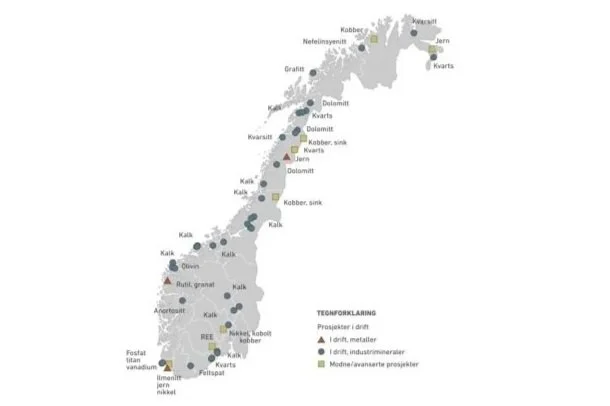
Image from NGU
Minerals are central to geopolitics
Norway possesses highly valuable mineral resources, and few people are aware that minerals play a central role in the geopolitical situation. This was the triggering reason why Society and Politics was established on March 5, when it published the article “Minerals Trump Trump.” Few media outlets are covering the situation, even though, over the past month, several signals have emerged that outline the strategy of Donald Trump: he aims to reclaim global dominance from China, but to do so, he needs minerals.
VG today published an article titled “He Has His Eyes on Greenland.” The article states that the United States has entered into a mineral agreement with Ukraine. That is incorrect. The American president expelled Volodymyr Zelenskyj from the White House on February 28 because the Ukrainian president refused to sign a mineral agreement without military security guarantees. No agreement has been concluded, and the situation remains largely unchanged, despite extensive negotiations. Reuters describes the negotiations as tense.
Critical minerals
Minerals and rare earths are critical for the production of, among other things, defense equipment, renewable energy, cars, and mobile phones. The three largest suppliers of minerals to the United States, by volume, are Canada, China, and Mexico. On March 20, Trump signed an executive order initiating domestic mineral production in the United States, but since the country cannot become self-sufficient, the president must also enter into agreements.
China, for its part, has sufficient domestic mineral production and holds a near-monopoly on the global market. On Sunday, The New York Times reported that China is now reducing exports to the United States as a countermeasure in the trade war. The question, therefore, is how far Trump is willing to go in his pursuit of minerals.
The EU faces an even greater challenge. Even if the EU implements its own measures, it will only be 35 percent self-sufficient by 2030 if the regulation known as Critical Raw Materials Act (CMRA) succeeds. This plan from 2023 is already outdated—not only in relation to the ongoing competition over minerals, but also in terms of self-sufficiency and military security. The plan does not account for mineral needs in a wartime scenario, and Europe is therefore not in a position to defend itself.
Norwegian mineral deposits
Norway has mineral resources both on land and on the seabed. Last year, significant quantities of rare earths were discovered at Fensfeltet in Telemark. On March 28, the government announced that it intends to implement the EU regulation into Norwegian law. At the same time, Minister of Trade and Industry Cecilie Myrseth presented a proposal for a new Minerals Act aimed at enabling new mining projects in Norway.
This means that Norway holds strong negotiating leverage. Its position vis-à-vis the EU is significantly strengthened, as it possesses natural resources that the EU will need well into the future. Furthermore, Norway is far more interesting to the United States than the government suggests: it has a strategic location in the Arctic, as well as oil and now minerals.
It is difficult to see sufficient grounds for claiming that the trade war will have major consequences for Norway, as Prime Minister Jonas Gahr Store and Finance Minister Jens Stoltenberg argue. The outcome depends on the policies pursued; Norway has both the natural resources and the capital for a new industrial venture. However, it appears they have succeeded in their political game; with considerable help from the Norwegian press, a marketing strategy has been pursued in which Støre and Stoltenberg are portrayed as heroes rescuing Norway out of the trade war — without there really being anything to rescue.
The political strategy of Store and Stoltenberg is to hand over control of Norwegian mineral resources to the EU. This could be catastrophic for Norway, as the EU is not in a position to defend it. There are only two sides: the United States and China. The United States is allied in the Middle East and can cut off mineral supplies from China to Europe. Moreover, Russia could gain influence over Europe’s fate if Trump allows it.
SOURCES
Geological Survey of Norway
Minerals and metalsVerdens Gang (VG)
On the minerals in GreenlandGovernment of Norway
Seabed mineralsGovernment of Norway
Norway’s mineral strategyNew York Times
China mineral exportsGeological Survey of Norway
Norway can increase mineral extractionThe White House
Immediate action to increase mineral productionEuropean Union
Critical Raw Materials Act (CRMA)
Content on Society and Politics is based on reliable sources and actual events, providing a news-oriented perspective intented for further debate. To access the article’s author and the related debate, membership on Hudd is required.
