
Political Impact of the
Peace Prize to Machado
Venezuela closed its embassy in Norway shortly after the Peace Prize was awarded to opposition leader María Corina Machado, exposing the political ripples of a prize meant to stand apart from state policy and its growing alignment with European foreign policy values.
October 16, 2025 | INTERNATIONAL POLITICS
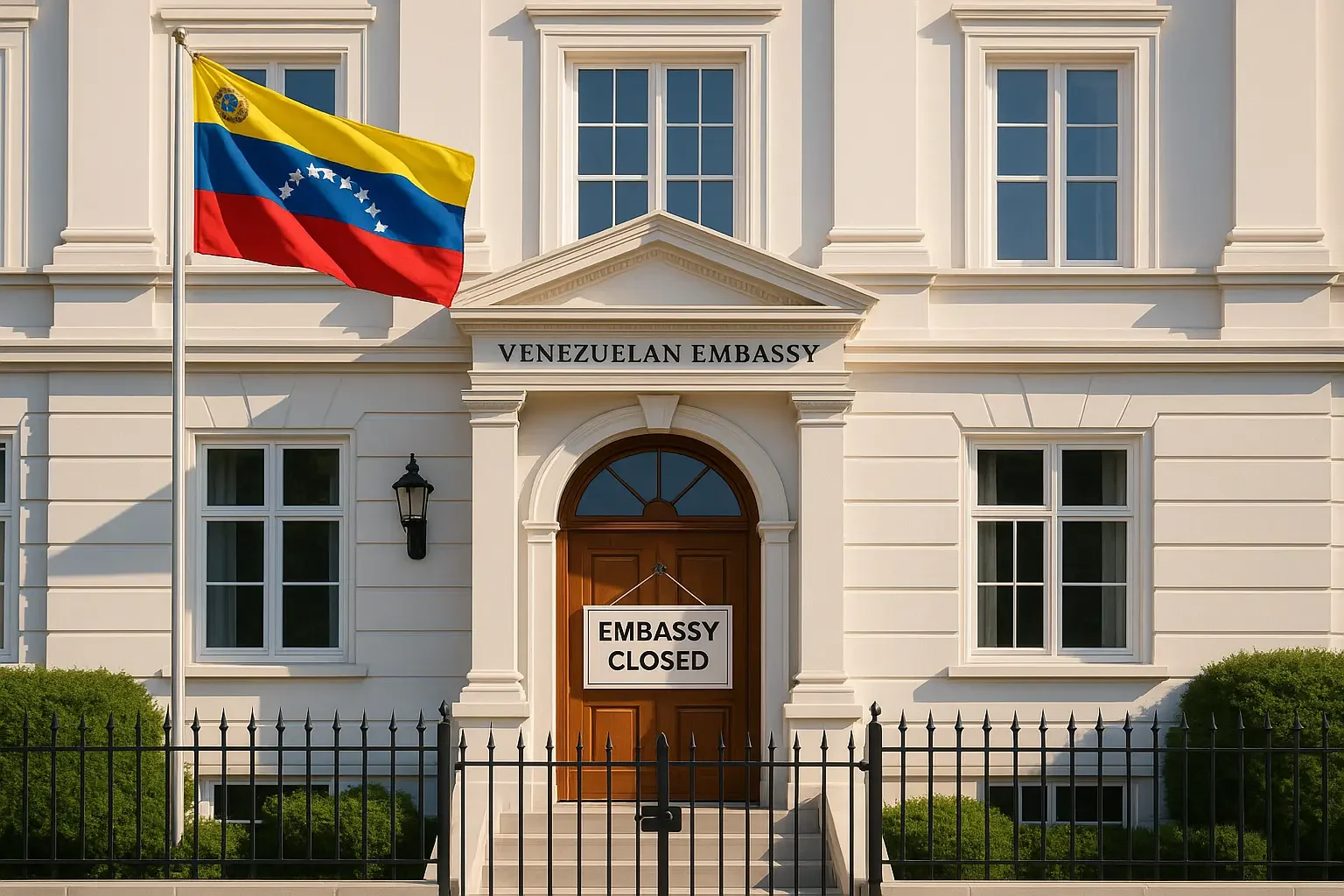
Image by AI/S&P
Venezuela announced this week that it is closing its embassy in Norway with immediate effect, only days after the Peace Prize was awarded to opposition leader María Corina Machado. The decision, according to Venezuelan authorities, follows an overall reassessment of its foreign representation. Caracas also confirmed the closure of its embassy in Australia.
Norwegian Foreign Minister Espen Barth Eide responded that the Peace Prize awarded to Venezuelan opposition leader María Corina Machado is independent of the Norwegian state and emphasized that Venezuela is free to determine where it wishes to maintain diplomatic presence.
The closure has consequences beyond Venezuela’s representation in Norway. Until now, the Venezuelan Embassy in Oslo has also served Venezuelans residing in Denmark, Finland, Sweden, and Iceland.
Norway itself closed its embassy in Caracas in 2013. According to Foreign Minister Eide, that decision was based on an evaluation of Norwegian interests and the need to deploy diplomatic resources where they are most needed. Norway now handles its diplomatic relations with Venezuela through the Norwegian Embassy in Bogotá, Colombia.
Over the years, Norway has aligned itself with international criticism of Venezuela. In January this year, Oslo joined the European Union’s declaration on restrictive measures against the Venezuelan government, in response to what the EU describes as continuing democratic backsliding and human rights violations.
The Nobel Committee’s Independence and Global Perception
The Norwegian Nobel Committee maintains that it operates independently and awards the Peace Prize strictly in accordance with Alfred Nobel’s will. Nobel’s intention was to honor those who have conferred the greatest benefit to humankind and who have worked for fraternity between nations and the promotion of peace congresses.
Historically, however, the Committee has interpreted this mandate broadly, often selecting laureates who are politically active and thereby aligned—directly or indirectly—with one side of national conflicts. Such choices have led to recurring debate about whether the prize can ever be viewed as truly apolitical. A previous analysis published by Samfunn og Politikk discussed how this expanded interpretation has placed the Committee in politically sensitive territory in A Geopolitical Manoeuvre: Awarding the Peace Prize to Machado. Regardless of the Committee’s stated political independence, the prize continues to be perceived politically across the world.
Observers have also noted that the Committee’s choices in recent years often align with Norway’s foreign policy priorities and, increasingly, with the broader European Union approach to democracy, sanctions, and international law. While formally independent, the Committee’s selections have mirrored Norway’s and the EU’s stance on countries under democratic pressure, including Russia, Belarus, Iran, and now Venezuela. This convergence between the Committee’s selections and the foreign policy positions of Norway and the EU is reflected in public records of Norway’s alignment with EU restrictive measures and the Committee’s own prize announcements from 2022 to 2024.
Broader Political Tensions
The week following the announcement of this year’s Peace Prize has seen heightened tensions involving Venezuela. The United States military recently reported striking a vessel allegedly carrying narcotics to the U.S., resulting in six deaths. Meanwhile, Washington has escalated its operations against the Venezuelan regime, and according to international media, the CIA has been authorized to conduct covert operations inside Venezuela.
Following the Peace Prize announcement, laureate María Corina Machado expressed public support for U.S. President Donald Trump’s measures against the Maduro government.
Diplomacy and Perception
The sequence of events underscores how the Peace Prize, though awarded in institutional independence, continues to have political consequences that reach beyond the Nobel Committee itself. For Norway, which formally separates the Committee from state policy, Venezuela’s closure of its embassy nonetheless highlights how closely the prize is perceived abroad as part of Norway’s political identity.
The situation also exposes the tension between moral diplomacy and pragmatic foreign policy. Norway’s role as host of the Peace Prize can strengthen its global reputation for peacebuilding, yet at the same time blur the distinction between independent award and national diplomacy. Increasingly, the prize is also seen as reflecting the shared values and foreign policy orientation of both Norway and the European Union, particularly in its emphasis on democracy, human rights, and opposition to authoritarian rule. A lack of transparency from both the Nobel Committee and Norwegian authorities risks undermining public trust in the very institutions that rely on credibility to sustain their moral authority.
For Venezuela, the move serves primarily as a political gesture of defiance toward what it frames as Western interference. For others, it reinforces the broader view that the Peace Prize, while rooted in humanitarian ideals, functions as a symbolic instrument with unavoidable political weight.
As global power balances shift and tensions between liberal democracies and authoritarian regimes deepen, the reactions to this year’s award illustrate how even the most principled institutions can become entangled in the politics of perception.
SOURCES
Firstpost
Venezuela closes its embassies in Norway and AustraliaRegjeringen.no (The Norwegian Government)
Norway joins the EU declaration on restrictive measures against VenezuelaEuropean Parliament
Sakharov Prize 2024 awarded to Venezuelan opposition leadersBBC
CIA authorized to conduct covert operations inside VenezuelaThe Nobel Prize
About the Peace Prize and its founding principlesFædrelandsvennen
Norway closes its embassy in VenezuelaNorway.no (The Norwegian Government)
Information on the Norwegian Embassy in Bogotá, ColombiaRegjeringen.no (The Norwegian Government)
Overview of EU declarations Norway has joined under the Common Foreign and Security PolicyNobel Prize Press Releases (2022–2024)
Official announcements of recent Peace Prize laureatesCarnegie Endowment for International Peace
The Nobel Prize reflects a vision for a future EuropeTehran Times
Nobel Peace Prize 2025: A fusion of dynamite’s memory, fresh power games, and Western narrativ
Previously available sources
Several sources that previously documented the Norwegian government’s assessments of foreign policy priorities and statements by Foreign Minister Espen Barth Eide are no longer accessible on Regjeringen.no or in Norwegian media for reasons unknown.
VG
Norway closes its embassy in Venezuela – reallocates diplomatic resources to ColombiaDagens Næringsliv
Norway closes its embassy in Venezuela – Eide: “We must adapt to shifting power dynamics”Regjeringen.no (The Norwegian Government)
Cooperation between Norway and the EU on foreign and security policyRegjeringen.no (The Norwegian Government) – Espen Barth Eide
Norway’s Place in the World: Foreign Policy Priorities
Content on Society and Politics is based on reliable sources and actual events, providing a news-oriented perspective intented for further debate. To access the article’s author and the related debate, membership on Hudd is required.
