

Norway's row chant at the World Cup — why the Vikings rowed
Thousands of Norwegian supporters are pulling invisible oars in unison and have become one of the defining sights of the 2026 FIFA World Cup. Some have misread it as an ethnic symbol, even though the Vikings were, in reality, the globalists of their age.
June 24, 2026
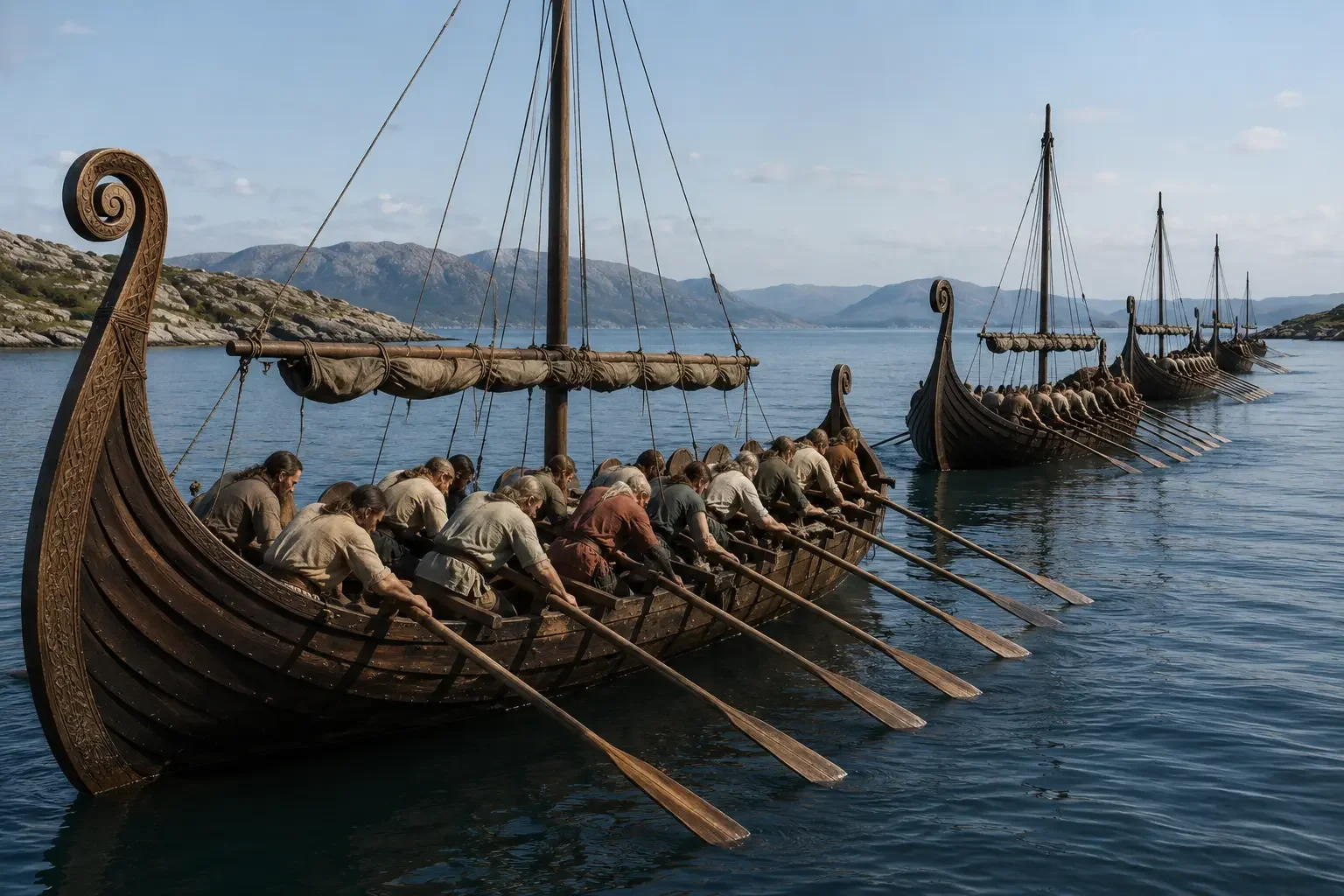
Image by AI/S&P
“Row!” — the chant taking over the World Cup
You have probably seen it even if you have never watched Norway play football. An entire stand of supporters sits down, grabs a set of invisible oars, and pulls backward in rhythm to the beat of a single drum while shouting “row.”
On the football pitch after the games, Erling Haaland, Martin Odegaard and their teammates sit down on the grass and row together with the crowd. The videos are going around the world. The Viking Row has spread beyond the stadiums, to the streets, parks, nightlife venues and private homes.
The symbolism is obvious: a stand full of people rowing in sync like a longship under oars, the vessel that carried Vikings out of Scandinavia more than a thousand years ago.
Norway’s national team leaned into that symbolism in the build-up to the World Cup, releasing an image of the squad on a windswept beach, with shields, swords and a Viking ship in the background.
The chant itself comes from the supporter group Oljeberget (The Oil Mountain) and is led by Halvor Viste Berg and a drum. Keeping the oars in time is all about rhythm: a crew has to pull as one, and Vikings kept time through song, shouts or drumbeats.
The oars was the engine, not the shield
Some people choose to interpret the rowing as an ethnic symbol, like a clenched fist: a people attacking in order to protect themselves, and they use it to justify nationalism and protectionism.
But the Vikings did not row to keep the world out. They rowed to reach it. The oar was not a shield; it was an engine of expansion, and the direction was always outward.
Erik the Red colonised Greenland around 985. His son Leif Erikson reached Vinland — the North American continent — around the year 1000, half a millennium before Columbus, leaving traces that archaeologists uncovered in the 1960s at L’Anse aux Meadows in Newfoundland.
Norse traders operated routes far beyond the British Isles and Ireland: down the Volga toward the Caspian Sea and the markets of the caliphate, and into Constantinople, where Scandinavians served in the emperor’s guard. The Islamic silver dirhams they carried home still turn up in hoards across Scandinavia. Their settlement and trade network stretched, as one archaeologist put it, from the American continent to the Asian steppe.
The Vikings were not an inward-looking tribe hiding behind the fjords. They were the globalists of their age.
They brought the world home
And they did not just travel outward. They brought the world back with them — in goods, in ideas and in blood.
The largest DNA study of the Viking Age ever conducted, published in Nature in 2020, sequenced 442 skeletons from more than eighty sites across Europe and Greenland. The conclusion was unequivocal: in the decades before and during the Viking Age, genes flowed into Scandinavia from southern Europe and from Asia. Not all Vikings were “purely Nordic.” Brown hair was far more common than the blond stereotype suggests. People with no Scandinavian ancestry at all, such as Picts in Scotland, both lived and were buried as Vikings.
The idea of a pure Nordic race waiting to be defended is a myth the Vikings themselves would have torn apart. Their world was mixed through trade, marriage, settlement and the thralls they brought home.
What it means in 2026
So what exactly are Norwegians celebrating when they row in support of the national team?
What they are celebrating is a culture — a story of seafaring, exploration, daring and reach. And a culture, unlike a gene pool, is something anyone can take part in. The Picts who “became” Vikings did exactly that a thousand years ago: they embraced an identity that was never bounded by ancestry.
Norwegians are not a single ethnic type. They are people of many ethnicities, children of immigrants, people of different religious backgrounds — or none at all. People pulling the same invisible oar and shouting “row” in unison. It reaches far beyond the stands: the whole country is rowing — crowds at public screenings, in parks, on the streets, in homes, in schools, in kindergartens, in nursing homes and even in Parliament.
Ethnic Norwegians and immigrants are united in a national celebration that belongs to everyone. Being Norwegian — identifying with the Vikings — is not about where your grandparents were born. It is about where you live, who you are and who you are sitting beside when you row.
It is a misunderstanding to use Viking rowing as a symbol of exclusion. The Vikings spent three centuries practicing inclusion as globalists. In 2026, in a stadium outside New York, Norwegian supporters are doing what the Vikings did: bringing different people into the same boat, getting everyone to grab an oar and pull in the same direction.
Row, row.
SOURCES
ESPN
Erling Haaland, Norway join 'viral' Viking Row after winThe Sporting News
Norway's soccer chant, explained: The history behind 'Ro! Ro!'Dagbladet
Oljebergets nye ro-rop går viraltABC News
Norway fans' Viking row celebration takes over World Cup stadiums and citiesUniversity of Cambridge
World's largest-ever DNA sequencing of Viking skeletons reveals they weren't all ScandinavianPolymarket
Norway vs France match market and 2026 FIFA World Cup Winner
Content on Society and Politics is based on reliable sources and actual events, providing a news-oriented perspective intented for further debate. To access the article’s author and the related debate, membership on Hudd is required.