

The value of Norwegian natural resources
You certainly know that activities linked to Norwegian natural resources contribute to a large part of Norwegian value creation, but what do you know about the actual value of the natural resources and how crucial they are for Norwegian welfare in the future?
March 9, 2026 | NORWEGIAN POLITICS
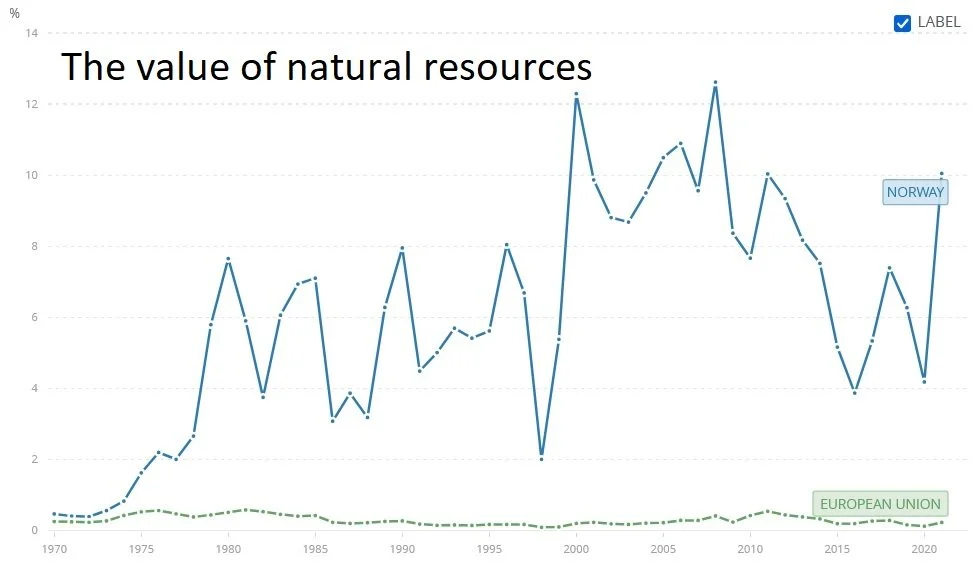
Chart from the World Bank
Oil accounts for about 20% of the gross domestic product in Norway. In comparison, fish accounts for about 1.5%. Gross domestic product (GDP) is the total market value of all goods and services produced in a country during a year, minus the intermediate consumption used in production. It is the most important measure of a country's economic activity, value creation, and standard of living. We know that both oil and fish are important for employment and export, but what is the actual value of the raw materials and what significance do they have for the Norwegian economy?
Natural resources and business activity
The state owns fish and the seabed; on land, the state owns minerals and soil types. No one owns water and air, but the state regulates the use. When a company wants to extract natural resources, the state receives income through quotas, licenses, and concessions. The landowner owns the forest, but not what is under the ground. In mining, the landowner normally receives rental income unless the company operating has purchased the land.
A raw material can create several types of business activity in an economy. First, extraction or catch occurs, where the actual raw material is taken from nature, for example through fishing, oil extraction, mining, or production of hydropower. Then follows processing and industry, where the raw material is refined into products with higher value, such as when fish becomes food products, oil is refined into fuel, or minerals become metals and building materials. Around these activities, a supplier industry is also developed that delivers technology, machines, equipment, and services that the industry needs to function. Finally, transport and logistics are created, because the raw materials and products must be transported, stored, and exported through ships, pipelines, railways, or trucks. Collectively, this forms a value chain where one raw material can provide the basis for extensive economic activity.
Rents - Natural resource rent
Natural resource rent, or "rents", is the part of the value creation from a natural resource that goes to the owner of the resource. For resources that the state owns, such as oil, gas, fish, and minerals, this surplus becomes a source of income for the community. "Rents" are calculated as the value of the production minus costs for labor and capital. For private resources, such as forest or crushed stone plants, "rents" are also calculated as surplus, but the income goes to the landowner or the company that owns the resource, not the state. Natural resource rent thus shows how large a part of the value creation from natural resources accrues to the owner, and provides a way to compare the value of different resources in the economy.
The aforementioned means that "rents" constitute the calculated value of the actual natural resource which in itself is free.
Now that we have an understanding of how natural resources are valued, we can look closer at the value of Norwegian resources. We take as a starting point figures from 2021 which are the latest from the World Bank. For comparison, the state budget in 2021 was 1242 billion NOK.
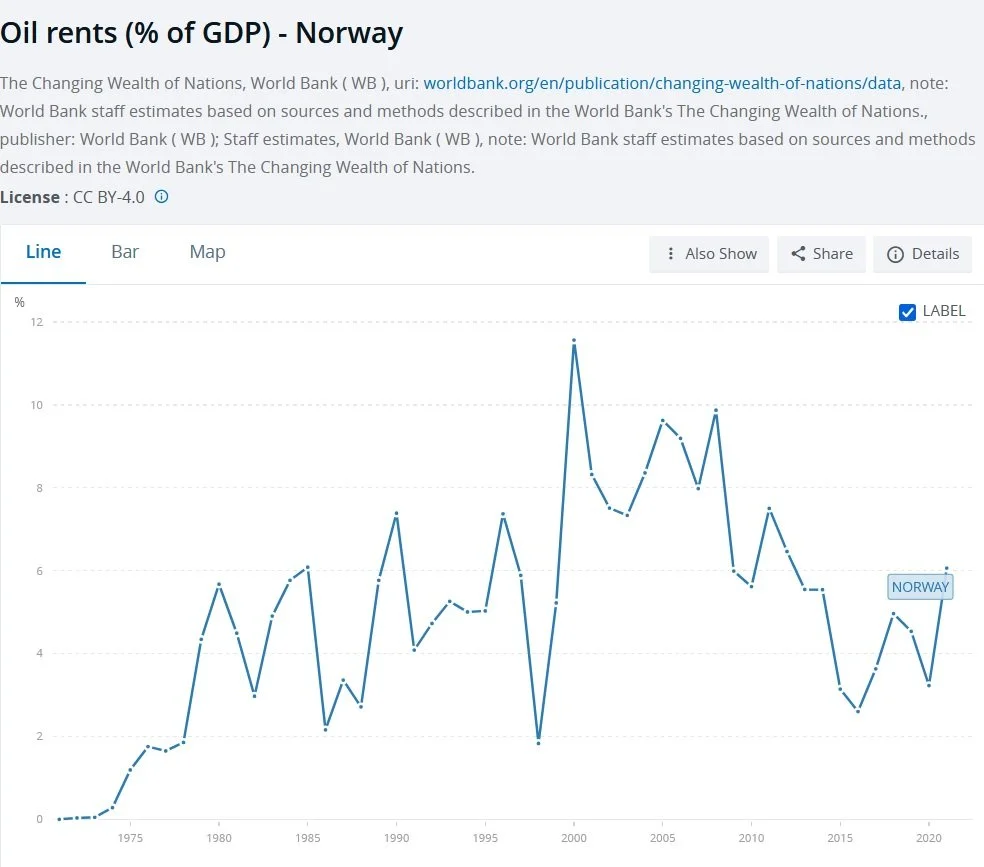
Oil
The value of the raw material oil constituted 6.1 percent of GDP in 2021 = 273 billion NOK
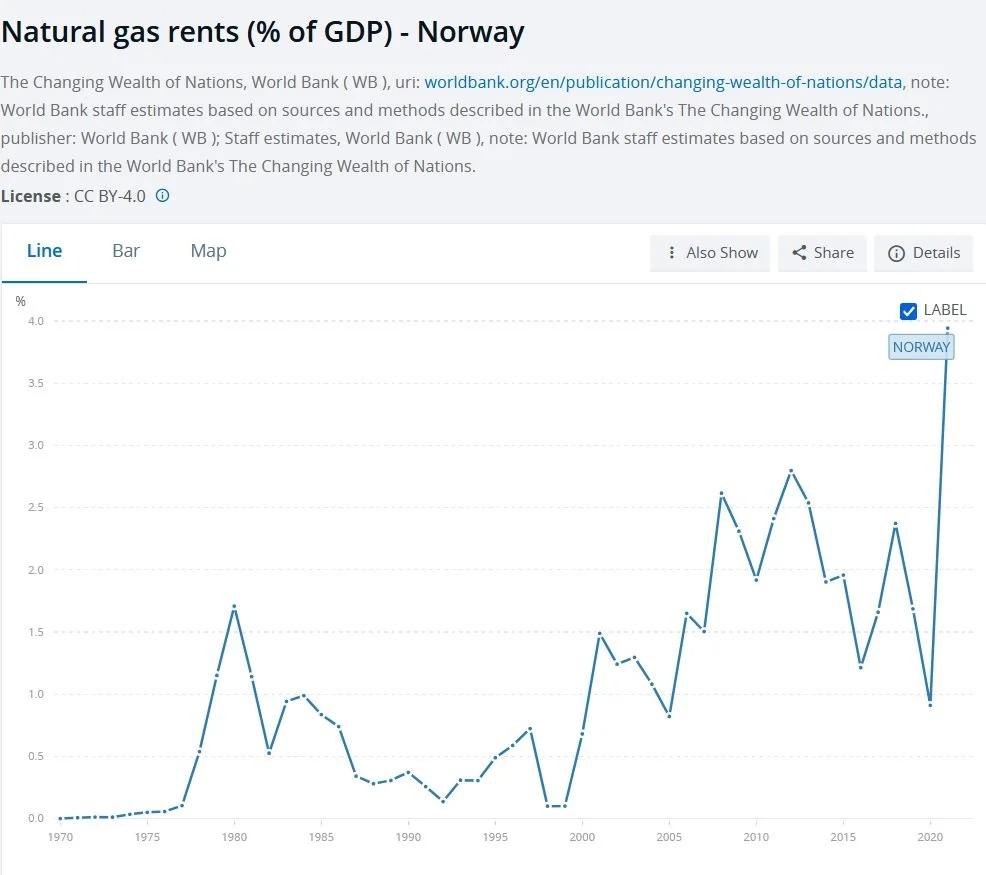
Natural gas
The value of the raw material natural gas constituted 3.9% of GDP in 2021 = 175 billion NOK
Natural resources total
Natural resources total constituted 10% of GDP in 2021 = 448 billion NOK. In natural resources total, oil and gas are included (see graphs above), coal (none for Norway), hydropower (~3% for Norway), forest (< 0.1% for Norway), minerals (< 0.1% for Norway).
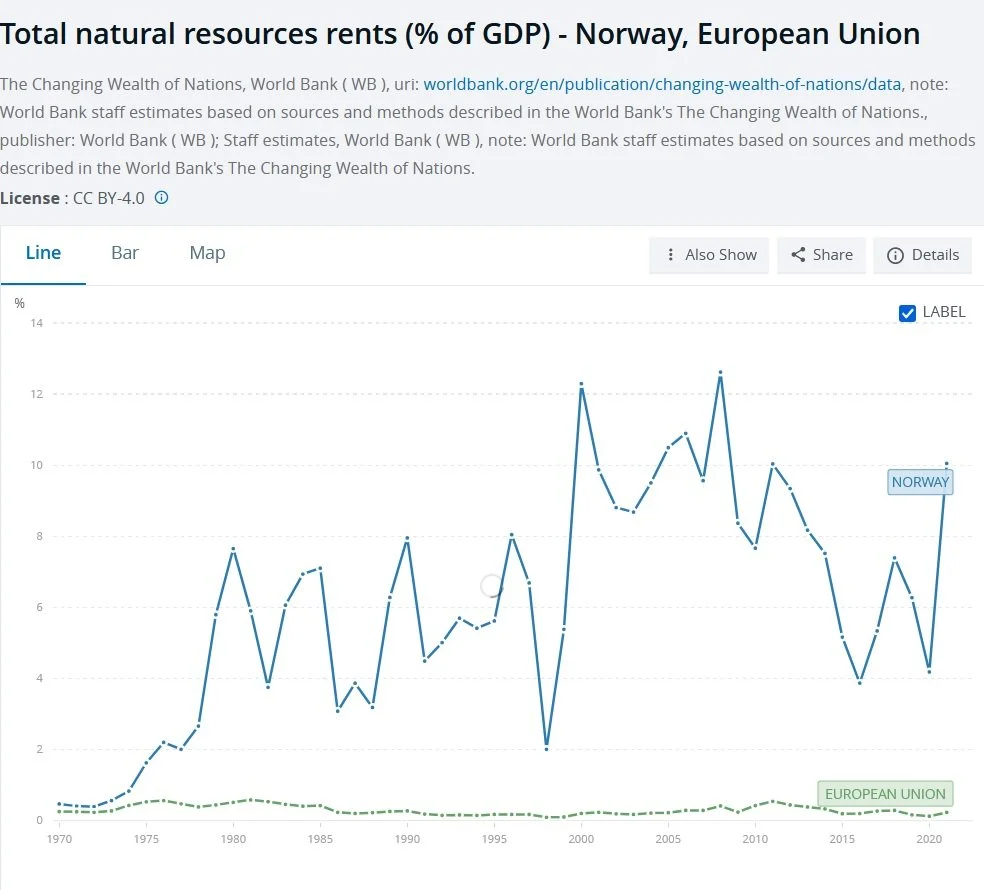
The graph shows how large a share of Norway's value creation comes directly from the value of the natural resource, i.e., without other conditions such as employment, investments, or technology costs affecting the result. It thus provides a measure of how much the value of the resource itself contributes to the Norwegian economy. The fluctuations are primarily due to price and demand on the world market. Oil and gas account for the largest part of the surplus; when the oil price rises or demand increases, the total natural resource rent also increases significantly, while price falls and low demand give a corresponding decline. Fish is not included in the natural resources above, but it can be mentioned that "rents" on fish correspond to less than 0.6%. It is surprisingly low and is presumably due to the raw material being poorly managed on Norwegian behalf. It can be mentioned that Sintef has calculated that Norway loses 20,000 jobs in the fish processing industry as a result of the EU imposing tariffs on processed fish.
36% of the state budget
The figures above clearly show that Norway's share of value creation from natural resources is significantly higher than the average in the European Union. This reflects that Norway has large, commercially valuable natural resources such as oil, gas, and fish, while most European countries have limited access to such resources. It shows that the EU is largely dependent on imports to cover energy needs and raw materials, and that Norway's natural resources have a strategic significance for Europe, both as a source of energy and as a supplier of important raw materials.
It is not possible for Norway to maintain today's welfare level if we give up the advantage we have with "free" natural resources. According to the figures for 2021, the natural resources constituted a full 448 billion NOK, it constituted 36% of the state budget this year. Can you imagine the state budget being reduced correspondingly?
Norwegian ownership
Norwegian ownership of natural resources has great significance for the state's income and economic room for maneuver. When the state owns resources directly or has ownership stakes in companies that extract them, the surplus accrues to the community instead of private actors. A clear example is Equinor, where estimates of the state's cash dividend in 2026 are about 25.8 billion NOK. Such income gives the state significant funds for public services, investments, and savings in the Government Pension Fund Global, and illustrates how ownership means that the value of the natural resources can benefit the entire society.
Foreign ownership can affect how natural resources are utilized and who receives the income from them. When a company owned by foreign actors operates mining, wind power, hydropower, or other resource extraction on Norwegian ground, the surplus largely accrues to the owners, and not necessarily the Norwegian community. The state can still collect income through taxes, fees, and concessions, but the direct control over the resource is reduced. This makes political and economic framework conditions important to ensure that the utilization happens in a way that safeguards national interests and the value for society.
Norwegian sovereignty reduced through the EEA agreement
EU directives and regulations have reduced Norway's room for maneuver when it comes to concessions, licenses, and regulation of natural resources. Even though Norway owns the resources, EU legislation dictates to an increasing degree how allocation and utilization shall happen. This weakens in practice the state's sovereignty and can limit the possibility to prioritize national interests, secure state income, or set requirements for environment and local value creation.
Norwegian mineral resources
Minerals will to a large extent replace oil and gas as an energy source in the future. Norway has large mineral resources that can replace the oil activity. It recently became clear that the mineral deposits at the Fen Complex in Telemark are nearly twice as large as first assumed. To put the deposits in perspective, they represent at least 70 times more energy than has been extracted from the North Sea in the form of oil and gas throughout history. The deposits at the Fen Complex are probably the third largest in the world, after fields in China and Brazil.
If Norway is to maintain today's level of welfare for future generations, there is no way around it: the minerals must remain under Norwegian sovereignty and control.
The Labor government announced in March last year that they will implement the EU's mineral regulation CMRA in the EEA agreement; that means in practice that the EU gets authority over Norwegian minerals through the value chain, the value of the natural resources will as a result be significantly curtailed. Read more here; Sovereignty over Norwegian minerals.
SOURCES
Statistics Norway (Statistisk sentralbyrå)
Production and income by industryNorwegian Petroleum (Norsk Petroleum)
Government revenues through direct ownership in EquinorWorld Bank
Oil rents (write Norway in the search field)World Bank
Natural gas rents (write Norway in the search field)World Bank
Total natural resources rents (write Norway and then European Union in the search field)Statistics Norway (Statistisk sentralbyrå)
The Norwegian economy in 2021Government of Norway (Regjeringen)
The 2021 National Budget – government revenues and expendituresNRK
Europe's new trump card: The giant find in Telemark nearly doubled
Content on Society and Politics is based on reliable sources and actual events, providing a news-oriented perspective intented for further debate. To access the article’s author and the related debate, membership on Hudd is required.
