
Ambiguous explanation from Crown Princess Mette-Marit regarding Epstein
More than a decade after her association with Epstein, Mette-Marit says she ended the relationship because it made her uncomfortable. She portrays herself as a victim, claiming she was misled and manipulated. However, many questions remain unanswered, and Mette-Marit’s body language appears ambiguous.
March 20, 2026 | SOCIETY
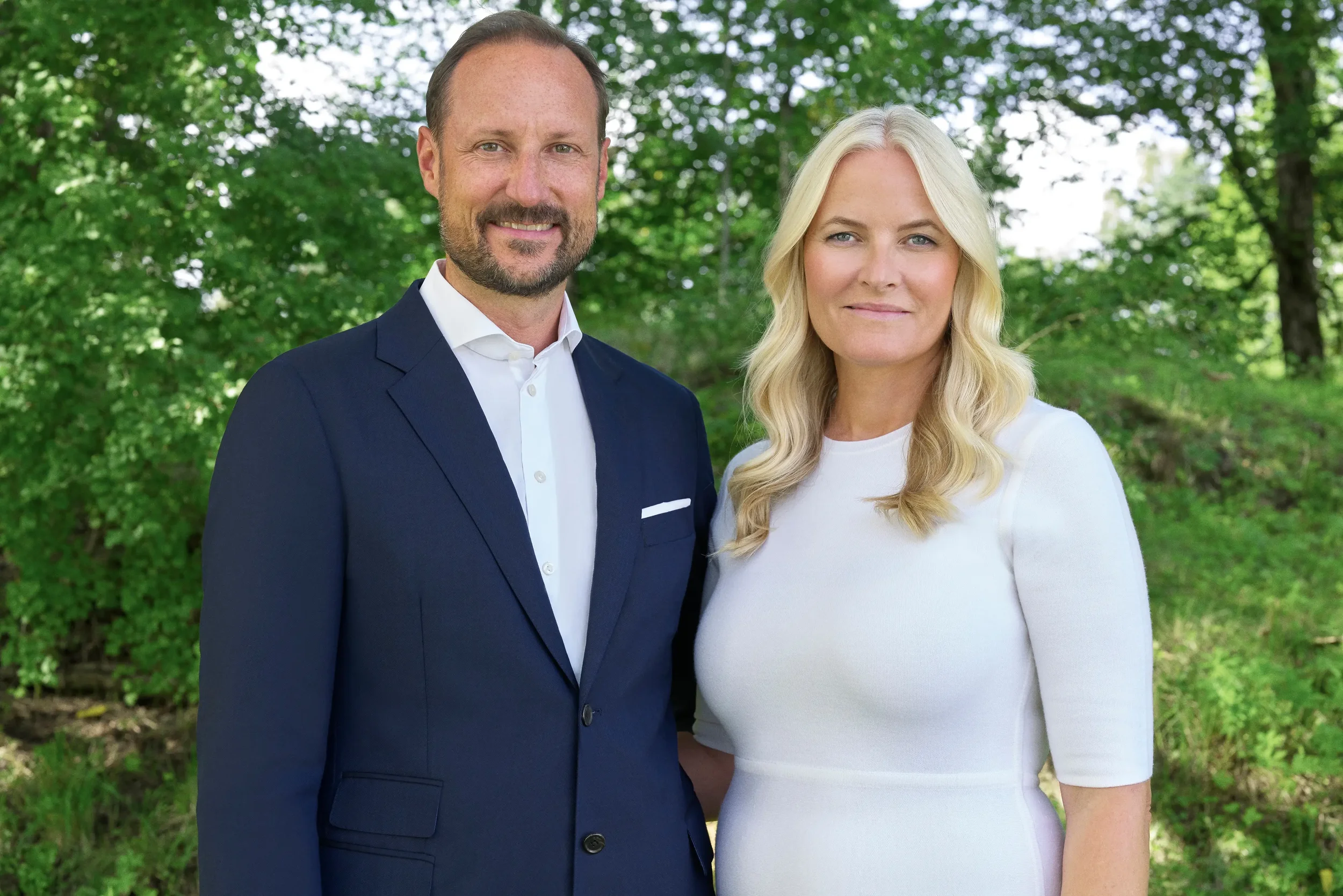
Crown Prince Haakon and Crown Princess Mette-Marit. Photo: Dusan Reljin / The Royal Court
In an interview with NRK, the Crown Princess has addressed her relationship with Epstein. The interview was recorded yesterday and aired today in an edited version. The extent of her ties to Epstein became known through files published on January 30. The Norwegian public has waited seven weeks for an explanation from Mette-Marit. This marks the first time the Crown Prince couple has commented on the matter since Crown Prince Haakon gave a brief statement on February 6.
Click here if you want to skip the summary of the interview and go straight to the assessment of Mette-Marit’s body language.
The Crown Prince couple have prioritized family and illness
At the outset, the Crown Prince couple say it has taken time to speak publicly about the Epstein case because their son/stepson, Marius Borg Hoiby, has been going through a seven-week trial. They add that Mette-Marit’s lung condition has worsened and that she requires rest. The couple explain that they have prioritized caring for their family during this period.
Claims email exchanges were friendly, not intimate
The Crown Princess appears composed as she explains that she came into contact with Epstein through a mutual acquaintance at a time when she was struggling with her role. She does not name the individual, but the mutual contact is said to be Bill Gates’ close associate Boris Nikolic; she had been friends with the former since the mid-1990s. She notes that others she trusted also had contact with Epstein. Whether she is referring to Thorbjørn Jagland, Mona Juul and Terje Rød-Larsen — who are under investigation for their ties to Epstein — remains unclear.
Mette-Marit says she and Epstein became good friends and that she trusted him, which she cites as the reason for the familiar tone in their emails. She does not recall searching for him online, but says she would have ended the relationship had she known his background. She maintains that the tone of their correspondence was friendly and normal. She declines to elaborate further on the exchanges, beyond saying it is challenging that they have become public. However, she says she is surprised and saddened by how Epstein and their mutual acquaintance referred to her in emails.
Mette-Marit explains that she stayed free of charge at Epstein’s home in Palm Beach in 2013, where she says something uncomfortable occurred that she does not wish to describe, though she informed Haakon. Nevertheless, she maintained contact with Epstein until 2014.
Epstein is said to have paid for a hair appointment and dinners, while Mette-Marit also covered expenses, and she believes their spending balanced out.
Deceived and manipulated by Epstein
In hindsight, Mette-Marit says it is difficult to accept that their friendship may have contributed to legitimizing Epstein. She states that she ended the relationship after gradually learning about his character from various sources. She says she felt both deceived and manipulated, and that she wishes she had never met him.
Mette-Marit maintains that she only became aware of the serious abuses in 2019, when the first Epstein files were published. She appears close to tears as she says she sympathizes with the victims and that the case has made a strong impression on her. The Crown Princess further explains that she needed time to process what emerged about Epstein’s abuse, and that her response in 2019 was therefore inadequate. She faced criticism at the time and has since received extensive criticism after details of her relationship with Epstein were revealed through files published earlier this year.
The Crown Princess’s role
Mette-Marit has not taken part in public engagements since January, and it remains unclear when she will resume her duties. On the same day another batch of Epstein files was published, December 19 last year, the Crown Prince couple told NRK in an interview that Mette-Marit will at some point in the future require a lung transplant.
Three organizations have ended their cooperation with Mette-Marit, while several others have put collaborations on hold as a result of the Epstein case. She says she understands this and hopes to regain public trust, as she wishes to continue her work.
The Royal Court
The interview indicates that Haakon was aware of the relationship between Mette-Marit and Epstein, but that the Norwegian Police Security Service and the Royal Palace were not informed, as it was considered a private matter. The Crown Prince couple give the impression that they have stood together throughout, both then and now, and that the King and Queen support them. They thus reject claims that the case has caused an internal crisis within the Royal Court, as some media have suggested.
Wise, caring and very strong
The Crown Prince couple appear outwardly strong together. Mette-Marit praises Haakon, while Crown Prince Haakon supports her, describing her as wise, caring and very strong.
Many will likely argue that this description does not align well with Mette-Marit’s actions. Her contact with Epstein appears unwise, both in form and substance. It reflects carelessness toward the monarchy, Haakon, her children, the King, the Queen and the public.
Strong may be credible, but not in the sense Haakon suggests. Mette-Marit appears so strong that it does not seem convincing that she is as trusting and easily manipulated as she claims. Rather, it may be perceived that she is herself being manipulative in portraying herself as a victim of Epstein.
Furthermore, the Crown Princess appears to show little humility, answering only the questions she chooses to address, while deflecting more uncomfortable ones by referring to her private life.
Crown Princess Mette-Marit’s body language
Only a small proportion of communication is verbal — this varies individually, but it is under 10 percent. When body language is viewed alongside speech, more of the communication becomes apparent. It is easy to speak untruthfully with words, but very difficult to override body language. Even without the knowledge to describe deviations in detail, many will intuitively sense that something is off when someone is not telling the truth.
Although Mette-Marit appears strongly affected when speaking about Epstein’s victims and her own experiences with him, this observer identifies deviations. The emotions appear genuine in isolation, but her body language may indicate that she brings these emotions forward to influence. Many will intuitively perceive the discrepancy. In behavioral terms, this can be observed in open eyes, raised eyebrows and tone of voice — signs that may indicate a focus on convincing in the moment. When expressing genuine sorrow, the face will normally settle into tension, with narrowed eyes and heavy eyebrows, the chin lowered, and the tone of voice deeper and slower.
Throughout the interview, she shows no signs of humility — rather the opposite. She consistently holds her head high with open eyes. One example is when she says she is embarrassed by the situation; embarrassment or shame will normally be accompanied by a lowered and slower tone of voice, and lowered eyelids, chin and shoulders.
It is also notable that her forehead is set in lines of concern when she gives statements that in isolation appear reassuring, and that she shrugs while presenting something as fact.
At other times, it appears that Mette-Marit uses body language to soften or reinforce what she says. She softens by smiling and laughing in a way that does not correspond with the seriousness of the subject. She reinforces by placing a hand on her chest to illustrate sincerity despite the rest of her body language not corresponding, or by looking at Haakon for confirmation.
There are also many “uh” sounds, and she confirms her own statements by ending with “mmm.” “Uh” is often used when telling a constructed story, while “mmm” serves as a confirmation to herself that what she said came out as intended.
Her body language is particularly ambiguous when answering questions about whether she searched for Epstein online, which she says she cannot remember. During this exchange, she shows several of the signs mentioned above, as well as more frequent blinking and fixed gazes into the distance. Blink frequency varies between individuals; Mette-Marit generally blinks little. Blinking more frequently than normal may be a sign of unease or stress in relation to what is being said. Fixing the gaze into the distance is not normally necessary when recounting an experienced story, and may therefore signal a constructed narrative. It can also be difficult to meet others’ gaze when speaking untruthfully, although this may depend on the individual’s level of conscience.
Mette-Marit also shows signs of both disarming and challenging the interviewer, Petter Oulie-Hauge. This can be observed in her use of laughter to disarm, and in the way she pushes her head slightly forward with an open, fixed gaze to challenge (put him in his place).
If you watch the interview for the first time, or again after reading this, you will likely notice further discrepancies between speech and body language. If you are not fluent in Norwegian, this may be harder to detect. You can also find an assessment of Haakon’s body language from his statement on February 6 here.
Manipulative performance
Overall, this appears as a manipulative performance, suggesting that the Crown Prince couple feel entitled to present a narrative on their own terms and under their own control. They have had many years to address Epstein in a credible manner, which they have not done. Over the past seven weeks, they have handled the matter as if the circumstances were new, as if they needed time to process and prepare. It was revealed seven weeks ago, but the events took place more than a decade ago. Today, Mette-Marit has indirectly confirmed that she lied when she commented on the matter in 2019.
In the interview, Crown Prince Haakon comes across as a marionette for Mette-Marit, his sole role being to affirm her narrative. To some, he may appear both naïve and submissive.
The performance gives the impression of having been carefully prepared over a long period, and that they have influenced the agenda. NRK journalist Petter Oulie-Hagen asks few critical questions and no critical follow-ups. NRK also stated today that the Crown Prince couple were given the opportunity to make additional recordings so they could convey what they wanted. This does not reflect standard press ethics; the state broadcaster has allowed the Crown Prince couple to use the interview as a tool for personal branding and promotion.
The trust is not restored
The interview provided few answers. Whether they are truthful may become clearer in the future as new Epstein files are published. In any case, a sincere apology is lacking.
It is doubtful that this interview alone will restore trust in Mette-Marit. There are too many unanswered questions and too much noise in her body language. Mette-Marit will have to rebuild trust step by step and demonstrate stamina over time. Her margin for error is exhausted.
Illness is mitigating and will be used to its full extent in rebuilding Mette-Marit’s reputation. The positive media effect of sympathy for the Crown Princess was evident before Christmas, when information about a future lung transplant was made public. It is notable that in today’s interview, Mette-Marit said her health condition will determine whether she can continue in her role. It is also worth noting that the Crown Prince couple describe their work as a project rather than a life’s calling. These statements may indicate that they have prepared a strategy if the public does not accept her as Queen of Norway.