
The wealth tax contributes to EU levelling
The wealth tax is presented as good socialist redistribution policy, but a growing number of business owners are moving abroad as a result of the tax, taking both Norwegian capital and tax contributions out of the country — is this really good redistribution policy?
July 27, 2025

Image by AI/S&P
Norwegian industry
Norwegian industry is doing exceptionally well compared with other European countries. Low unemployment is associated with a healthy economy, but that does not mean low unemployment is synonymous with welfare for the worker, as the government likes to present it. The real situation is that workers in low-paid occupations can no longer maintain a standard of living above the poverty line. This situation has arisen because Norway is exposed to social dumping as a result of the EEA Agreement, which entered into force in 1994.
Social dumping
Social dumping is a term used to describe workers, often foreign, having pay and working conditions that are poorer than what is normal for the same type of work (The Norwegian Encyclopaedia).
The EEA Agreement gave Norway access to the EU's internal market, but also the right to free movement of goods, services, capital and persons, which now covers the EU's 27 member states and three EEA countries. The consequences of the four freedoms weighed against the value of access to the EU's internal market have never been assessed, because the Labour Party and the Conservatives have alternated in government since the EEA Agreement entered into force; both parties are EU supporters and want full membership.
To be competitive in the EU's internal market, Norwegian products and services have faced a continuous challenge in the fact that Norway is a high-cost country. Access to cheap labor is so important for competitiveness that the trade unions fairly quickly gave up the fight for fear of losing jobs, and thus failed to maintain minimum wages at the level they had previously been. Norwegian governments have had a continuous challenge in keeping Norwegian wage growth at a level that does not exceed the EU's wage growth.
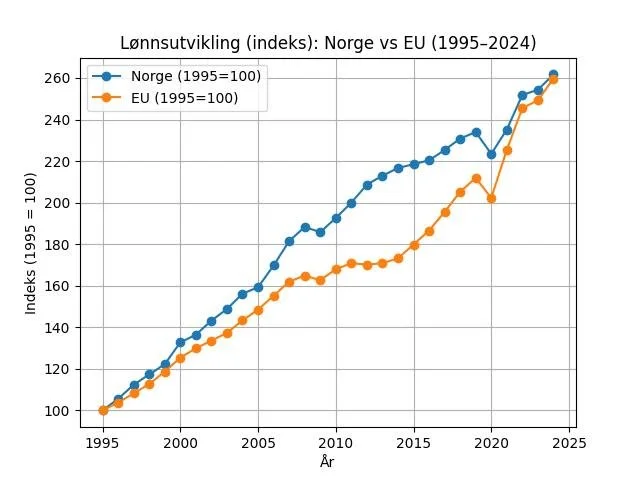
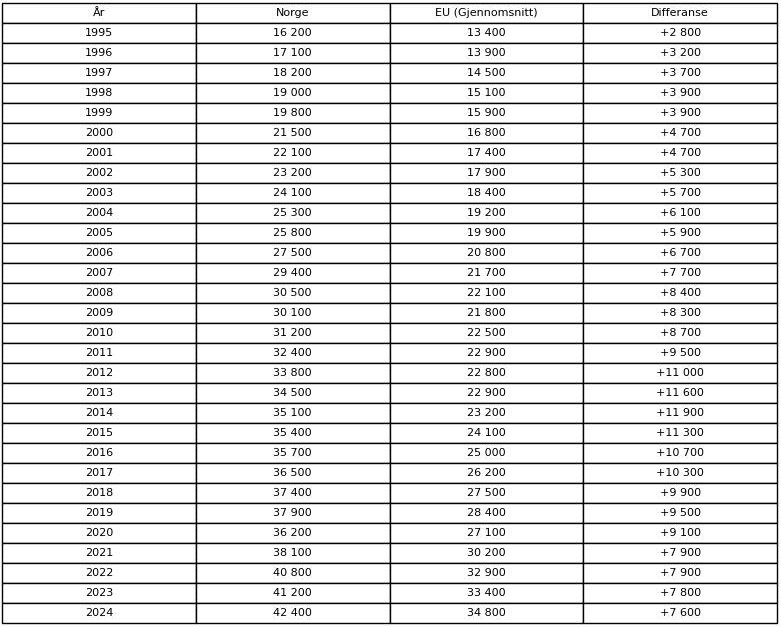
The graph shows the development in wage levels in Norway and the EU measured as an index (1995 = 100). An index means that the starting year (1995) is set equal to 100, and that all later values show the percentage change relative to that year. For example, a value of 105 means the wage level has risen by 5%. Find the underlying figures in sources at the bottom.
Norwegian ownership
Foreign workers are often employed by European companies, which means that the dividends (the capital) the company or firm has acquired through Norwegian workplaces in Norway are taken out of the country. Foreign ownership therefore has a directly negative effect on Norwegian value creation. In turn, this leads to fewer Norwegian owners and fewer Norwegian investments.
Norwegian ownership is important to ensure that the potential in Norwegian business benefits Norway. EU alignment means in practice that Norwegian business is held back, which affects not only the Norwegian capacity for value creation, but also the capacity for welfare, for security and for sovereignty.
The wealth tax
The Labour Party claims that the wealth tax is good redistribution policy, and this naturally appeals to socialist voters. But against the background of the above, there is reason to consider this with a more critical eye.
A growing number of Norwegian business owners are taking their capital and moving out of Norway. One thing is that the wealth tax the government intends to collect disappears anyway upon relocation; a far more serious consequence is that Norwegian ownership is reduced and the share of foreign owners grows.
As if this were not enough, Norway is, through a steady stream of new EU laws, obliged to use suppliers in EU countries. A very recent example of this is the EU's minerals regulation, the CRMA, read more. Norway is increasingly less able to prioritize or protect Norwegian companies, which means that Norwegian ownership represents a direct challenge to the EU rapprochement. It is in fact in the Labour Party's interest that Norwegian ownership is reduced, since its goal is EU membership — and this places the Labour Party's commitment to the wealth tax in a different and murkier light.
Unfortunately, Norwegian voters are not sufficiently informed when the wealth tax is discussed. Against the background of the above, there is reason to be skeptical even if one supports redistribution policy.
SOURCES
The Norwegian Encyclopaedia
Social dumpingThe Norwegian Encyclopaedia
The EU's internal marketFigures taken from Eurostat
Purchasing power parities
Content on Society and Politics is based on reliable sources and actual events, providing a news-oriented perspective intented for further debate. To access the article’s author and the related debate, membership on Hudd is required.