

Image by S&P
Very low activity
According to Hudd's website, as of September 2026 they have more than 210,000 users. They write that these are active users, but that is misleading. This is the number of users who have registered on the application, not how many are actually active. In reply to an enquiry from S&P to Hudd in May, Hudd states that 20% of the users were active every day, which gives a figure of around 42,000 active users.
For comparison we can look at the figures for Facebook. The figures are from Q1 2023, the most recent ones published by Ipsos. At that point Facebook had 3,560,000 registered users in Norway, of whom 2,870,000 were active daily (66%), that is, a far higher share than Hudd.
However, the number of active users says little about the activity, about how many actually engage. Engagement in social media is counted as response to posts. The response consists of reactions, comments and shares. This is measured against the number of followers, reach or impressions. Engagement is generally low in social media. Facebook had only 0.04% and Instagram had an engagement rate of 0.3% in 2025.
On Wednesday 2 September, 31 new posts were published on Hudd (*). This figure represents an ordinary day on Hudd over time. Three of the 31 posts came, incidentally, from Society and Politics, which has had a debate group on Hudd since 5 March 2025.
S&P has had an engagement rate of around 0.12% per post. That lies within the range between Facebook and Instagram given above.
As of today, 3 September, Hudd is in 30th place in the App Store category Social Networking in Norway.
The figures above show that Hudd's challenge lies in 1) recruiting new users and 2) keeping the users active.
Use of personal data
Hudd has profiled itself as a serious and safe actor. Logging in with Vipps is meant to provide secure login and prevent the challenge other social media have with fake accounts. It is further stated that Hudd neither shares nor sells personal data. This is something we shall now look at more closely.
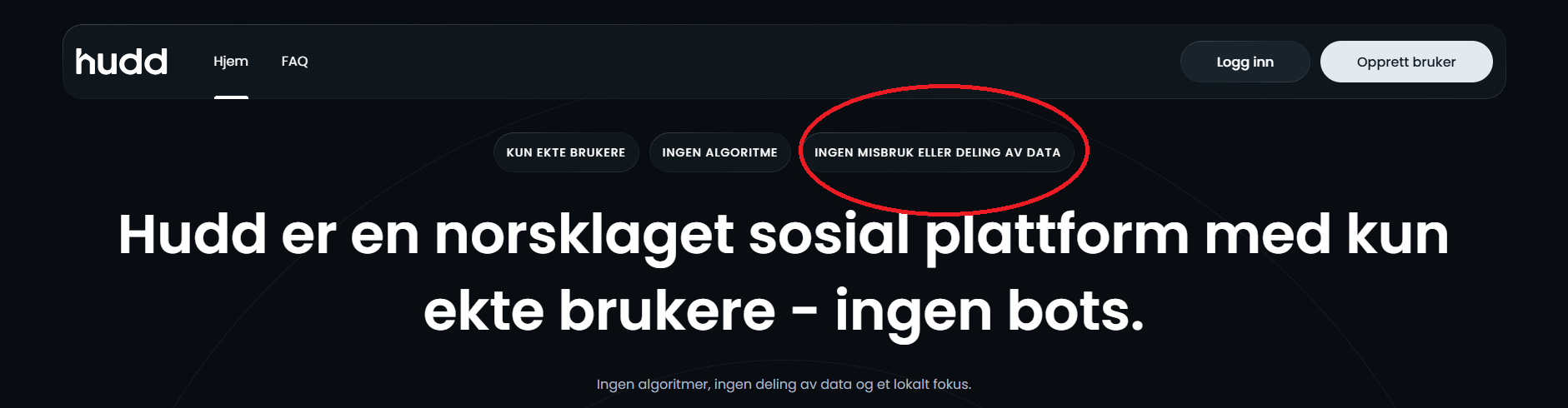
From Hudd's homepage; "No misuse or sharing of data".
Hudd has recently sent third-party product offers to its users without having obtained consent in advance, as S&P assesses that section 15 of the Marketing Control Act requires.
Since Hudd uses Vipps for login, they have a valuable personal data register. This value can be materialised even if Hudd does not share the register directly. The value for Hudd lies in the fact that the data is verified as a result of Vipps login being built on BankID (Norwegian electronic ID). Each user is thereby a confirmed Norwegian person with name, date of birth, telephone number and email address. In addition, Hudd retrieves the user's registered address from the National Population Register. The privacy policy states that the information about where the user lives is used to select both organic and commercial content that the person is presented with. Such a register is far more attractive to advertisers than a list of self-registered email addresses.
When Hudd says that they neither sell nor share personal data, this is correct as far as it goes, but they nevertheless sell a service to third parties in which personal data forms the basis. The service Hudd sells is distribution of email and selection of target group. The personal data never leaves Hudd, but its value is realised all the same through the sale of access to the users.
Following dialogue with Hudd on 3 September, via the application, Hudd says that an error has occurred. Further, that in the future consent shall be obtained if emails with content from third parties are to be sent.
Third-party marketing
In the aforementioned emails, as well as through marketing in the application, Hudd has shared third-party content which S&P assesses may be in breach of sections 6 and 15 of the Marketing Control Act, the regulations on the marketing of credit and chapter 5 of the Financial Contracts Act.
Despite Hudd having been made aware of the relevant statutory provisions by S&P on 3 September, the financial advertisement in question is still active on Hudd.
Experiences with using Hudd
Since March 2025, S&P has had a debate group on Hudd, which was shut down on 2 September. The group was the largest user group on Hudd (apart from Hudd itself), with 8,600 members. S&P published several hundred posts in the group over 18 months. * In addition, the administrator has user experience from a private account with 10,500 followers, this also from March 2025. There is therefore substantial use behind this review.
User functionality
Hudd has been through a great many changes in the user interface (GUI). The development bears the marks of trial and error, something which has created confusion. The user interface has not been as intuitive as what one finds in other social media, especially seen in relation to the limited functionality the application has.
The user functionality consists mainly of being able to publish a post of 4,000 characters, specify hashtags and add five images, a file or a video. It also has a very simple drawing function.
The comment fields are limited in that one can only give likes on main comments. Furthermore, the thread is confusing in that the latest main thread lies at the top, while the latest comment also lies on top inside the thread. It is not possible for a user to delete unwanted comments from others or close the comments field, which particularly affects vulnerable individuals' control over their own user profile.
Posts cannot be shared outside Hudd. The only option is to invite new users to Hudd. This is perhaps a deliberate strategy, but it does not appear to have succeeded.
Group functionality
All users can create groups on Hudd and there are many of them, but only some twenty have more than 1,000 members and all have very low activity. The group "Hva skjer i Oslo" has just over 7,300 members and has published only 8 posts in the past week.
It is easy to create groups, but the functionality is again limited to the bare minimum of what one needs to run a group. It has none of the particular functions other social media have, where one can approve or filter comments to prevent hate speech, close the comment field or the like.
Neighbourhood functionality
The neighbourhood functionality was profiled as Hudd's hallmark. It is meant to give you an overview of what is happening in the local area. However, very few businesses, organisations, sports clubs and the like have registered and actually use the application. Parents with children tell S&P that they have tried to get other parents over to Hudd, for administering school and leisure activities, without succeeding.
Other functionalities
There is, among other things, a completely ordinary chat function, a calendar function which has no value without a substantial network on Hudd, and an alert function for critical events which has only been used a handful of times. Furthermore, categories have been created which are meant to make it easier to filter what you actually want to see. Hudd publishes posts in chronological order. A category function would have been useful if there were high activity in the feed, but there is not. As mentioned above, there were only 31 posts in the feed on 2 September.
Offers benefits
Hudd offers benefits from its partners, or rather its customers. As mentioned above, at least one of them appears to be a breach of the Marketing Control Act. These benefits are, incidentally, nothing other than what you will find anywhere on the internet or in your email inbox.
Sluggishness and many errors in the application
The application is generally slow. Some pages are especially slow to load and some fail completely.
There are many errors in the mapping of buttons. They fail or do not perform what they are supposed to, despite giving a response. If you want to block a user, for example, you cannot be sure that the person was actually blocked.
Here is a small selection of error reports from members; banners in groups cover half the screen, cannot open comments in posts, do not see new chat messages, do not see the images, cannot report a user, and so on. It creates particular irritation that the notification system does not work as it should.
There is also much that does not match between the mobile application and the web version. How one navigates with back buttons, what one sees, how the buttons work and line breaks in posts, to mention some.
Conclusion
The technical solution is weak and not on a par with what one expects in 2026. Hudd appears to have prioritised changes and new functionalities over error correction. Another possible explanation is a lack of continuity in the development as a result of hired-in expertise.
The user functionalities are very limited compared with what one finds in other social media.
Activity and engagement are very low. At the pace they are recruiting new users, it will take 29 years to become as big as Facebook in Norway.
Hudd has the same problem with internet trolls as other social media platforms, and it is therefore not accurate to claim that posting on Hudd is safe in that respect.
The user experience is so poor that Hudd cannot be recommended.
For content creators who want to build a network it is not worth the effort. Since 1 August last year, S&P has built up considerably more traffic to the website you are now visiting through channels other than Hudd.
Against the background of Hudd's technical challenges, one may ask whether the personal data is securely stored at the company. When one adds that Hudd provides services to third parties, based on personal data, Hudd does not appear to be a safe platform.
In addition, competitors such as Facebook, Instagram and TikTok are in the process of having new requirements imposed on them which will make them safer. That will also affect Hudd's potential.
From an investment point of view it is difficult to see the value of Hudd as the application appears today, with limited functionality and many errors. It may be cheaper to build a corresponding application from scratch in a well-functioning development environment (this assessment presupposes that Hudd mainly uses external development and operations services). The value of Hudd appears to lie in user registrations, personal data and user behaviour.
It now remains to be seen what Hudd does after the enquiry from S&P. The company has acknowledged an error with the aforementioned third-party advertisement. If it does not recur, and they in addition acknowledge that the technical challenges and limitations in the application must be prioritised, it may perhaps be possible.
In any case, S&P will spend no more time on Hudd. Content and account will be deleted to ensure that personal data does not end up with third parties or others, or with another company in the event of a sale of Hudd.
As a general recommendation, anyone who has registered with an application they no longer use should delete the account and obtain confirmation from the company that personal data and user data have in fact been deleted.
SOURCES
Anbefaler.com
We recommend Hudd (a recommendation paid for by Hudd)Ipsos
SoMe tracker Q1 2023Hudd
Privacy policyHudd
TermsHudd
About Hudd
Content on Society and Politics is based on reliable sources and actual events, providing a news-oriented perspective.
Learn more about S&P >