

China warns EU following new Russia sanctions
The geopolitical situation is escalating to a new level after the EU, for the first time, sanctions Chinese companies as a result of the war in Ukraine. This occurs simultaneously as the EU enters into an action plan for critical minerals with the USA.
April 26, 2026 | SOURCES | INTERNATIONAL POLITICS
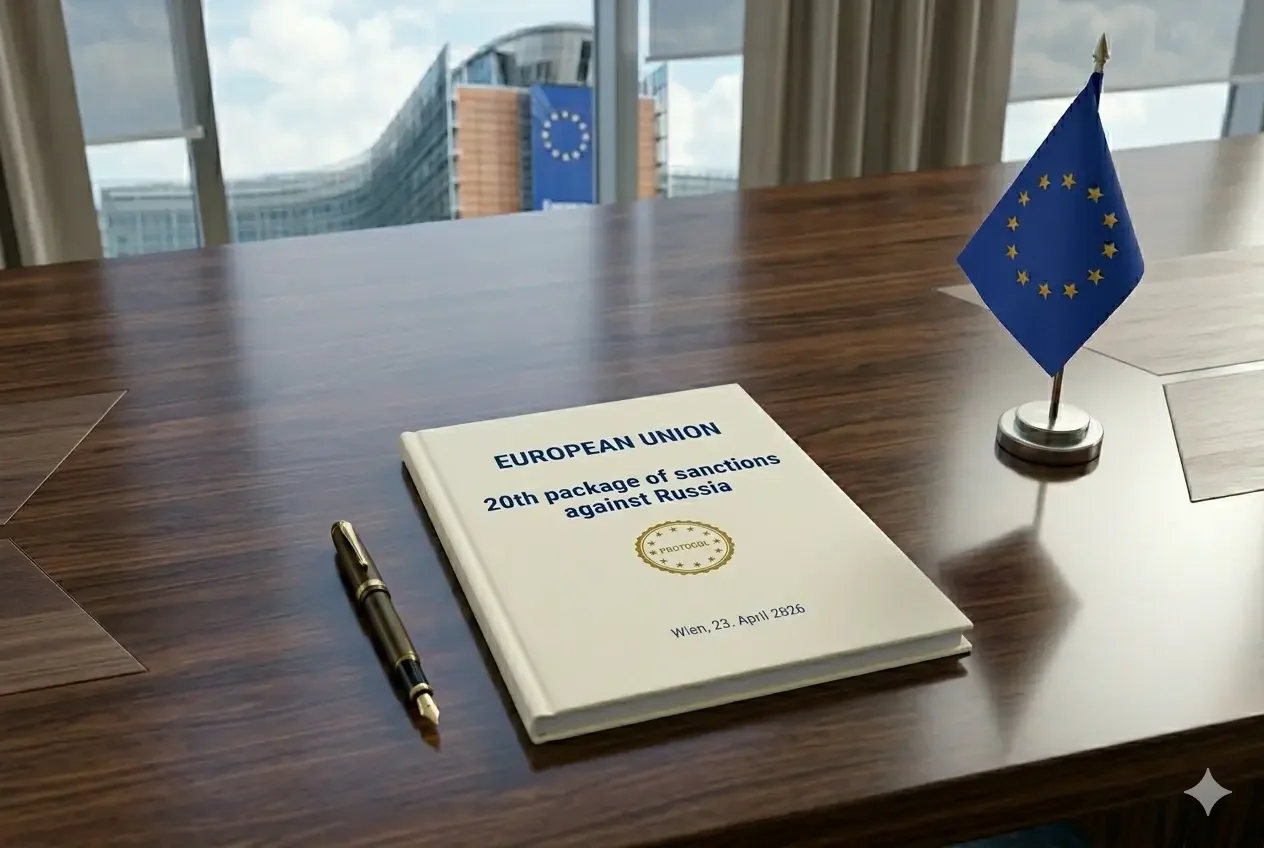
Image by AI/S&P
20th Sanctions Package Against Russia
The European Union finally adopted the 20th sanctions package against Russia this week (April 23), after Viktor Orbán and his Fidesz party lost the parliamentary elections to the opposition party Tisza in Hungary. Viktor Orbán originally vetoed the sanctions package in February, but the newly elected Prime Minister Péter Magyar chose to lift this veto shortly after his historic election victory. This political shift in Budapest marks the end of a long-standing diplomatic stalemate and enables EU member states to act in unity regarding sanctions policy against the Kremlin.
Throughout his second presidency, Donald Trump has exerted sustained pressure on European leaders to adopt a tougher stance toward Russia. Despite continuous political and rhetorical resistance from the EU against the American administration, the new sanctions package responds to Trump’s demands that Europe must take greater responsibility for its own security and reduce economic ties to rival superpowers.
This is also directly connected to the fact that the EU and the US on Friday concluded a memorandum of understanding on minerals cooperation, as well as an action plan aimed at a binding minerals agreement, read more here.
Extensive Sanctions Against Russia
The new sanctions package is comprehensive and specifically targets the import of critical minerals and the export of technological components necessary for weapons production. The EU has introduced new import bans on metals and critical minerals such as copper, nickel, and aluminum, valued at over 530 million euros, to strike at Russia’s export revenues. Simultaneously, the export ban is expanded to include advanced technological components, telecommunications equipment, and machine tools used directly in the Russian defense industry for the production of missiles and drones. The package also contains extensive measures against the Russian "shadow fleet" of tankers and introduces new restrictions on terminal services for liquefied natural gas starting in January 2027. Furthermore, the package includes a total ban on transactions with an additional 20 Russian banks and stricter restrictions on the use of crypto-assets to prevent sanctions evasion.
How China is Affected
China is directly affected by the new sanctions through the blacklisting of several Chinese companies and entities based both on the Chinese mainland and in Hong Kong. The European Union accuses these entities of supplying critical high-tech components, goods, and raw materials with dual-use potential that support the Russian military-industrial complex. By including these companies on the so-called sanctions list, they are prevented from purchasing sensitive European technology and participating in trade with operators from member states. This measure is intended to choke supply lines for civilian electronics and hardware that Russia converts for military use on the battlefield in Ukraine. Additionally, the sanctions hit logistics companies in third countries that contribute to Russia's export of energy resources through maritime services and insurance schemes.
China Warns the EU
The Chinese Ministry of Commerce issued an official statement yesterday evening condemning the decision to include Chinese entities and raw materials on the sanctions list. A spokesperson for the ministry stated that China expresses strong dissatisfaction and firm opposition to what they call unilateral sanctions and extraterritorial jurisdiction by the EU. Beijing claims that the EU's actions contradict the political consensus previously reached between leaders from both sides and warns that this undermines mutual trust and stability in the bilateral relationship.
The authorities in China demand that the Chinese companies be removed from the list immediately and simultaneously announce that they will implement all necessary measures to protect the legitimate interests of their businesses. Beijing explicitly warns that all negative consequences resulting from this sanctions policy will have to be borne by the European Union alone.
Escalating the Geopolitical Struggle for Military Power
The situation is further complicated by the above-mentioned agreements the US and the EU concluded on Friday. A minerals agreement between the US and the EU that could involve guaranteed price floors for minerals in a closed Western market is a direct attempt to break China's dominance in global supply chains. Beijing views this as a provocation, particularly as it signals a Western ambition of complete independence from Chinese raw materials for weapons production.
The sanctions in the 20th package must be seen in the context of this strategic shift, where the EU now chooses sides with the US to secure its own supply security in an era characterized by increasing military coercion. The rapid escalation with mutual sanctions illustrates how control over raw materials essential for modern defense systems now stands at the center of the global balance of power.
SOURCES
WIKBORG REIN
EU adopts its 20th package of sanctions against RussiaReuters
China condemns EU's inclusion of Chinese entities in sanctions package against RussiaEuropean Commission
EU adopts 20th package of sanctions against RussiaBloomberg
Beijing Warns EU After China Firms Included in Russia SanctionsOffice of the United States Trade Representative
Ambassador Jamieson Greer Announces United States-European Union Action Plan for Critical Minerals Supply Chain ResilienceXINHUA
China firmly opposes EU's Russia-related sanctions targeting Chinese firms
Content on Society and Politics is based on reliable sources and actual events, providing a news-oriented perspective intented for further debate. To access the article’s author and the related debate, membership on Hudd is required.