

US considers withdrawing troops from NATO countries
Donald Trump, Pete Hegseth and Marco Rubio say NATO has failed the United States in the war against Iran and signal that measures against NATO or individual member states are under consideration.
April 9, 2026 | INTERNATIONAL POLITICS
American Discontent with NATO
The US administration has repeatedly stated that a lack of support for the war in Iran will have consequences for NATO. Yesterday, NATO Secretary General Mark Rutte visited Washington, where he held meetings with Secretary of State Marco Rubio and President Donald Trump to discuss the situation. Despite an apparently amicable tone between those mentioned, the situation appears to be tense. Last night, Donald Trump published the following message on Truth Social;
NATO WASN’T THERE WHEN WE NEEDED THEM, AND THEY WON’T BE THERE IF WE NEED THEM AGAIN. REMEMBER GREENLAND, THAT BIG, POORLY RUN, PIECE OF ICE!!!
Punitive Measures Under Consideration by the US
One of the options being considered by the US administration is to withdraw NATO entirely from the United States. Legislation passed by Congress in 2024 prevents a US president from withdrawing the United States from NATO without a two-thirds majority. However, Trump has shown a willingness to bypass existing legislation on several occasions—for example, by striking Iran without obtaining approval from Congress as required by the War Powers Act of 1973.
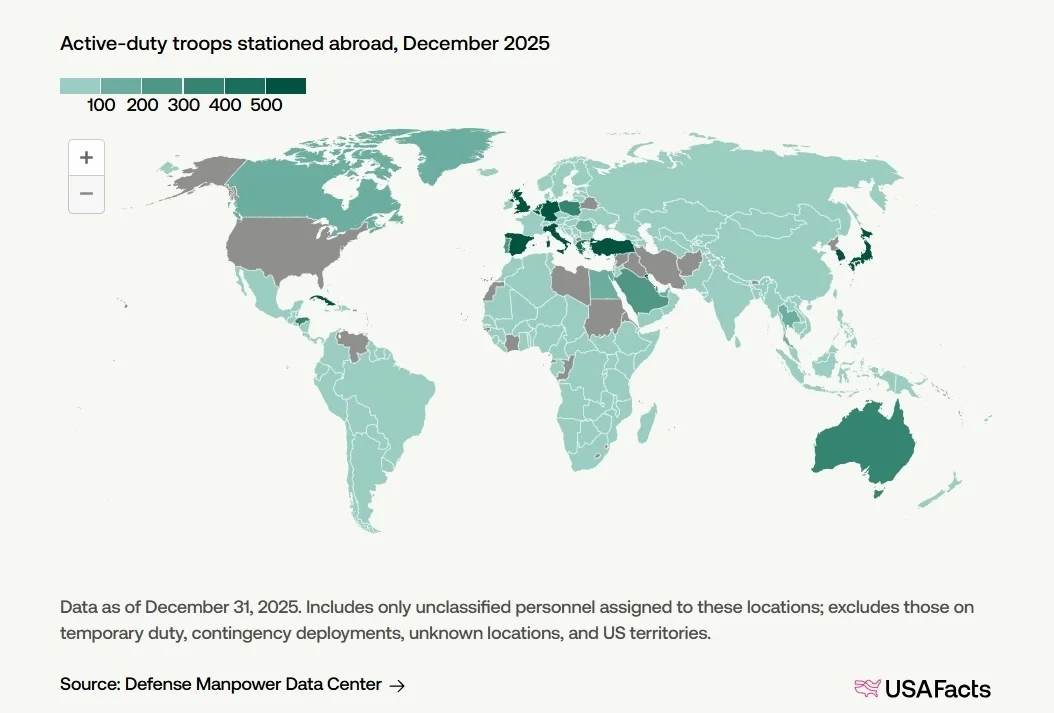
There are other options that would keep the US within Article 5 of the NATO treaty. One option under discussion is to withdraw US forces from countries that the United States believes are not supporting it in the war against Iran. At the top of the list is likely Spain, which has refused to allow the US to use air bases and airspace in the war against Iran; the US has a force of 3,800 in Spain. The United Kingdom may also be at risk, where the US has a force of 10,200. This would in turn have consequences for defense capabilities, as the US provides militarily advanced equipment and expertise that cannot be replaced.
Access to Critical Minerals and Rare Earths as a Key Factor
At the beginning of this year there was a crisis in NATO as a result of the Greenland conflict, but it subsided after the Munich Security Conference in February. This was because the EU (including Norway) gave commitments to the US on cooperation on critical minerals and rare earths, resources that are decisive both for ordinary industry and for the defence industry. This understanding was highlighted by NATO Secretary General Mark Rutte during the security conference. The EU (including Norway) halted mineral cooperation with the US early last year as a result of the trade war triggered by Donald Trump. Before that, memoranda of understanding had recently been concluded with the Biden administration. The Norwegian Prime Minister Jonas Gahr Store had even promised the US mineral supplies in his letter of congratulations to Donald Trump when the latter won the presidential election in November 2024.
The ongoing mineral negotiations remain difficult. One point of contention is that the US demands that minerals for car batteries be sourced from an allied country, while the EU depends on supplies from China. The US accuses the EU of not investing enough in Western mineral projects to enable Europe to reduce its dependence on China.
After the War in Iran, the US Controls Transport Routes in the Middle East
It may be difficult to see what the US has achieved with the war in Iran, but it has achieved something that is likely far more significant for both the US and the EU than is commonly perceived. After the war, Europe has no form of influence over the Middle East. This is highly concerning, as the fastest and cheapest transport route from China and Asia is now controlled 100 percent by the United States. When this is linked to Europe’s dependence on minerals from China for weapons production, it becomes serious. This is so significant for global power dynamics that it may have been the sole objective of the US administration in the war against Iran: to prevent Iran, through nuclear weapons, from controlling transport routes, and to secure US control. Furthermore, the US assesses that Europe has effectively removed itself from the equation by not contributing to the defense of transport routes on which it itself depends.
What the US Could Achieve by Withdrawing Troops from NATO Countries
Trump seeks to break up the EU and enter into bilateral defense and trade agreements with individual European countries. By withdrawing forces from certain NATO countries, other EU countries could be pushed closer to such agreements out of fear of Russia.
Of the 27 member states of the European Union, Ireland, Malta, Austria and Cyprus are not NATO members. Among European NATO countries, Albania, Iceland, Montenegro, North Macedonia, Norway, the United Kingdom and Turkey are not EU members. Among European countries that are neither EU nor NATO members are Switzerland, Moldova, Serbia, Belarus, Ukraine, Bosnia-Hercegovina and Kosovo.
It is also possible that Donald Trump, who has a strong interest in the Arctic, could place additional pressure on Norway, Iceland and the United Kingdom, which are not EU members. Greenland remains at risk even though many perceived that Trump “backed down on Greenland.” Greenland’s future may depend on the previously mentioned mineral negotiations. If the ongoing negotiations fail or are prolonged, Greenland will once again become a target—not because the US needs to extract minerals in Greenland, but to deny a non-cooperating Europe access to these mineral resources.
RELATED ARTICLES
The European Union moves into its next battle after the NATO crisis is put on hold
US won the minerals battle against Europe, NATO endures, and military security has been restored
Europe should listen to the Polish prime minister Donald Tusk regarding the threat from Russia
Greenland is the EU’s mineral lifeline amid China’s monopoly and US global deals
Scenario for a defenseless Europe if the United States withdraws from NATO
SOURCES
Truth Social
BBC
Trump criticises Nato as alliance chief describes meeting as 'very frank'Politico
Trump lashes NATO after ‘frank and open’ Rutte meetingThe Guardian
Nato chief says Trump ‘clearly disappointed’ by US allies’ refusal to join Iran warThe Washington Post
Trump Team Explores Punishment for NATO Countries That Didn’t Support Iran WarThe Independent
Trump rants ‘NATO wasn’t there’ as he reportedly weighs plans to punish allies unhelpful with Iran warNewsweek
Trump Floats Pulling US Troops From ‘Unhelpful’ NATO CountriesUSA Facts
Where are US troops stationed?Defense Manpower Data Center (DMDC)
DoD Personnel, Workforce Reports & PublicationsPolitico
Europe flails as US launches critical minerals land grabDiscovery Alert
EU-US Critical Minerals Cooperation: Strategic Talks Transform Trade RelationsThe Norwegian Government
Prime Minister Stores congratulation letter to Donald Trump
Content on Society and Politics is based on reliable sources and actual events, providing a news-oriented perspective intented for further debate. To access the article’s author and the related debate, membership on Hudd is required.