
EU and US near agreement that could end the conflict
This week, the US and the EU may strike a deal moving the parties closer to resolving the conflict, after increased US pressure this spring. A minerals agreement would end the conflict that has run since Donald Trump returned to office in January last year.
April 23, 2026 | SOURCES | INTERNATIONAL POLITICS
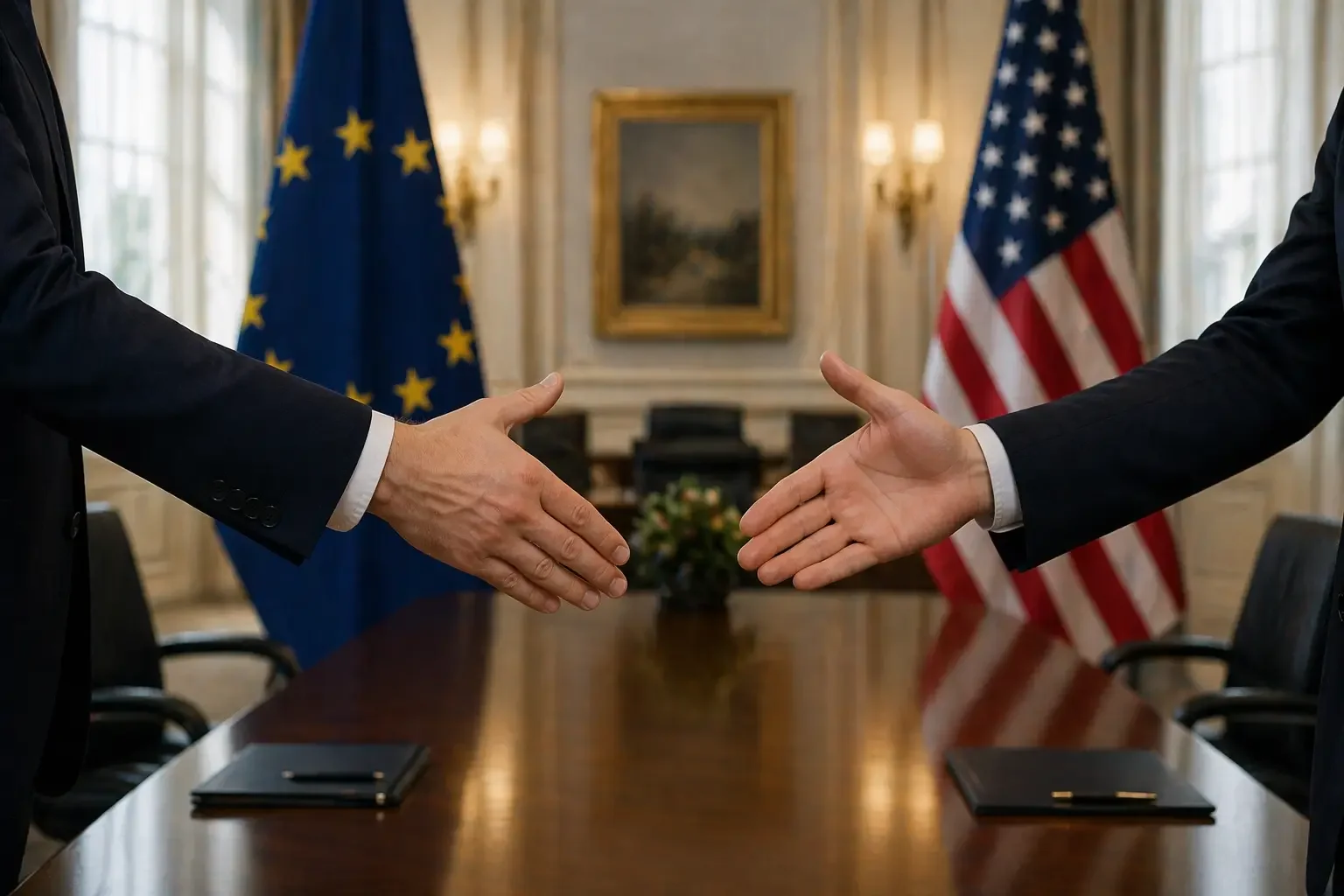
Image by AI/S&P
Negotiations between the EU and the United States
A two-day trade meeting between the US and the EU opened in Washington today. The delegations are led by US Commerce Secretary Howard Lutnick and EU Trade Commissioner Maroš Šefčovič respectively. The talks have been ongoing since the EU finally opened for negotiations on critical minerals through a commitment given on 4 February this year, when it was announced that a letter of intent would be signed within 30 days. The EU has still not signed the agreement.
The United States pressured the EU through Greenland threats
In an undiplomatic manner, the EU was pushed to the negotiating table as a result of Trump claiming that the United States needed Greenland for national security. The EU yielded to the pressure because of a severe shortage of minerals on the European continent, which constitutes a significant security risk. Over the past year, the United States has rapidly secured extensive mineral resources and built up larger reserves, while the EU lags far behind. The United States can now manage without the minerals in Greenland, which make up a substantial share of the EU’s total mineral deposits; the pressure lies in the US military capability to cut off access to these resources for the EU.
At the same time, Trump has repeatedly threatened to withdraw from NATO. During the Munich Security Conference in February, NATO Secretary General Mark Rutte stated that the parties had agreed on a framework for Greenland and the Arctic that defused the situation. The details and formalization of the agreement have taken time, but Trump is expected to maintain pressure on the EU until the final framework is in place. The agreements are crucial for continued cooperation between the EU, the United States, and NATO.
Increased pressure on the EU this spring
The war in Iran has increased pressure on the EU for several reasons. The United States now controls key transport routes for raw materials to Europe through the Strait of Hormuz and the Suez Canal. At the same time, the United States is in the process of establishing a drone base in Morocco, giving it potential control over traffic in the Strait of Gibraltar. This means that the United States has positioned itself to cut off mineral supplies from China to European weapons production. The Spanish prime minister’s opposition to Trump and alignment with China has contributed to additional pressure on the EU; read more here.
Furthermore, the war in Iran has led the United States to use nearly half of its air arsenal. This may explain why Donald Trump stated yesterday that the ceasefire will continue, even without a formal agreement with Iran. At the same time, the war represents a weakening of the United States’ own defense capabilities. This is negative for the EU, which depends on American weapons in the war in Ukraine. Both the US ability and willingness to contribute militarily may be further reduced, increasing pressure on the EU. Europe has very limited capacity to defend itself against Russia and has, despite significant efforts, not succeeded in pushing Russia back from occupied areas in Ukraine.
Nevertheless, it is even more significant that the United States has established legal mechanisms to maintain pressure on the EU over a long period, possibly permanently, by defining 60 critical minerals as a matter of national security and granting the president authority to impose tariffs. In the worst case, this could lead to the United States taking action against Norway to restrict energy supplies to Europe and secure Norwegian minerals.
The EU’s alternative
Due to the lack of critical minerals in Europe, the EU in practice has no alternative to an agreement with the United States, unless the union chooses to align itself with China.
SOURCES
European Commission
Joint press statement among the European Commission, the United States Government, and the Japanese Government following February 4 Critical Minerals Ministerial meetingBloomberg
EU, US Near Critical Minerals Deal to Combat Chinese ControlFinancial Times
US trade chief urges allies to pay more for critical mineralsReuters
EU and US near critical minerals deal to combat Chinese control, Bloomberg News reportsEU Debates, News & Opinion
The US’s critical mineral offensive strategy: how can Europe step up?The Strategist
EU and US critical-minerals strategies: same goal, different methodsManara Magazine
America’s Suez Canal ConundrumHESPRESS
Morocco US defence roadmap expands into industry and technology, analysts sayU.S. Energy Information Administration
World Oil Transit ChokepointsCSIS
Last Rounds? Status of Key Munitions at the Iran War CeasefireJust News
Trump upends China's lucrative sanctioned oil import scheme after Iran, Venezuela interventionsFrance24
US firms voice 'concern' over China's new supply chain rules
Content on Society and Politics is based on reliable sources and actual events, providing a news-oriented perspective intented for further debate. To access the article’s author and the related debate, membership on Hudd is required.