

Europe Approaches a Long-Forewarned Turning Point
Europe is unable to position itself between the great powers. The United States demands military loyalty, China controls raw materials, while Brussels is steering in a direction where Russia emerges as the main winner.
April 1, 2026 | INTERNATIONAL POLITICS
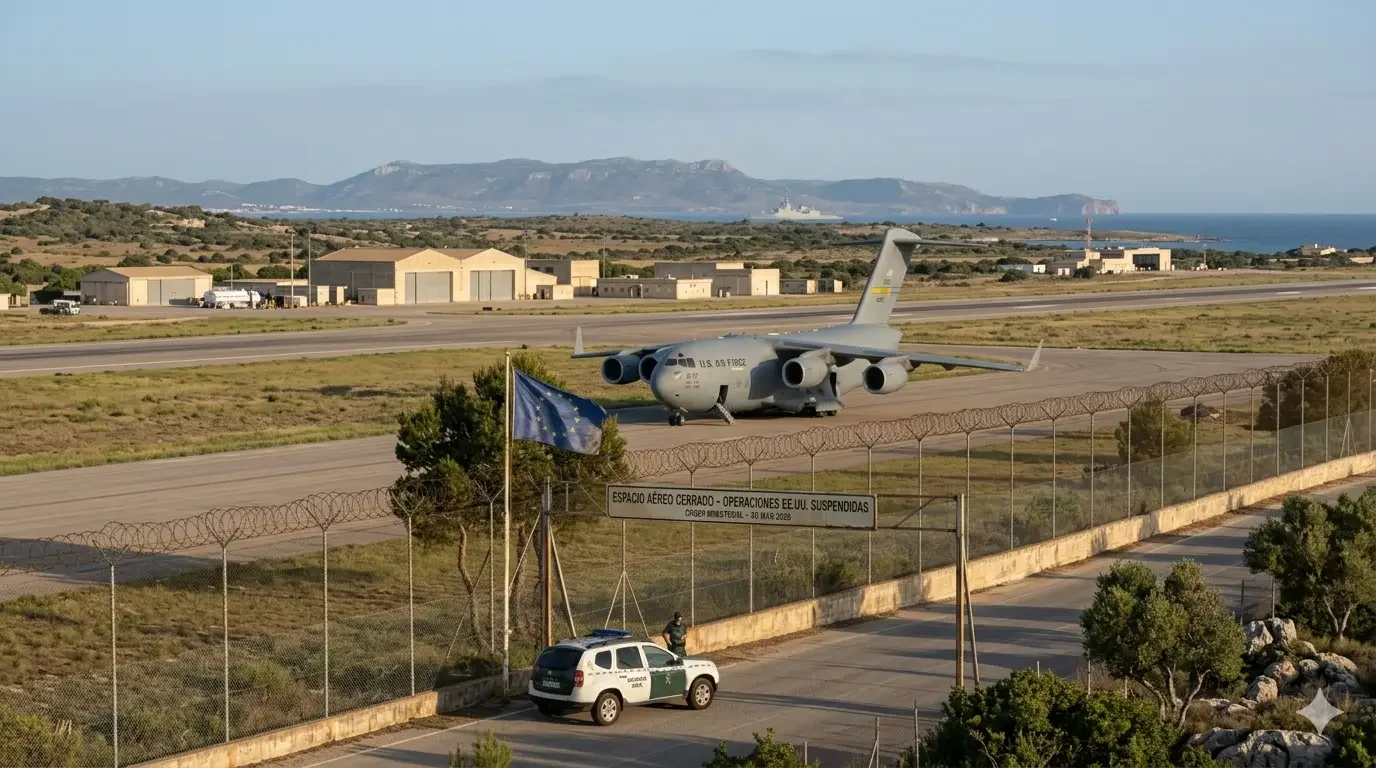
Image by AI/S&P
Europe One Step Back
The war against Iran has triggered a geopolitical earthquake whose long-term consequences Europe and Brussels may not fully grasp. Since the first attack on 27 February, Europe has refrained from supporting the United States and Israel in the war; this appears to be due both to principled considerations and to fear of becoming involved.
On the other side of the Atlantic, the American administration believes that European leaders are failing to recognize the threat posed by Iran and China controlling large parts of the world’s natural resources. The United States considers this a threat the Western world has not addressed, and has therefore invaded Iran before the regime develops nuclear capability that would give it control over transport routes in the Middle East.
It is primarily other countries in the Middle East, Israel, and Europe that depend on transport routes through the Strait of Hormuz and the Suez Canal. The United States is using this leverage against Europe to press for loyalty, but has not succeeded. As a result, the NATO crisis that dominated the beginning of this year, following the Greenland conflict, has been reactivated.
S&P has anticipated this situation for Europe and has published a number of articles on the subject over the past year. Some of them are listed at the end.
Europe blocks the United States
While Washington demands military coordination, it is met with a coordinated European rejection that is shaking the foundations of NATO. Prime Minister Pedro Sánchez has led the way by denying the United States access to the strategically critical bases at Rota and Morón, but the resistance runs deeper than that. Across the continent, we are now seeing a “silent blockade,” in which several EU countries have closed their military airfields to sorties directed at Iran.
Two days ago, Spain declared that Spanish airspace is also closed to American military aircraft operating in the war against Iran—a decision that has the tacit support of other European leaders who fear uncontrolled escalation. By cutting vital air bridges, the Pentagon is forced into costly detours. The American administration interprets this as a breach of the NATO agreement, prompting President Donald Trump, Defense Secretary Pete Hegseth, and Secretary of State Marco Rubio to state that this will have consequences for NATO.
Energy crisis as a result of the closure of the Strait of Hormuz
Europe is facing an acute supply crisis after Iran blocked the Strait of Hormuz to all Western shipping. Twenty percent of the world’s daily oil supply, as well as critical liquefied natural gas (LNG) from Qatar, is trapped by Iran’s blockade. European leaders have rejected U.S. demands for a joint military operation to reopen the sea route, despite persistent efforts by NATO Secretary General Mark Rutte. This strategic reluctance has pushed oil prices above $125 per barrel and created a real risk that European fuel reserves could be depleted within a few months. Brussels does not appear to understand the consequences of this paralysis and insists on diplomatic channels that seem ineffective, while European industry faces a looming production halt.
A Europe without industry and defense
The strategy from Brussels, or lack thereof, lacks both military and resource realism. Europe depends on critical minerals and rare earth elements from China to keep its own defense industry operational, a vulnerability that is reinforced by the growing rupture with Washington.
At the same time, the balance of power in the Middle East has fundamentally shifted; Israel has consolidated control over the region’s key logistical hubs and intelligence networks. Without a functioning alliance with the United States, Europe risks ending up as a geopolitical bystander, cut off from necessary raw materials and without influence over the transport routes that ensure the continent’s survival.
The American security strategy
The consequences of resource scarcity are described in the American security strategy that Donald Trump launched in November last year. The document marks a fundamental shift from collective NATO guarantees to a transactional model in which military protection is strictly conditioned on bilateral loyalty and support for core U.S. interests.
By blocking American operations and refusing military participation in the Middle East, the EU has in practice disqualified itself from Washington’s new security hierarchy. The United States supports only allies that align with American priorities, leaving Europe, with few exceptions, outside the American security umbrella. Europe is caught in an unrealistic neutrality between China and the United States that cannot coexist with the current American administration.
Russian comeback
It is currently unclear whether a coherent European strategy exists at all, or whether the Union has been reduced to a reactive actor. The crisis will initially affect Europe’s access to oil, but the long-term consequences are more extensive. By rejecting Washington’s demands to become independent of Beijing, Europe has entrenched an unpredictable future dependence on Chinese raw materials for its industry and defense sector.
If the United States chooses to intervene against maritime supply lines from Asia to force European loyalty, an insoluble strategic dilemma will arise. If sea routes are blocked, the EU may be forced into a security-politically untenable cooperation with Russia to secure supplies via land-based transport corridors through Eurasia. Europe thus risks being trapped in a choice between American security guarantees and Russian-Chinese control of resources.
Europe’s future may be bleak
Both European sovereignty and democracy are at risk; some countries may leave the EU and choose the United States over the threat represented by Russia. Even if the United States ends the war against Iran and the energy situation stabilizes, Europe no longer has influence over the United States, Israel, the Middle East, or the transport routes from Iran and China. This is highly problematic.
At present, Europe itself does not appear to have a solution to this situation; a possible solution may therefore lie in the U.S. midterm elections in November. If Republicans lose seats in Congress to the Democrats, American foreign policy could shift in Europe’s favor. But much can happen in geopolitics before November.
RELATED ARTICLES
Two thoughts on the US attack on Iran – Dislike Trump’s methods, support a positive outcome
US and Europe still on the back foot after Rubio’s speech in Munich
Europe should listen to the Polish prime minister Donald Tusk regarding the threat from Russia
Stoltenberg backs Rutte: We must not create illusions about what Europe can achieve alone
Greenland is the EU’s mineral lifeline amid China’s monopoly and US global deals
Scenario for a defenseless Europe if the United States withdraws from NATO
The United States is asserting the right of the strongest against a Europe that refuses to yield
The EU runs out of minerals for weapons after only four months
The trade war is driven by the need to control critical minerals to maintain a strong defense
SOURCES
The Guardian
Spain closes airspace to US military over Iran war, widening rift with USAS USA
Spain denies the U.S. use of its bases for the war in IranModern Diplomacy
Spain Closes Its Airspace to US Military Aircraft Involved in Conflict with IranEuropean Council on Foreign Relations (ECFR)
Beijing hold’em: European cards against Chinese coercionChina Observers Central (CHOICE)
How China Uses Critical Materials to Divide the Transatlantic AllianceForeign Policy Research Institute (FPRI)
The New NSS: Transactional Realism and the Future of NATOFactCheck.org
The Impact of the Iranian Blockade on Global Energy MarketsEnergy Intelligence
Strait of Hormuz Closure: Oil Markets React as Brent Hits $126
Content on Society and Politics is based on reliable sources and actual events, providing a news-oriented perspective intented for further debate. To access the article’s author and the related debate, membership on Hudd is required.