

Two thoughts - dislike Trump’s methods, work for positive outcome
The UN condemns the military conflict between US, Israel, and Iran. Yet the conflict offers an opportunity of liberation for the Iranian people—an opportunity citizens, authorities, and politicians in the Western world are unwilling to acknowledge.
March 1, 2026 | INTERNATIONAL POLITICS
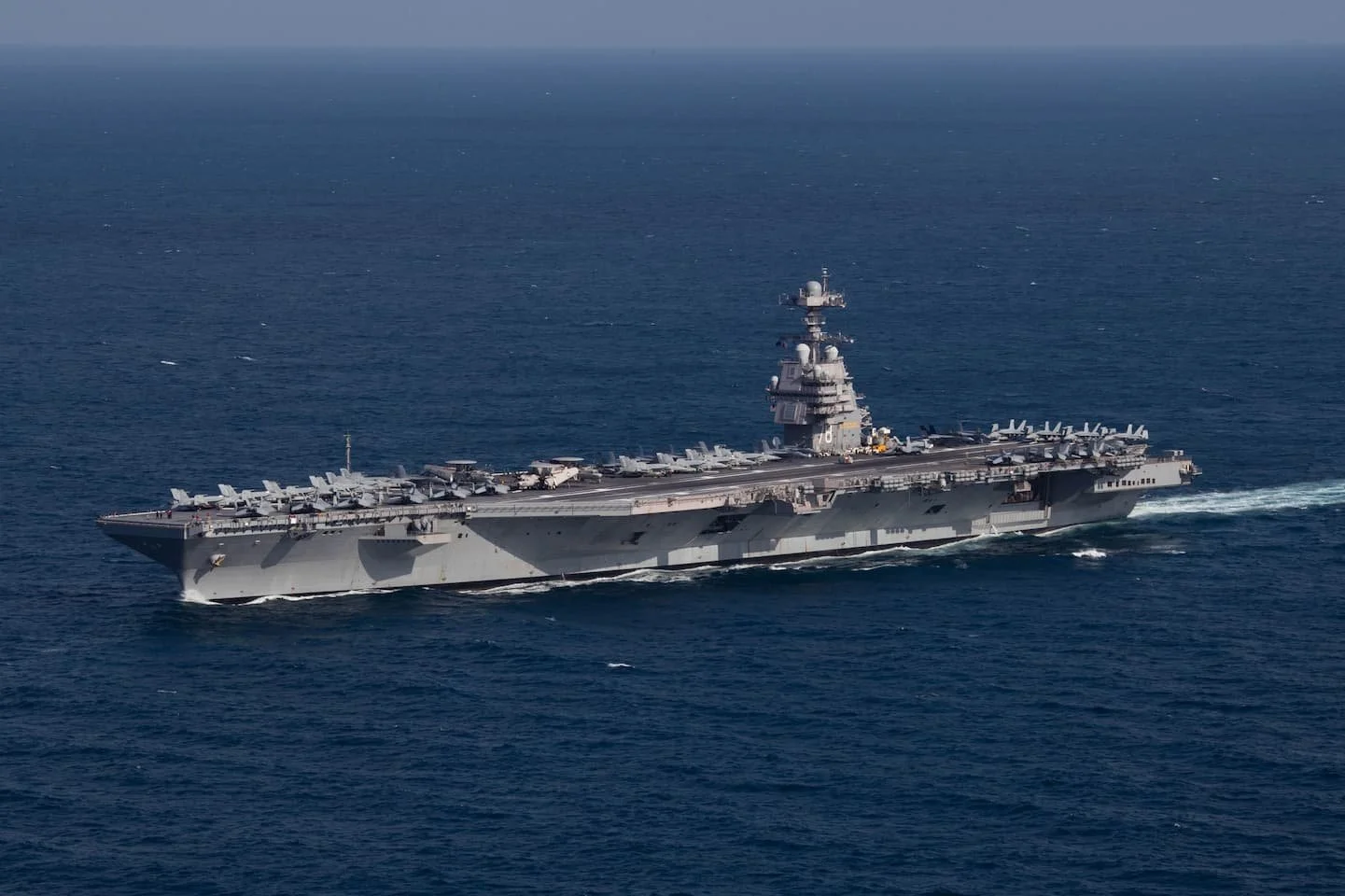
Photo: U.S. Navy/Wikimedia Commons (Public Domain)
US/Israel attach on Iran
The United States and Israel attacked Iran on Friday. The Secretary-General of the United Nations (UN), Antonio Guterres, announced the following yesterday:
"I condemn today’s military escalation in the Middle East. The use of force by the United States and Israel against Iran, and the subsequent retaliation by Iran across the region, undermine international peace and security.
All Member States must respect their obligations under international law, including the Charter of the United Nations. The Charter clearly prohibits “the threat of the use of force against the territorial integrity or political independence of any state, or in any other manner inconsistent with the Purposes of the United Nations.”
See the full statement in the link below.
The U.S. Ambassador Mike Waltz’s statement to the UN Security Council on Saturday evening:
”Iran’s continued pursuit of advanced missile capabilities, coupled with its refusal to abandon nuclear ambitions despite diplomatic opportunities, presents a grave and mounting danger. The international community has long affirmed a simple and necessary principle: Iran cannot have a nuclear weapon. That principle is not a matter of politics; it is a matter of global security. And to that end, the United States is taking lawful actions.”
Waltz then refers to relevant resolutions, as well as chapters of the UN Charter which the U.S. believes provide legal justification. See the full statement in the link below.
Society and Politics notes that there are divided opinions regarding the legality of the attack but does not discuss its legality. Beyond the condemnation issued by the UN toward the United States, Israel, and Iran, it is up to the United Nations to investigate, determine, and potentially implement political measures or sanctions against the aforementioned parties.
The Iranian Revolution
It has been 47 years since the Iranian Revolution of 1979. The revolution led to the overthrow of Shah Mohammad Reza Pahlavi following widespread protests. He was replaced by an Islamic government led by Ayatollah Ruhollah Khomeini. The revolution ended the monarchy and established the Islamic Republic of Iran, with a political system based on religious authority. This changed both Iran’s domestic politics and its relationship with the West.
The Iranian people’s struggle for freedom has continued for decades and includes protests against political repression, lack of democracy, and restrictions on civil rights. Students, workers, and women have played central roles, particularly during the protests in 1999, 2009, and 2022. Authorities have responded with arrests, violence, and killings of demonstrators. Thousands of people have been killed by the regime during January and February 2026.
Controversial American attacks
Many compare the attack on Iran with the Gulf War (1990–1991), the Iraq War (2003–2011), and the Afghanistan War (2001–2021). Kuwait has fared better than Iraq and Afghanistan following these wars: Kuwait has experienced economic growth and remains politically stable; Iraq has experienced economic and some political progress without achieving stability after Saddam Hussein’s dictatorial rule; Afghanistan is back under Taliban dictatorship.
The United States had allies when it led the aforementioned wars. In this attack on Iran, Israel is an ally, and more countries may follow. Iran has responded by attacking targets in Bahrain, Iraq, Jordan, Kuwait, Qatar, Saudi Arabia, and the United Arab Emirates in addition to Israel. An escalation of the war appears possible; nevertheless, it is important to note that the United States has not invaded the country with ground forces on this occasion.
Motivation and outcome
Democracy in itself is unlikely to be the motivation for the war, but rather regime change to ensure that Iran 1) does not support and finance terrorist organizations, 2) does not develop nuclear weapons, and 3) does not control energy and transport routes as a consequence of points 1 and 2. It can be debated which comes first, as energy equates to power, but it ultimately makes little difference, as the three are interconnected in the case of Iran.
Power creates the ability to oppress or to liberate. There is hope that the attack by the United States and Israel can bring liberation, and to reject that hope is merciless on behalf of the Iranian people. Unfortunately, citizens, authorities, and politicians in the Western world are setting aside the human rights of the Iranian population out of fear that Donald Trump may succeed. If the outcome were that human rights are restored in Iran after 47 years, these individuals would have misjudged Trump in their interpretations and underestimated him — the narrative they constructed portraying him as an authoritarian and undemocratic leader would collapse. There is a possibility that Democrats in the United States and elsewhere in the world may have been mistaken in their assessment of Trump; that would offer hope both for the people of Iran and for the balance of power in a new world order.
Society and Politics urges all Western nations to actively contribute to the liberation of Iran, even if they do not approve of Trump’s method. This is an opportunity to restore human rights in Iran after 47 years, contributing is an obligation that all democracies have.
For the record, Society and Politics states that its articles are written from a libertarian, not conservative and not socialist, standpoint. S&P calls for realism in contemporary politics and journalism.
SOURCES
United Nations
Emergency meeting of the Security Council on IranUnited Nations
Statement by the Secretary-General on IranX (Antonio Guterres)
Antonio Guterres condemns military escalation in the Middle EastUnited States Mission to the United Nations
Remarks by Mike Waltz at an emergency UN Security Council briefing on IranYouTube/C-SPAN
US Ambassador Mike Waltz speech to the UN Security Council on Iran attackBritannica
Iranian RevolutionThe Washington Post
Iran's killing of protesters reached levels rarely seenUnited Nations (OHCHR)
UN experts demand transparency and accountability following protests in Iran
Content on Society and Politics is based on reliable sources and actual events, providing a news-oriented perspective intented for further debate. To access the article’s author and the related debate, membership on Hudd is required.
