

Trump’s Peace Committee could be decisive for Europe
Trump’s new peace board could create further division. While Europe faces demanding and decisive decisions, the solution may lie in a bilateral agreement on minerals and defense. This could be the opportunity for Norway to lead Europe through the crisis.
January 20, 2026 | INTERNATIONAL POLITICS
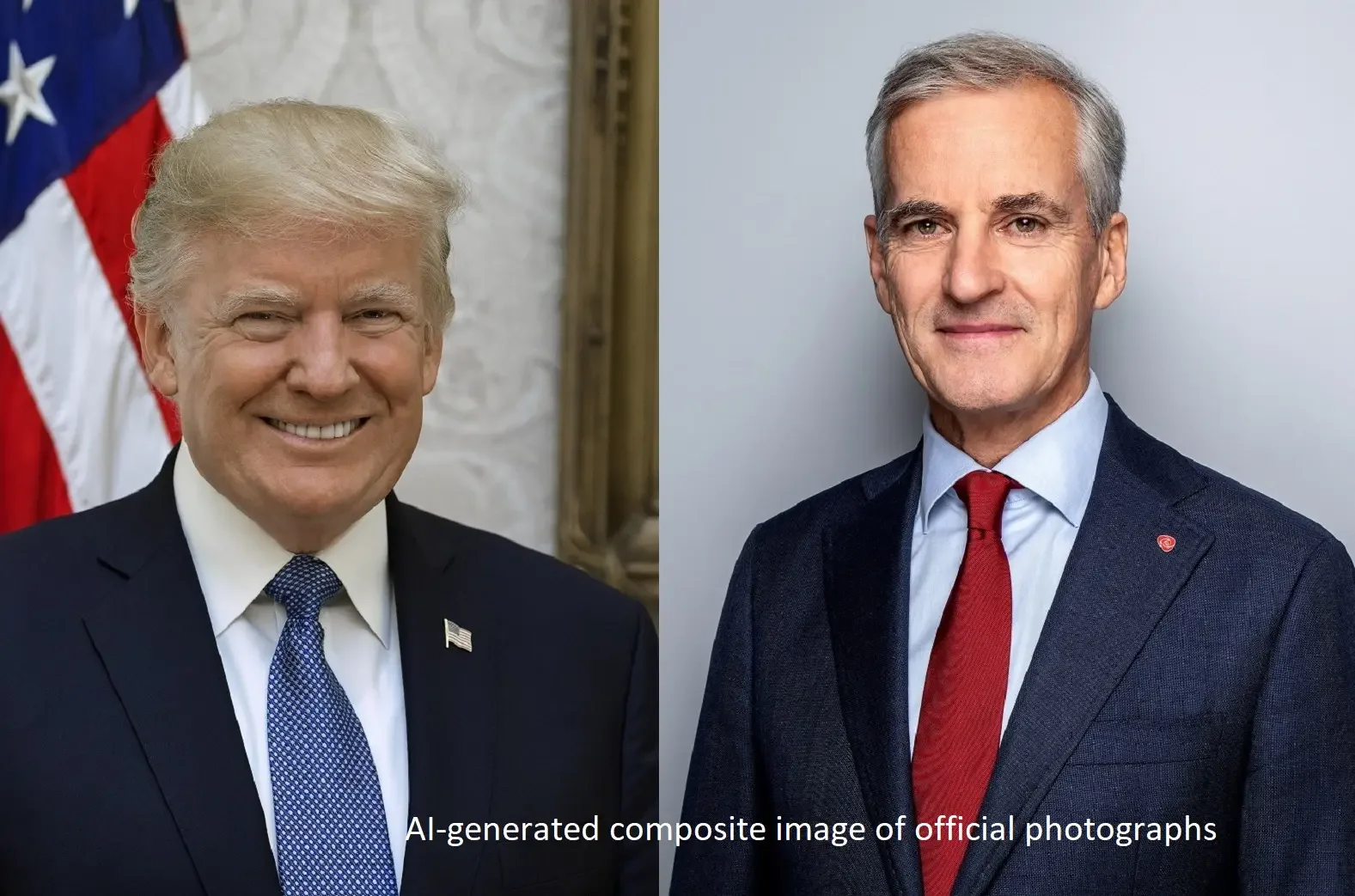
Official photographs Jonas Gahr Store and Donald Trump
National Committee for the Administration of Gaza
The U.S. President has established the National Committee for the Administration of Gaza (NCAG). According to information from the White House, the committee is to implement phase two of the peace plan for Gaza and lasting peace, stability, reconstruction, and prosperity in the region.
Some media outlets refer to the committee as a "Board of Peace."
The committee is led by Donald Trump and includes the following members: Secretary Marco Rubio, Steve Witkoff, Jared Kushner, Sir Tony Blair, Marc Rowan, Ajay Banga, and Robert Gabriel.
According to Al Jazeera, the committee will feature a third tier consisting of heads of state from invited countries. Various media reports indicate that invited countries include Egypt, Turkey, Jordan, Argentina, Canada, Morocco, France, Russia, Slovenia, Thailand, Vietnam, Hungary, Kazakhstan, Belarus, and the European Commission.
Other media outlets report that the entry fee for participation is 1 billion dollars.
Donald Trump's "Board of Peace" may prove to be the organization that formalizes the new world order as we have seen it develop since he was reinstated as president in one year ago today.
Sceptical heads of state
It will be diplomatically intricate to decline a peace initiative from the most powerful leader in the Western Hemisphere. A rejection will be interpreted as a dismissal. Consequently, several countries will choose to participate for strategic reasons.
According to the BBC, Israeli Prime Minister Benjamin Netanyahu’s office has stated that the committee is not coordinated with Israel and works against its policies.
European leaders find themselves in a very difficult situation as Trump wishes to split the EU. One of the tactics Trump uses is to negotiate individually with EU countries; some of them may leave the EU, read more about this here. The formation of the peace council could be the decisive piece in the power play. There could be four possible outcomes of this:
The EU fractures, and individual countries enter into bilateral defense and trade agreements with Trump to secure themselves against Russia. The countries remaining in the European Union could then face a war with Russia that they lack the military strength to win, read more here. Russia has China on its side.
If the EU manages to hold together, they face a major challenge. The U.S. will most likely take control of Greenland and Norway, leading to the EU losing control over the mineral resources. The EU's only option then becomes turning to China for closer cooperation as the EU is entirely dependent on external mineral supplies, read more here. And even then, if the EU has a solid and reliable agreement for mineral supplies for weapon production, these supplies could be cut off by the U.S. or its allies. The EU cannot win a war; believing so is the greatest and most dangerous misconception existing in the European sphere today, read more here. The result could be that Europe is divided between the U.S. or Russia.
The EU pivots and joins Trump's visions for the Western Hemisphere and enters into a bilateral mineral and weapons agreement, read more about the U.S. strategy here.
The U.S. Congress and the American people come together and topple Trump. Actions have been announced across the U.S. today. It is possible to topple Trump.
Norway has a central but unknown role
According to several Norwegian media outlets, Norway's Prime Minister Jonas Gahr Store has also received an invitation, but has not yet decided whether to attend.
In connection with the ongoing Greenland crisis, Store and Finland's President Alexander Stubb sent a message to Trump on Sunday to calm the situation. Trump replied to Støre with the following message: "Considering your Country decided not to give me the Nobel Peace Prize for having stopped 8 Wars PLUS, I no longer feel an obligation to think purely of Peace.".
President Trump probably has a long list of unresolved issues with Prime Minister Store. The US has defined 60 critical minerals as a matter of national security, and Norwegian minerals play a central role. Back in November 2024, Støre made a commitment to Trump in the letter of congratulation after the latter won the presidential election. There Støre writes, among other things:
“Being one of the largest suppliers of critical minerals to the U.S, with the largest-proven deposit of rare earths elements in Europe, Norway is committed to deliver sustainable and secure chains for advanced US manufacturing.”
However, in March 2025, the government published a press release stating they are working to implement the European Unions's Critical Raw Materials Act (CRMA) into Norwegian law. Furthermore, the promise from the congratulatory letter was not followed up via a trade agreement with the U.S.; Norway is one of the few countries that still has not entered into an agreement after the U.S. imposed tariffs in April 2025.
Donald Trump is likely not satisfied with the Norwegian Prime Minister and how he has handled the relationship with the U.S. Read about more situations, including the Nobel Peace Prize dispute, here.
Jonas Gahr Store can lead Norway and Europe into safety
Norway is not an EU member and stands more freely than EU countries. Since the U.S. has not required any of its defense and trade allies to change their form of government (away from democracy), Norway should enter into a defense and trade agreement with Trump to secure the country against Russia. Such an agreement should have been concluded by the deadline for tariff negotiations that expired on July 31 last year, but it is still possible.
A few days ago, on 16 January, Trump signed a presidential order (Proclamation 11001) directing the administration to negotiate mineral agreements and price floors for the mineral industry with allied countries.
It would also be strategic in relation to the EU to have a mineral-rich country on the continent that is not occupied by Russia. Ukraine is known to be mineral-rich, but many of the resources are in Russian-occupied areas, and the U.S. has secured half of the resources through an agreement.
A more long-term strategic approach to the situation, from both the EU and Norway’s side, would lead further than the short-term strategy pursued so far. New elections will come in the U.S., and although conservatism in the U.S. will persist and Europe is turning in the same direction, the situation could normalize again. Jonas Gahr Støre likely has his last opportunity to change strategy; provided he demonstrates the necessary statesmanship, he can potentially lead both Norway and Europe into safety.
What should the U.S. and Trump do?
Ensure that Venezuela becomes democratic. Go no further with Greenland than liberating them from Denmark, let democracy persist, and enter into a mineral and defense agreement with them. Offer the EU a bilateral mineral and defense agreement.
This article is written as information for the present and documentation for posterity.
SOURCES
BBC
Israel pushes back on Trump’s picks for executives on the Peace BoardThe White House
Comprehensive plan to end the Gaza conflictAP News
Trump’s Board of Peace includes several invited leadersThe Hill
Trump puts a $1 billion price tag on permanent seats on the Gaza Peace BoardTime
Trump says there is no need “to think purely of peace” in letter to NorwayRegjeringen
The government will incorporate the EU’s rules on critical raw materials into the EEA Agreement
Content on Society and Politics is based on reliable sources and actual events, providing a news-oriented perspective intented for further debate. To access the article’s author and the related debate, membership on Hudd is required.
