

Trump’s Peace Board begins work amid allied caution
Representatives from multiple regions gather in Washington for the first session of a new Gaza administration body amid questions about its role alongside the United Nations.
February 19, 2026 | INTERNATIONAL POLITICS
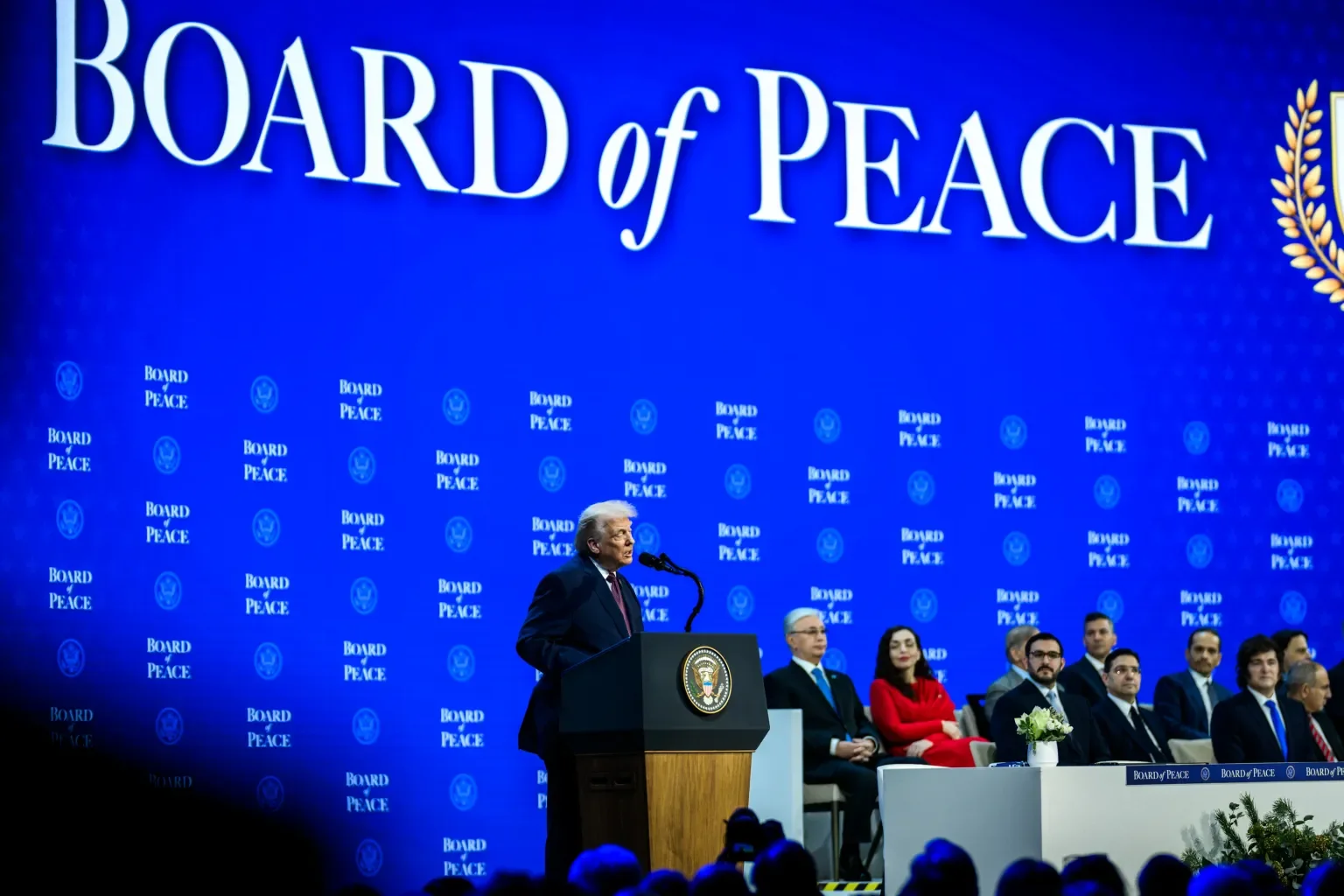
Photo: Official White House Photo by Daniel Torok
First meeting in Washington
The first meeting of Donald Trump’s Peace Board takes place today in Washington. The structure of the initiative has created some confusion, as it consists of both a governing body and a later reorganization of an existing institution.
The National Committee for the Administration of Gaza (NCAG) was established on January 16 with its own administrative structure. The former U.S. Institute of Peace was recently reorganized and renamed the Donald J. Trump Institute of Peace, and the committee will hold its first meeting there.
More than 60 countries were invited to participate, but many — particularly in Europe — declined amid doubts about the president’s intentions. There has also been speculation that the administration seeks to sideline the United Nations, and the council is widely viewed as a potential challenger to the UN framework. The European Commission and a small number of countries are attending the meeting as observers.
Peace initiative
The initiative is politically significant for the U.S. president, who has repeatedly presented the project as part of a broader Middle East peace effort and linked it to ambitions of international recognition, including discussion surrounding a possible Nobel Peace Prize. Trump has argued he should have received the prize last year, saying he mediated peace in several conflicts, including a ceasefire between Israel and Gaza announced the same week the Nobel Prize was revealed in October. Venezuelan opposition politician María Corina Machado, who received the award, later handed the medal to Trump.
The meeting is intended to launch the governance and stabilization framework proposed for Gaza following the war. The committee is expected to coordinate security arrangements, humanitarian distribution and long-term reconstruction planning. More than $5 billion has been pledged for Gaza reconstruction and humanitarian needs.
Meets scepticism
The project is met with considerable skepticism. Expectations for the Washington meeting remain limited, and in the Middle East the 100-day peace and recovery plan has largely stalled while humanitarian aid into Gaza continues at a slow pace. Analysts note that key questions remain unresolved — including who will govern the territory, who will provide security on the ground and how the immediate needs of the Palestinian population will be addressed — with no clear indication the board can break the deadlock in negotiations between Israel and Hamas.
List of participants
Participants include representatives from multiple regions:
Middle East
Egyptian Prime Minister Mostafa Madbouly, Turkish Foreign Minister Hakan Fidan, Israeli Foreign Minister Gideon Sa’ar
Asia
Cambodian Prime Minister Hun Manet, Indonesian President Prabowo Subianto, Kazakh President Kassym-Jomart Tokayev, Pakistani Prime Minister Shehbaz Sharif, Uzbek President Shavkat Mirziyoyev, Vietnamese Communist Party General Secretary Tô Lâm
Europe
Albanian Prime Minister Edi Rama, Hungarian Prime Minister Viktor Orbán, Kosovan President Vjosa Osmani
South America
Argentine President Javier Milei
Observers
European Commission, Italy, Greece, Romania, Cyprus, Norway (possible more).
RELATED ARTICLES
SOURCES
The Washington Post
Trump’s Board of Peace to meet as Gaza stability plan languishesEuronews
Commissioner Šuica to represent the EU at Trump’s Board of Peace meeting in WashingtonEU News
Gaza: EU Commission joins Trump’s Board of Peace as observerBBC
Venezuelan Nobel Peace Prize winner presents her medal to Trump
Content on Society and Politics is based on reliable sources and actual events, providing a news-oriented perspective intented for further debate. To access the article’s author and the related debate, membership on Hudd is required.
