

Trade agreement concluded between the US and the EU
The American president has negotiated a 15% one-way tariff on goods from the EU. Let us take a closer look at why the EU had to accept this and how it affects Norwegian security.
July 28, 2025
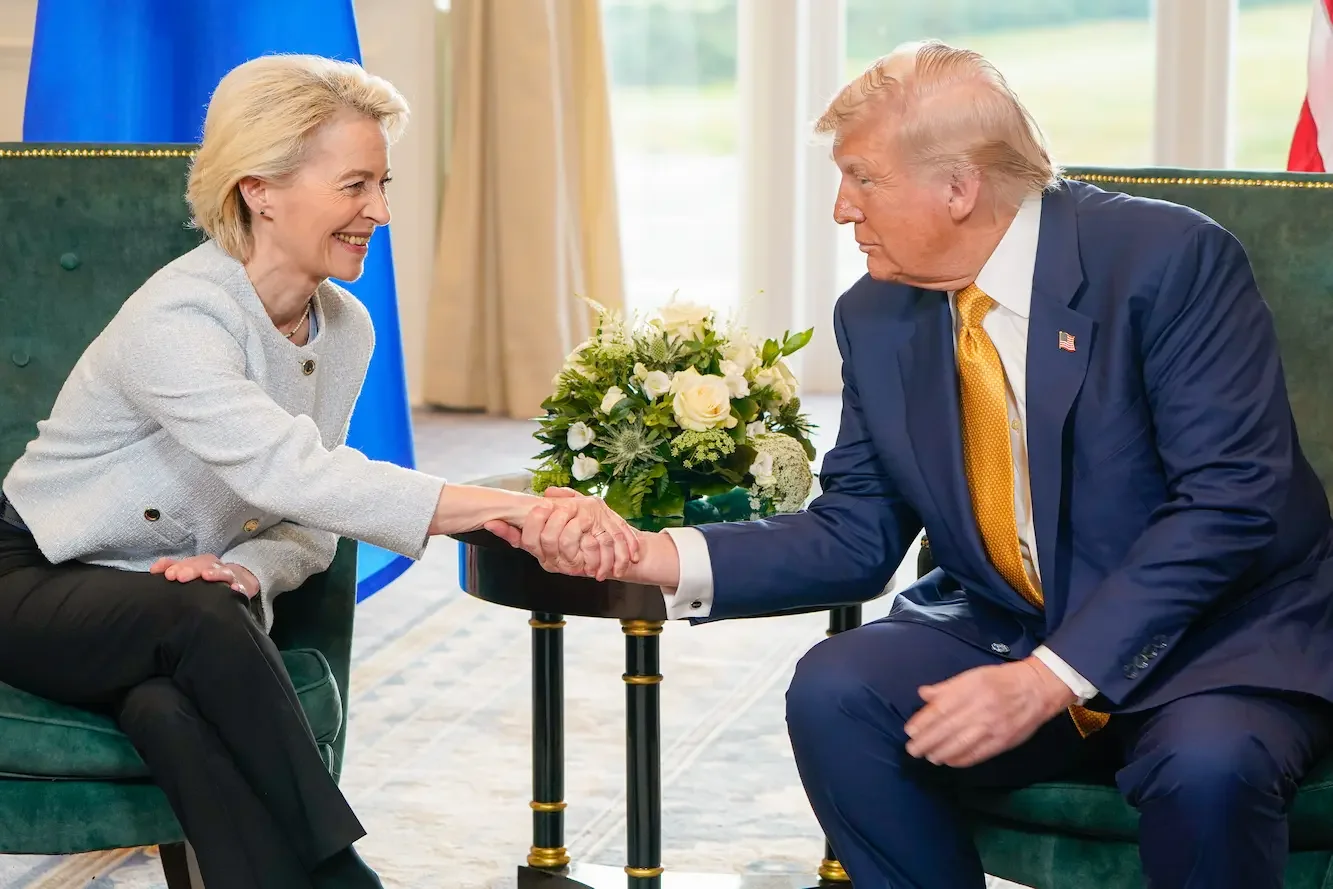
Ursula von der Leyen and Donald Trump, Photo: EU, 2025 / EC – Audiovisual Service (CC BY 4.0)
Background and framework for the agreement
Even before Donald Trump was inaugurated as president for the second time in January this year, there were signals that he would pursue a more protectionist policy in favor of American interests. On what Trump called "Liberation Day" on 2 April, the administration presented global tariff rates. The EU was notified of a tariff rate of 20%, while Norway was given 15%. The US justifies the tariffs by pointing to trade deficits. It is correct that the US has a substantial trade deficit with the EU, while in Norway's case it is disputed whether this is actually so, depending on the method of calculation. During the negotiations with the EU, Trump threatened tariffs of up to 30%.
Yesterday, Donald Trump and EU President Ursula von der Leyen concluded a trade agreement at Turnberry in Scotland. The agreement is overarching and political in character; the details still have to be negotiated. In the main, European goods will be subject to a ceiling of 15% tariff, certain goods are exempt from tariffs, while steel and aluminium will face higher rates.
Although von der Leyen stated at the press conference that semiconductors are covered by the 15% rate, US Commerce Secretary Howard Lutnick said the question would be clarified later. This is worth noting. Semiconductors are components used in electronics and computer chips, but their production depends on a range of critical minerals and rare earths. This is a central, but little-known, theme in the conflict between the US, the EU and China.
Critical minerals are central to transatlantic trade and defence security
Critical minerals are essential not only for the production of technological products, but also for industry, energy and defence. They are used, among other things, in the production of semiconductors, computer chips, magnets and batteries. These components are necessary in cars, mobile phones, computer technology, defence materiel and renewable energy. Securing access to critical minerals has therefore become a central question for both economic competitiveness and national security.
Back in February this year, Ukraine's President Volodymyr Zelenskyy was thrown out of the Oval Office after refusing to enter into a minerals agreement with the Trump administration. After considerable pressure and reduced military support from the US, Ukraine concluded the agreement on 30 April.
The agreement gave the US extensive access to Ukrainian mineral deposits, which has at the same time put pressure on the EU. The background is that Europe is 98% dependent on imports of rare earths for technology, the energy transition and the defence industry. There are not enough mineral deposits on EU territory for the EU to become self-sufficient in critical minerals, which in practice means the EU is not capable of defending itself in a prolonged war without an external partner.
This side of the transatlantic negotiations with the US has not been communicated, but it explains that the US holds stronger cards than the trade deficit in the negotiations, and that is the reason the EU has to yield.
At the same time, it is worth noting that it remains unclear whether semiconductors are included in the agreement or not; that may prove to be important.
Through the agreement, the US has in any case demonstrated its position as the dominant power in NATO. NATO is stronger as a result of the agreement that has been concluded, and Norway is therefore also safer.
Norwegian mineral deposits and tariff negotiations
The US also wants access to Norwegian minerals. Finance Minister Jens Stoltenberg has confirmed that negotiations are under way on both defence materiel from the US and minerals from Norway, the latter somewhat evasively. The central question in the negotiations is the extent to which Trump is putting pressure on Norway to secure the US first refusal on the minerals. If so, it could sideline the EU and the CRMA minerals regulation that is to be implemented in the EEA Agreement; read in detail about the EU's minerals legislation here.
The negotiating deadline with the US expires in a couple of days. Little has emerged either from the negotiations now under way or from the meeting that took place in April between Prime Minister Jonas Gahr Store, Jens Stoltenberg and Donald Trump at the White House. The Norwegian people have to only a small extent been involved in the issue.
The question is whether Norway should in the long term tie its defence and security policy more closely to the EU or to the US. It is a decisive choice for Norway's future security, particularly since the EU will not be capable of defending either itself or Norway without outside support for the foreseeable future.
Norwegian minerals will probably determine the tariff rate Norway ends up with. If the government maintains its decision to give the EU control over Norwegian minerals through the aforementioned CRMA regulation, Norway must accept the economic consequence. When the EU has in addition notified Norway of tariffs on steel, that ought to generate debate about the government's intentions. Will the EU in future both gain control over the minerals and at the same time impose tariffs on them so that we cannot process them in Norway?
It may seem that the government's only consideration and strategy is to follow the EU without regard for Norwegian sovereignty and security. The US can give us defence security independently of NATO; with Russia as a neighbour to the east, it is natural that all options are assessed.
It now remains to be seen where the Norwegian tariff negotiations with the US land.
Content on Society and Politics is based on reliable sources and actual events, providing a news-oriented perspective intented for further debate. To access the article’s author and the related debate, membership on Hudd is required.