
Kallas Reveals Multiple Logical Flaws in EU Strategy
The European Union’s strategy for a stronger and more independent Europe is based on questionable assumptions, which in turn explains the push to restrict the veto right.
January 29, 2026 | INTERNATIONAL POLITICS
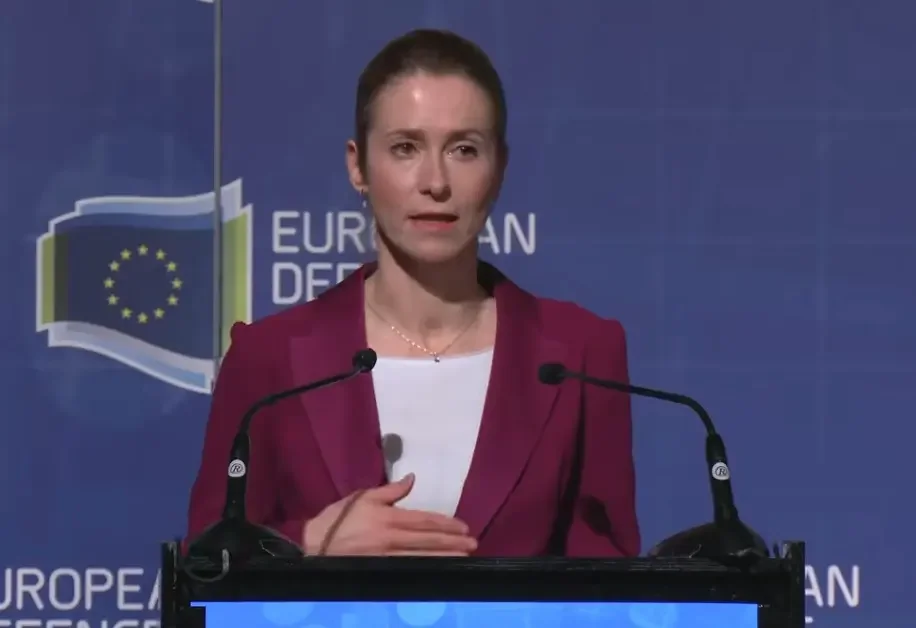
Kaja Kallas, image source EU
Kaja Kallas' speech
Yesterday, Kaja Kallas delivered a keynote at the European Defence Agency Annual Conference 2026. Kallas is the Vice President for Foreign Affairs and Security Policy of the European Union. Her speech is widely seen as strategic for the future of the EU, particularly because she argued for replacing the member states’ veto right with qualified majority voting.
But before turning to that proposal, it is worth looking more closely at some very important — and more overlooked — statements in her speech. These statements set the EU’s official policy context, which has not been widely communicated or fully recognized.
The EU’s Official Threat Assessment
Kallas said that:
it has become painfully clear that russia will remain a major security threat for the long term
the middle east will remain completely unpredictable
china will remain a long-term challenge; it poses a risk to Europe’s economic model, threatens countries in the east and south china sea, and supports russia’s war against ukraine. In this regard, china is not the only one: as president zelensky underlined in davos last week, russia can only continue to build weapons and pay for them thanks to the import of critical parts and continuing oil sales. If we want to stop the war, we must cut russia off from both.
the EU wants strong transatlantic ties; the united states will remain europe’s partner and ally
no great power in history has outsourced its survival and survived
the risk of a world where might makes right is very real
She also warned that Europe is approaching what she described as the “last and dangerous alarm”, a point beyond which there will be consequences. Before that bell rings, she argued, Europe needs to inject a sense of urgency into its efforts, beginning with defence: the need to develop the capabilities required to deter and defend.
Four Priority Areas for Action
Kallas then outlined four areas where Europe must act with urgency.
1. Defence
The first and most important area is defence. Europe needs the capabilities required to deter and defend.
Kallas argued that the diagnosis is well known: there is a lack of complementarity of capabilities in Europe, and European countries remain too focused on national interests to tackle fragmentation in a serious way. Fragmentation, she said, makes Europe slow and weak. What is needed is a cultural shift — away from thinking like nations and towards acting jointly as Europeans — across the full spectrum of defence activities, including investment, development, procurement, maintenance and training.
While defence spending is rising, she noted that Europe still lacks a number of strategic enablers, many of which are too costly and complex for any single member state to develop alone. Europe therefore needs to put its militaries in a position of strength. As she put it succinctly: Europe must be able to win the fight tonight and be ready for tomorrow.
At the same time, she acknowledged that although progress has been made, addressing capability shortfalls also requires confronting difficult questions — including what geopolitical role Europe and the EU ultimately want to play.
2. Defence Industry
The second priority area is the defence industry. Here, Kallas argued, significant steps are already being taken to set the conditions for the industry to flourish.
However, she stressed that Europe must first and foremost fill its own capability gaps. In parallel, it also faces another major task: sustaining support for Ukraine, including a commitment of 60 billion euro.
3. Partnerships
The third priority area is partnerships, beginning with NATO. Kallas acknowledged the political issues that have limited cooperation in the past, but argued that NATO needs to become more European in order to maintain its strength — and that this requires Europe itself to act.
European efforts, she said, must be better synchronised with NATO in order to complement each other, and to demonstrate how a distinct European pillar adds value through greater burden sharing and increased military strength on the continent.
Beyond NATO, she noted that bilateral partnerships are becoming an increasingly valuable tool, not only in security and defence, but also across broader foreign policy issues. Countries around the globe, she observed, are seeking to diversify their partnerships in response to heightened risks. The EU now has nine specific security and defence partnerships, the most recent of which she signed with India.
4. Decision-Making
The fourth priority area concerns political and military decision-making. Europe, Kallas argued, needs decision-making structures that are more fit for purpose and more responsive to the urgent situation it faces.
She was explicit that Europe can be slow, and that it cannot be the case that one country’s veto determines policy for all others. Procedures therefore need to become more effective. In this context, she argued that Europe should also be willing to consider what she referred to as “the Q word” — a gradual extension of qualified majority voting in the common foreign and security policy.
Logical Flaws
India and the Financing of Russia’s War in Ukraine
Kallas stressed that Russia’s ability to sustain its war effort depends on continued oil revenues, and that cutting these financial flows is essential if the war is to be brought to an end. Yet in the same speech, she highlighted the EU’s expanding network of security and defence partnerships, including the conclusion of a new partnership with India. This is striking given India’s role as one of the largest purchasers of Russian oil, and a central source of revenue for Moscow following the introduction of Western sanctions. It should be noted that Donald Trump last autumn pressured the EU to sanction India, read more here.
The question that arises is not one of intent, but of coherence: how the EU reconciles its stated objective of cutting Russia’s war financing with closer strategic cooperation with countries that help sustain it.
Ambitions versus Material Reality
The ambition level of Europe’s rearmament stands in sharp contrast to the realities of global supply chains. Kallas called for a rapid strengthening of Europe’s military capabilities, increased defence production, and the ability to sustain long-term support for Ukraine. At the same time, she does not address Europe’s structural dependence on external suppliers of critical raw materials.
The EU is overwhelmingly dependent on imports of critical minerals and rare earth elements that are essential for modern weapons systems, the defence industry, and high-tech production. China dominates these value chains, while Europe’s own extraction and processing account for only a marginal share. The volume of raw material inputs required to sustain high-intensity production of military equipment and weapons is substantial, yet this constraint is largely absent from the framework Kallas outlines.
At the same time as the EU identifies China as a strategic challenge, it remains entirely dependent on materials from a country that is a dictatorship. Read more about the EU’s acute mineral shortage here.
A Shared Threat Perception, but a Lack of Political Unity
While Kallas outlines the external challenges facing the EU, she also acknowledges that Europe remains deeply fragmented and slow to act. This weakness has not emerged in a vacuum. Donald Trump’s return to the White House has led the US administration to prioritise bilateral solutions over multilateral cooperation.
When Kallas signals that the EU must restrict national veto rights, this risks intensifying internal tensions. It may energise conservative forces that emphasise national sovereignty and protectionism. Such dynamics may ultimately serve Donald Trump and the visions embedded in the US National Security Strategy more than they serve the EU, read more about the American strategy here.
NATO, Article 5, and Strategic Uncertainty
Kallas presents NATO as Europe’s most important alliance and implicitly bases Europe’s security architecture on the assumption that Article 5 remains fully credible. This is despite the fact that Donald Trump has not unequivocally confirmed an unconditional US commitment to come to the defence of NATO allies.
Instead, American rhetoric has increasingly suggested that the response to an attack may depend on factors beyond burden-sharing alone. It may also depend on which country is attacked, its bilateral relationship with Washington, and its political alignment with US strategic priorities.
The EU’s strategy, by contrast, is designed to function within the existing transatlantic framework, rather than to strengthen or renew it in a form that meets US expectations. This places it in clear tension with the EU narrative built around deterrence, collective security, and guaranteed allied support.
Strategic Autonomy and the Shift of Dependency
A further contradiction lies in how strategic autonomy is presented. While the speech emphasises the need to reduce dependence on others, the practical measures point less toward self-sufficiency than toward a redistribution of external dependencies.
Due to acute shortages of resources, capabilities, and industrial inputs, the EU is compelled to expand cooperation with third countries beyond the United States. In a conflict, external supply lines would be cut or severely disrupted by an adversary. At the same time, the United States retains decisive influence over key strategic regions, including the Middle East, which is critical to global energy flows and logistics. Shifting dependency reduces exposure to a single actor, but does not constitute genuine strategic autonomy.
A Fragile Strategic Assumption
Finally, there is an obvious vulnerability at the core of the EU’s strategy. Both current NATO Secretary General Mark Rutte and former Secretary General Jens Stoltenberg have been clear that Europe can strengthen its defence capabilities, but cannot become autonomous, read more here.
EU defence ambitions are therefore intended to complement, not replace, NATO and the United States. At the same time, the strategy rests implicitly on a critical assumption: that no EU or NATO member state will actually be attacked by Russia, the United States, or another major power. Deterrence, integration, and gradual capability development all presuppose the absence of direct confrontation.
In this light, Kallas’ reference to the last and dangerous alarm takes on greater significance. The strategy is designed to function up until that alarm sounds—but not beyond it. Should the threshold be crossed, the gap between Europe’s ambitions, dependencies, and actual capacity to act would become immediately visible, with potentially severe consequences.
Conclusion
Taken as a whole, the strategy Kallas presents ultimately risks producing precisely what the EU seeks to prevent: a future in which might makes right determines Europe’s fate. The United States is far ahead and has already asserted the principle of the strongest prevailing in the Western Hemisphere, read more here.
The strategy is unrealistic and poorly aligned with Europe’s material, political, and strategic realities. Internal fragmentation within the EU appears a likely outcome. Read more here. As uncertainty grows and security guarantees weaken, some member states may choose to secure their defence through closer bilateral ties with the United States rather than remain bound to an EU framework they perceive as slow and insufficient.
This may occur even if the EU succeeds in weakening or removing national veto rights, since formal unity cannot substitute for credible security guarantees. The United States can offer European countries trade and military protection, but not continental political unity. At some point, it is likely to become unmistakably clear that the EU cannot provide hard security. The tension between these two realities lies at the heart of Europe’s strategic dilemma.
Content on Society and Politics is based on reliable sources and actual events, providing a news-oriented perspective intented for further debate. To access the article’s author and the related debate, membership on Hudd is required.
