
Dictatorial, authoritarian, or democratic rule in Venezuela?
The U.S. attack on Venezuela is seen as a threat to Europe, as Washington ties control of natural resources to military power. Europe’s acute resource shortages have significantly weakened the EU’s global standing.
Januray 6, 2025 | INTERNATIONAL POLITICS
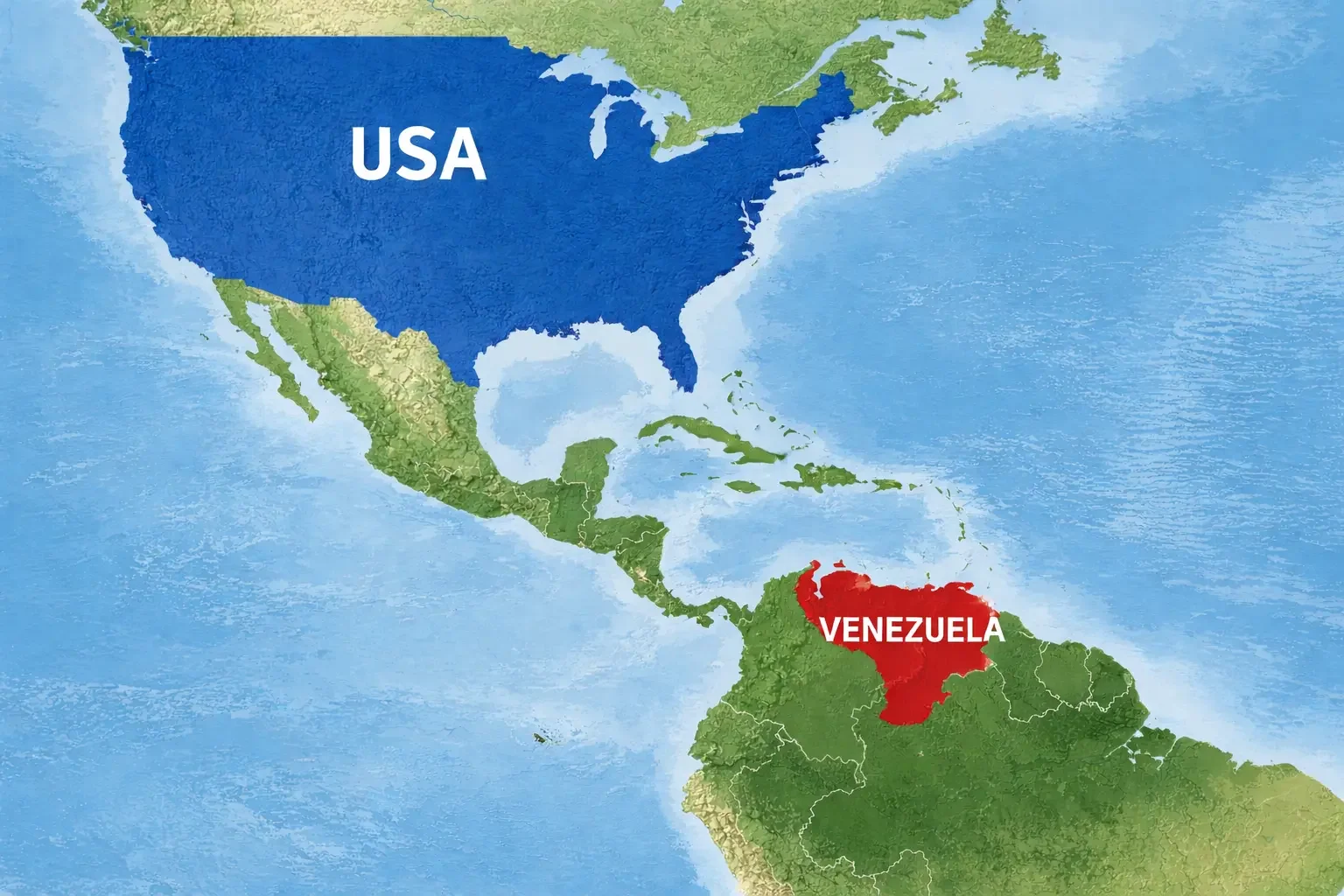
Image by AI/S&P
Exercises power over the West
On January 20 last year, Donald Trump assumed the U.S. presidency for a second time after winning the election in November. He had already signaled geopolitical changes, and the balance of power in the Western world shifted abruptly as Donald Trump ignored the NATO alliance and took control of the West. Today’s attack on Venezuela and the arrest of President Maduro confirm that Donald Trump has assumed this power.
Over the past year, European leaders have protested Trump’s many exercises of power and have received public support.
While the Venezuelan people see the US attack as liberation, Europe's leaders see the method as a threat to their own democracy.
Maduro claims the US motive is access to the country's natural resources, but the US has maintained that it wants to stop drug smuggling and restore democracy. In his statement today, Donald Trump presents a comprehensive plan to rebuild Venezuela's oil production and secure energy for the entire region — in line with the National Security Strategy published in November last year and plans drawn up together with peace prize winner Machado.
Venezuela is also very rich in minerals that the US needs in order to take trade power from China. Trump links trade to military security, which means he will protect countries that enter into good trade agreements. In this way the US aims to secure both peace and trade across the entire American continent.
Sees Trump's trade methods as a threat to democracy
The very core of the opposition Donald Trump arouses across the Western world is that trade is linked to military power; this is perceived as a threat to democracy.
Since the American continent is priority 2 for Trump, after the US, the future becomes interesting for the other countries in Latin America, as well as for Canada and Greenland in the north. Both Canada and Greenland have rejected trade agreements on what they consider to be American terms, but the US is investing in mining companies operating in these countries to secure access to natural resources.
In the National Security Strategy, Donald Trump makes it clear that he wants to restore world power in the Western Hemisphere, which in practice means sidelining Russia and China. As he sees it, he is inviting Europe to take part in this, and he has repeatedly expressed that European leaders are weak compared with the aforementioned, and that migration will wipe out the authentic Europe. Trump believes that Europe is itself responsible for peace, through trade with the US.
The EU's power is weakened and the population misled
Despite the fact that the EU has shown active resistance by rejecting several of Donald Trump's cooperation initiatives, the EU's power is substantially weakened. None of the EU's decisions have prevented the US from carrying out its strategy, only delayed it.
Europe has no real power or defence security, because Europe is in a precarious shortage of resources on its own continent and will run out of minerals for weapons production after only a few months of war.
At the same time, Europe's leaders have led the population to believe that Europe has real power and defence security. This has also resulted in the population appearing to have greater fear of the US than of Russia and China.
Those who follow American TV stations and social media will discover that American freedom of expression is still alive and well; nevertheless a narrative exists to the contrary. For Russia and China too a false narrative appears to exist, but in the sense that actual conditions of extensive press and internet censorship, human rights violations and one-party dictatorship are overlooked.
Dictatorial, authoritarian or democratic rule in Venezuela?
It now remains to be seen what the development in Venezuela will be. Venezuela's opposition leader Maria Corina Machado won the Nobel Peace Prize last year. In December she was smuggled out of Venezuela, where she had been living in hiding, in order to come to Oslo to receive the prize.
Some believe the peace prize helped to validate the US military operations against Venezuela. Machado herself supports Donald Trump; whether this contributes to him supporting her in the fight for democracy in Venezuela is not known.
SOURCES
Time Magazine
Trump advisers and Machado plan for Maduro’s departureNATO
NATO Secretary General Mark Rutte’s speech to the Munich Security ConferenceEuropean Union
A Strategic Compass for Security and DefenceBloomberg
Europe’s Defenses Risk Faltering Within Weeks Without US SupportBloomberg
Europe’s Military Limits Show Why It’s Desperate for US HelpBloomberg
US Firms Are Snapping Up the Rare Earths Europe Needs to RearmBloomberg
US Gives Europe 2027 Deadline to Lead NATO Defense, Reuters SaysEuropean Union EUR-Lex
Critical Raw Materials Regulation
Content on Society and Politics is based on reliable sources and actual events, providing a news-oriented perspective intented for further debate. To access the article’s author and the related debate, membership on Hudd is required.
