
Western technology and mineral strategy to outcompete China
The US has launched three complementary initiatives – Pax Silica, FORGE and Project Vault. The goal is to break China's grip on critical minerals and secure Western leadership in artificial intelligence and advanced technology. Here is what you need to know and the countries that have joined.
May 27, 2026 | SOURCES| INTERNATIONAL POLITICS
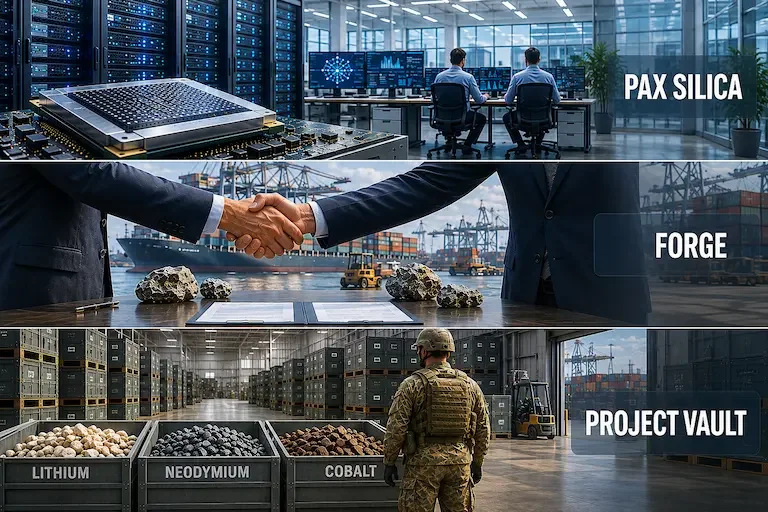
Image by AI/S&P
Uniting the West against China
In the space of a few months, the United States has launched what appears to be its most ambitious industrial strategy ever. Behind the initiatives lies the recognition that access to critical minerals is not merely a trade issue – it is the foundation of national security and technological power. Through these measures, the US is bringing Western allies together at a political level for a joint push in AI infrastructure and advanced technological industry, as well as a binding framework of agreements in which allies commit to mineral projects within the alliance to secure Western raw material supplies and preparedness.
Pax Silica
Pax Silica is a US-led multilateral initiative launched in December 2025 with the aim of securing Western technological leadership in the competition with China. The initiative is coordinated by the US Department of State under Under Secretary of State for Economic Affairs Jacob Helberg, and brings together allied nations around the development of AI infrastructure, semiconductors, critical minerals, energy and advanced manufacturing. The goal is to establish the industrial and technological capacity (supply chains) required to lead the development of artificial intelligence and other advanced technologies. Pax Silica is a political declaration, not a binding trade or investment framework, but promotes and facilitates investments and agreements between businesses in the supply chain.
Pax Silica has 15 member countries: Australia, Finland, India, Israel, Japan, Norway, the Philippines, Qatar, South Korea, Singapore, Sweden, the United Arab Emirates, the United Kingdom and the United States. The EU wishes to establish equivalent measures for its internal market, but lags behind both strategically, technologically and industrially.
FORGE
The Forum on Resource Geostrategic Engagement (FORGE) was launched at the largest ministerial meeting on critical minerals to date, held in Washington on 4 February 2026, chaired by Secretary of State Marco Rubio with Vice President JD Vance as keynote speaker. FORGE is a non-binding framework for critical minerals; in practice it is a political cooperation. Fifty-four countries took part, including the European Commission. Building on the Minerals Security Partnership from 2022, FORGE is a Western political response to China's dominant position in critical minerals: a strategic policy framework between the US and its allies on mineral extraction, investment and supply commitments.
The goal of the American administration is to introduce guaranteed price floors for minerals. Setting a price floor combined with adjustable tariff rates will shield allies' mineral extraction projects from Chinese price competition and reduce the bankruptcy risk that otherwise stands in the way of new investment. Allies wishing to take part in the sheltered Western market must commit to trading minerals within the alliance rather than importing from China. The cost of maintaining the price floor is to be distributed across the Western market, which makes the mechanism sustainable. Investment and ownership in the Western minerals industry may be public or private, and is facilitated through FORGE.
Countries wishing to take part in the Western mineral market must enter into a plurilateral mineral agreement named the Agreement on Trade and Critical Minerals (ATCM). Those remaining outside can expect tariffs on critical minerals and products derived from them entering the United States, regardless of whether they participate in FORGE.
At the ministerial meeting in February, the United States signed 11 new bilateral mineral frameworks or memoranda of understanding in addition to 10 concluded over the preceding five months. In total, the United States has entered into 21 bilateral mineral frameworks or memoranda of understanding, and is negotiating with a further 17 countries.
The EU committed to entering into a memorandum of understanding and additionally signed an Action Plan to conclude a plurilateral agreement (ATCM) on 24 April. The negotiations are difficult because FORGE and ATCM are a direct counterpart to the EU's own mineral legislation, the Critical Raw Materials Act (CRMA). In light of American developments in this area over the past year, the CRMA has seen limited progress, and the EU also lags behind both strategically, technologically and industrially.
Project Vault
Project Vault was launched two days before the FORGE meeting, on 2 February 2026. Project Vault is a comprehensive programme for strategic mineral reserves. The US has defined 60 raw materials as critical minerals and rare earth elements, and access to these has been declared a matter of national security. The legal basis was established through Proclamation 11001, signed by Donald Trump on 14 January 2026. The proclamation grants the president authority to control mineral imports through requirements for bilateral agreements with exporting countries, as well as the ability to impose tariffs or exclude countries from the American market if such agreements are not in place.
Following this presidential order came a further order on 2 February 2026 establishing Project Vault, a public-private partnership worth $12 billion, financed through the Export-Import Bank and private capital. It is run by VaultCo LLC, an independent entity with its own board and management, in which EXIM holds a non-voting board observer role.
Project Vault is to build strategic reserves of the 60 designated minerals for civilian industry, while the defence sector is covered through the National Defense Stockpile. Together this will give Washington considerably greater strategic freedom of action in any conflict involving critical minerals, trade or defence security.
The Department of Defense has simultaneously taken direct ownership stakes in mining companies such as MP Materials, Lithium Americas and Trilogy Metals. This marks a new phase in which the US military invests directly in commercial mineral extraction as part of national security strategy. By comparison, the EU's mineral reserves are estimated to cover only a limited number of weeks in a serious crisis situation – the situation is so critical that the actual figures are classified.
A unified framework designed for success
Together, Pax Silica, FORGE and Project Vault represent three distinct levels of US strategy.
Pax Silica unites Western allies around a shared commitment to technological leadership in AI, semiconductors and advanced industry. FORGE is a political framework for trade, investment and access to critical minerals among allies. Project Vault is purely national, a US stockpile programme to protect its own industry against supply disruptions. The tariff regime the Trump administration has put in place underpins all three.
For Western countries wishing to remain relevant in the technological competition with China, the question is no longer whether to participate, but on what terms.
Of great significance for Norway
Norway holds the world's third largest mineral resources. A detailed account of how these developments affect Norway can be found in the Mineral Petition.
SOURCES
The White House Proclamation 11001 – Adjusting Imports of Processed Critical Minerals
The White House Fact Sheet: Proclamation 11001
Council on Foreign Relations A Guide to Trump's Section 232 Tariffs
Brownstein Supreme Court Restricts Presidential Tariff Authority Under IEEPA
Export-Import Bank of the United States Project Vault and the U.S. Strategic Critical Mineral Reserve
Mining.com Trump launches $12B Project Vault
Geopolitical Monitor Project Vault and the New Era of US Strategic Mineral Stockpiling
Mayer Brown Critical Minerals: Project Vault and the New US Critical Minerals Playbook
US Department of State 2026 Critical Minerals Ministerial
Atlantic Council US critical minerals policy goes collaborative with FORGE
Brownstein Project Vault and FORGE Signal Next Phase of U.S. Critical Minerals Policy
CSIS Critical Minerals Ministerial Introduces New International Cooperation Strategy
U.S Department of State
What is Pax SilicaU.S Department of State
Pax Silica Summit
Content on Society and Politics is based on reliable sources and actual events, providing a news-oriented perspective intented for further debate. To access the article’s author and the related debate, membership on Hudd is required.