

US critical minerals policy and its implications for the EU
A new EU study concedes that the EU has no instrument to secure the mineral industry against Chinese prices, and acknowledges that the American model has a solution. The implications for Greenland and Norway as resource owners could be considerable.
July 23, 2026
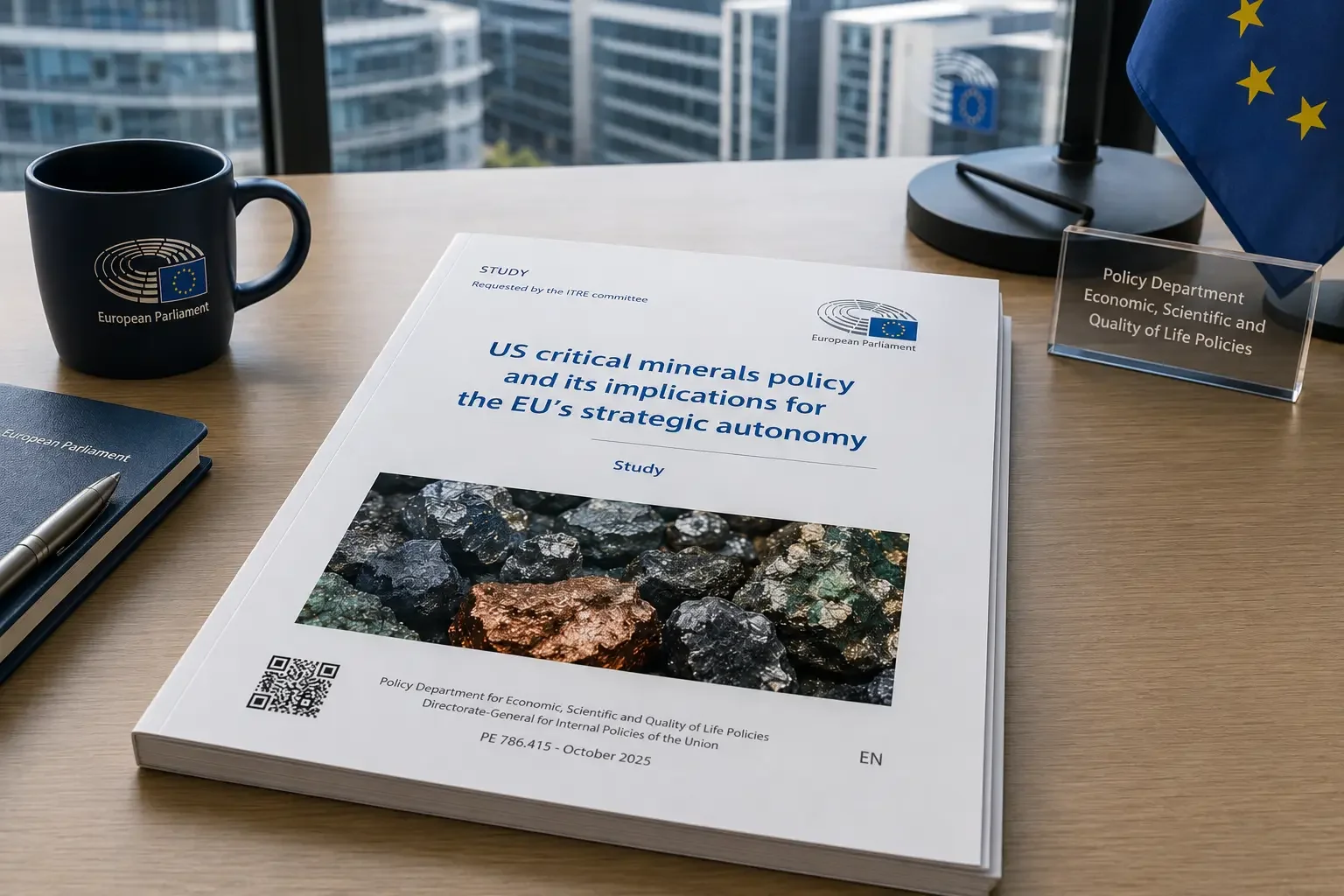
Image by AI/S&P
Brussels study confirms what S&P has concluded
On 13 July 2026 the European Parliament published a study on US critical minerals policy and what it means for Europe (PE 786.415). It was prepared internally by the Parliament's own policy departments, and discusses what the findings mean for the industry and internal market committees, ITRE and IMCO.
Its conclusions match those Society & Politics has reached through its own research and analysis since March 2025 — highlighted in our seven charts, our guides to the US and EU strategies, the Norwegian Mineral Petition, and ongoing mineral reporting.
The study carries no date beyond July 2026, but is indexed as published on 13 July — the same day the deadline under U.S. Proclamation 11001 fell.
What the study concludes
1 · The US invests far more
US federal agencies mobilize around EUR 46 billion. The EU provides EUR 5–6 billion. The instruments differ too: American support is large-scale and shares risk with the companies, while the EU relies mainly on grants and loans.
2 · The US guarantees the price
Washington uses trade-linked price floors and adjustable tariffs. Brussels has no dedicated instrument to secure long-term revenues for mine and processing plant developers. The study notes that price floors are hard to sustain alone — unless set up collectively with allies through frameworks like FORGE.
3 · The EU has no stockpile yet
The US runs a dual system: the long-standing National Defense Stockpile and the EXIM-backed Project Vault. The EU is still operationalizing its own, through a forthcoming CRM Centre and coordination among 27 member states.
4 · Refining is the bottleneck
The study places the vulnerability in processing, where China controls 90 percent of rare earth refining and 74 percent of lithium and cobalt. On the extraction side it says only that the US and the EU possess "some mining potential", without quantifying it. For Europe that question is left open: refining capacity is of no use without ore, and Europe's ore must come from outside.
What the study proposes
The study directs its options to the two committees ITRE and IMC.
For ITRE, to close the financing gap: two-way contracts for difference (CfDs) and buyer-of-last-resort schemes for revenue certainty, resilience criteria in EU industrial legislation, and credit guarantees to enable long-term power contracts at a fixed price.
For IMCO, to protect the internal market: screening Chinese-backed processing projects and US-origin IRA and CHIPS subsidies under the Foreign Subsidies Regulation, and resilience conditions in public procurement. The study also notes that member states support their own projects on unequal terms, and proposes EU-level funding to even this out.
What the study leaves out
Every instrument the study proposes acts inside the EU. CfDs, buyer-of-last-resort schemes, procurement criteria and EU-level funding all reach member states and companies within the single market.
The comparison is drawn between two jurisdictions, the US and the EU. The countries that hold the resources — Norway and Greenland— do not apply. Europe's largest deposit of rare earth elements sits outside the framework the study examines.
That matters for the price problem the study identifies. It concludes that the EU has no instrument to secure long-term revenues, and that price floors are sustainable only when set up collectively with allies through frameworks like FORGE. The remedies it then proposes are EU budget instruments. A price floor under FORGE reaches the owner of the resource directly; a CfD financed from the EU budget does not.
The study also observes that member states support their projects on unequal terms. The rules that determine what such support is allowed to be are the state aid rules. The study does not go into them.
The issue
The study shows why price support is necessary: without it, developers get neither investors nor financing. Nobody will fund a mine or a processing plant when it has to compete with China, which sets prices and restrictions as it sees fit.
The American answer is a closed Western market with a price floor — a guaranteed minimum price that follows the entire value chain from mine to finished product. The floor protects against price swings and bankruptcy, and is meant to make the mineral industry attractive to investors. The model is referred to in the study as FORGE; it should be noted here that FORGE is a non-binding political framework which presupposes that a plurilateral minerals agreement (ATCM) is concluded in order to achieve a price floor.
The EU has not resolved the problem of bankruptcy risk and the risk this poses to the production of defence materiel. Although CRMA is intended to coordinate private financing and public support from the member states, the internal market is too small to carry a price floor. The EU's solution therefore still rests on support schemes, as the study points out.
Both models come at a cost. Under FORGE it is borne by buyers along the value chain, since the floor follows production through to the finished product. A combined Western market is large enough to carry it. The EU Parliament's study stresses that the floor depends on that Western market actually being established.
The study proposes that the EU use contracts for difference (CfDs), buyer-of-last-resort arrangements and a future sovereignty fund to coordinate support from the member states.
The difference, then, is that the US lets the market carry the cost while the EU places it on the public purse. Morrow, the Norwegian battery plant that went bankrupt earlier this year, would have had better terms under the American model. It would have competed in a Western market rather than directly against China. Instead Morrow received 1.5 billion kroner in Norwegian state support, funded by taxpayers to no avail.
Norway and Greenland
The EU's strategy is not written for resource holders. It is written for a jurisdiction that must buy what it does not have. Every instrument in the study serves the same purpose: securing supply into the single market, on terms set inside it.
That is a problem for the countries the EU depends on. Europe's largest deposit of rare earth elements is at the Fen Field in Telemark, and Greenland holds some of the largest untapped deposits of the Atlantic. Neither is in the EU. Both are expected to supply it.
A resource holder, and supplier, sets different terms than a buyer. It needs a price it can finance the industry against, and the freedom to sell to whoever offers the best terms. EU, through CRMA, offers neither. It offers capital with delivery conditions attached, decided in Brussels, and a market smaller than the one the US is assembling.
The study identifies exactly this gap and proposes remedies that stop at the EU border. A price floor carried collectively with allies would reach the owner of the resource. A CfD drawn on the EU budget will not.
Nothing in the study changes the conclusion Society & Politics has reached: for Norway and Greenland, the best available option remains a bilateral mineral agreement with the United States.
RELATED ARTICLES
Content on Society and Politics is based on reliable sources and actual events, providing a news-oriented perspective intented for further debate. To access the article’s author and the related debate, membership on Hudd is required.