
July 2026 could be defining for the relationship between U.S. and EU
It’s turned into July 2026, and the Turnberry Agreement has finally entered into force. Brussels believes it has fulfilled the conditions of the agreement, but from Washington there is deafening silence, while new legal trade weapons involving Greenland and Norway are loaded.
July 2, 2026
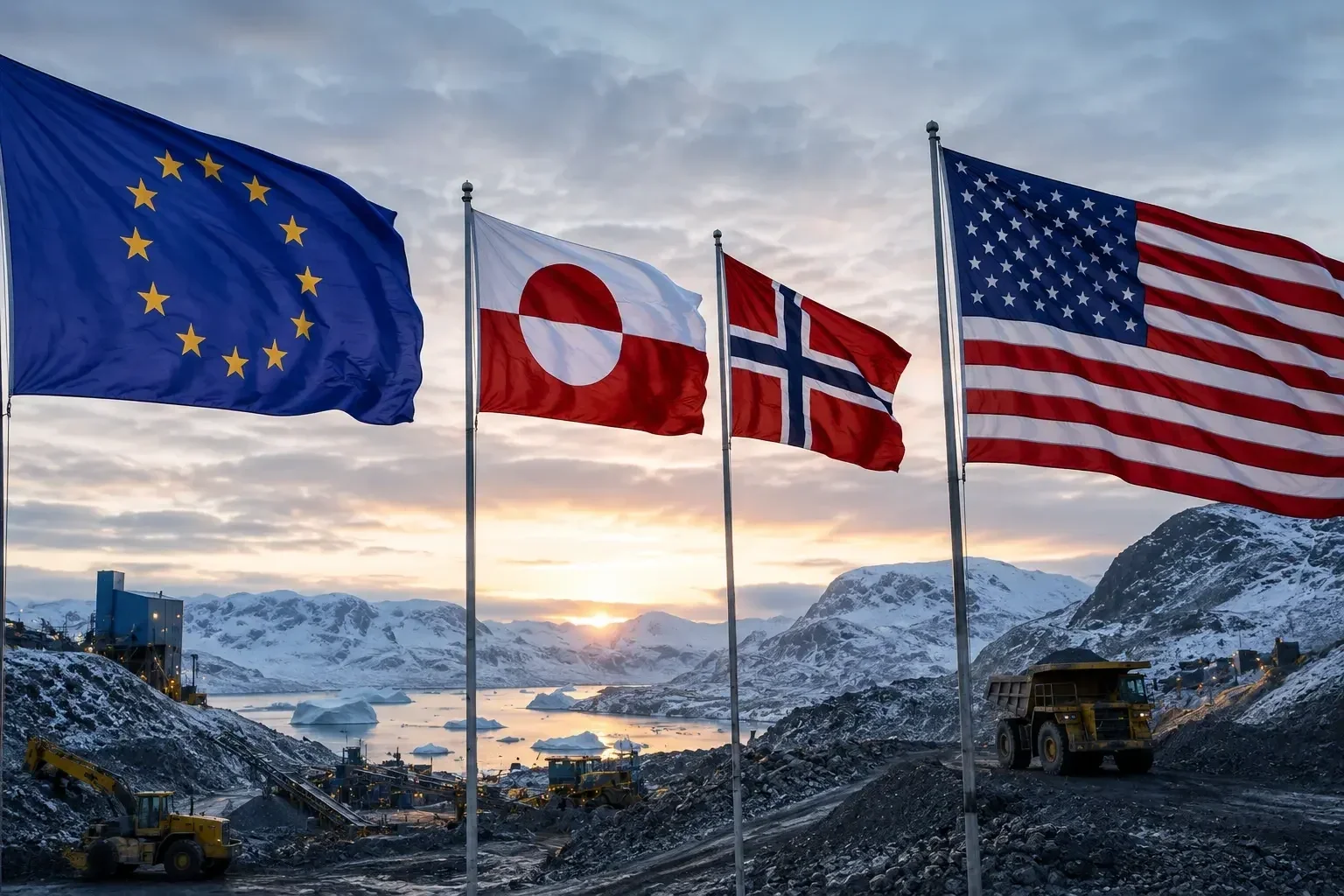
Image by AI/S&P
The Turnberry Agreement
The trade agreement between the EU and the U.S. was concluded by U.S. President Donald Trump and European Commission President Ursula von der Leyen at Turnberry in Scotland in July last year. The agreement came after Trump announced high tariffs on the EU. Under the agreement, the EU has accepted a tariff ceiling of 15 per cent to accommodate the US demand for an adjustment of the trade surplus. Following a lengthy approval process, the European Parliament adopted the agreement on June 16. The Council gave its final approval on June 25, and the regulation implementing the EU's obligations entered into force on 1 July.
Brussels now considers that it has fulfilled its part of the Turnberry Agreement but included a suspension clause stating that the agreement applies only if the U.S. reduces tariffs on steel and aluminium from the EU by December 31 this year.
Despite the Turnberry Agreement now being in force, the U.S. has not confirmed that the conditions have been fulfilled.
Mineral conflict
Behind the trade agreement lies a deeper conflict over critical minerals. At the start of this year, Donald Trump escalated the conflict when he threatened to acquire Greenland. The EU had to give way and on 4 February entered into a commitment to conclude a memorandum of understanding on critical minerals within 30 days.
The EU did not, however, sign the agreement until 24 April, at the same time signing an action plan for negotiating a plurilateral minerals agreement (ATCM). No binding minerals agreement has been concluded.
One reason is that the EU's minerals strategy is not compatible with the American strategy. The EU is part of the FORGE minerals cooperation and joined Pax Silica last week, but these are political declarations of cooperation on critical minerals supply chains and must not be confused with a binding minerals agreement.
In early May, Trump threatened to impose tariffs on European cars unless the EU implemented the conditions of the Turnberry Agreement by 4 July, arguing that electric vehicle batteries contain critical minerals sourced from China. This was followed by U.S. Ambassador to the EU Andrew Puzder, who warned of confrontation in a signed opinion article published in Politico on May 18, read more. Two days later, the Turnberry agreement was approved by the Council of the European Union, before subsequently being approved by the European Parliament and entering into force as described above.
Norway central to the minerals conflict
Greenland is well known as part of the conflict between the U.S. and the EU, but it is less known that Norway also plays a central role. Norway has the largest rare earth deposits in Europe and the third-largest in the world after China and Brazil. Put simply, the U.S. and the EU are competing for access to Norway's mineral resources.
On April 18, Society and Politics published an in-depth article on how the U.S. has positioned itself strategically and legally for a conflict with the EU this summer, and how that conflict implicates Norway, read more.
Key dates in July
Several dates of major importance fall in July, not only for the future relationship between the EU and the U.S., but also for Greenland’s and Norway's future as sovereign states.
July 4
Trump's deadline for the EU to implement the Turnberry Agreement. If the agreement is not considered fulfilled, the U.S. will impose a 25 percent tariff on European cars under Section 232.
July 7
A Section 301 hearing on forced labor will be held in Washington. The U.S. has identified 60 countries that either do not prohibit or do not effectively enforce a ban on imports of goods produced with forced labor and is considering additional tariffs ranging from 10 to 12.5 percent depending on each country's practices. Norway could face a tariff of 12.5 percent.
The Section 301 tariff authority is intended to provide a permanent legal basis for tariffs and replace the temporary Section 122 tariffs, which expire on July 24. More information follows below.
July 10
Meeting of the EEA Joint Committee. This is relevant because Norwegian minerals are central to the conflict between the EU and the U.S. As early as March 2025, Norway's Labour government decided to implement the EU's Critical Raw Materials Act (CRMA) into Norwegian law. The EU is placing significant pressure on the EEA and Norway to implement the legislation so that the EU can secure control over Norwegian mineral resources, get the details here.
If the EEA Joint Committee decides to incorporate the CRMA into the EEA Agreement, the legal act cannot be implemented without a decision by the Norwegian Parliament, pursuant to Article 26, second paragraph, of the Norwegian Constitution.
On June 2, the Norwegian Parliament adopted five resolutions on Norwegian minerals policy. Resolution 851 asks the government to consider how Norway should contribute to achieving the objectives of the EU's CRMA Regulation—including recycling, circular value chains and mapping—but the resolution concerns the objectives themselves, not incorporation into the EEA Agreement. The remaining resolutions concern how the government should ensure ownership control in licensing for critical minerals, examine the establishment of a state-owned minerals company or minerals fund, and map Norway's minerals value chain.
July 13
In January this year, Trump signed Presidential Proclamation 11001, directing the administration to negotiate minerals agreements and assess minimum price mechanisms within 180 days. That deadline expires on July 13.
Administration officials are then required to submit a status report to Trump. If the negotiations have not produced results by the deadline, the proclamation authorizes tariffs, import restrictions and minimum prices.
July 24
When Trump launched his "Liberation Day" tariffs on April 2, 2025, they were based on the International Emergency Economic Powers Act (IEEPA). On February 20 this year, the U.S. Supreme Court ruled that the IEEPA does not authorize tariffs. On the same day, Trump replaced that legal basis with Section 122, a temporary authority that expires after 150 days—on July 24. Congress could extend it, but this is considered unlikely. It is therefore expected to be replaced by the permanent authority provided under Section 301.
The tariff that first becomes relevant under the section in question relates to forced labour; later this year, a tariff relating to excess capacity may also come into play.
On forced labour, both the EU and Norway are among the 60 economies under investigation that may be hit by tariffs under the new Section 301 authority. The EU would in that case face 10 per cent and Norway 12.5 per cent, since the former has concluded a trade agreement while the latter has not.
With regard to forced labor, both the EU and Norway are among the 60 economies under investigation and could become subject to tariffs under the new Section 301 authority. In that case, the EU would face a tariff of 10 percent, while Norway would face a tariff of 12.5 percent.
Regarding industrial overcapacity, 16 economies are under investigation, including the EU and Norway. Norway's tariff exposure is based on oil exports, seafood and the Government Pension Fund Global, but overcapacity also includes mineral-related sectors such as batteries, critical minerals and metals. This means Norway could face tariffs from July 24 while also being exposed to tariffs once Norwegian critical minerals enter production. Possible tariff rates related to industrial overcapacity have not yet been announced.
Norway still has the opportunity to conclude a trade agreement with the Trump administration. The government has never explained why such an agreement was not concluded before the 31 July deadline last year, or why it has still not been concluded.
How the U.S. will use Section 232 and 301
The Trump administration's objective in imposing tariffs is to reduce the trade deficits the U.S. has with individual economies. Several countries have concluded trade agreements that provide more favorable terms than the tariffs otherwise imposed. As a result, tariffs are widely regarded as a negotiating tool.
However, tariffs are also used as a geopolitical instrument. The U.S. aims to reclaim trade leadership from China in order to secure its global position in the future. China's influence is primarily linked to its dominance of mineral supply chains, particularly critical minerals and rare earth elements, where it holds an almost global monopoly.
The U.S. has launched mineral projects on its own continent and concluded minerals agreements with governments and mining companies around the world to break China's dominance. The EU, which has relatively limited mineral resources within its own territory, has become 98 percent dependent on China for rare earth elements.
The U.S. aims to build a Western minerals alliance to take on the competition with China. Through the political minerals partnerships FORGE and Pax Silica, together with a binding plurilateral minerals agreement, the ATCM, a sheltered Western minerals market is to be built. The market is to be protected by a guaranteed minimum price (price floor) in order to encourage investment and provide bankruptcy protection in mineral extraction, processing and derivative production — commonly referred to as the critical minerals supply chain.
The Trump administration considers a minimum price mechanism essential if the West is to reduce its dependence on China for critical minerals. Once Western countries come together in a common minerals market, the price floor can be financed, read more.
As noted above, the EU has instead chosen a different minerals strategy through the Critical Raw Materials Act (CRMA), which is not compatible with a minimum price mechanism, read more.
Canada and France are leading the effort to establish a G7 minerals alliance known as “The Buyers Club”, which aims to secure lower prices through joint procurement. Trump rejected U.S. participation in the alliance during the G7 summit in June, read more.
The U.S. has designated 60 critical minerals as matters of national security. Presidential Proclamation 11001, referred to above, is linked to these minerals. Countries that have not concluded a minerals agreement with the U.S. may be subject to tariffs on minerals, including derivative products, under Section 232. As a result, countries outside FORGE could see their competitiveness weakened relative to the U.S. and its minerals partners.
As noted above, Section 301 will initially apply to forced labor and industrial overcapacity. Minerals may become subject to tariffs under both legal authorities. Consequently, the U.S. has legal trade instruments that can be be used to exert pressure on both the EU and Norway.
SOURCES
Council of the European Union
EU-US trade: Council gives final approval for the tariff commitments under Joint StatementEUR-Lex
Council of the European Union
EU-US trade: Council and Parliament strike a deal to implement the tariff elements of the Joint StatementPBS News
Trump threatens 100% tax on European imports if countries impose tax on digital servicesFederal Register
Notice of Determinations and Request for Comments Concerning Actions in Section 301 InvestigationsOffice of the United States Trade Representative
Report on Acts, Policies, and Practices of Various Economies Related to the Failure to Impose and Effectively Enforce a Prohibition on the Importation of Goods Produced with Forced LaborFederal Register
Initiation of Section 301 Investigations of Acts, Policies, and Practices of Various Economies Related to Forced LaborU.S. Department of Homeland Security
2025 Update to the UFLPA Strategy to Prevent the Importation of Goods Mined, Produced, or Manufactured with Forced Labor in the People's Republic of ChinaEFTA
Standing and Joint Committee Meeting Schedule 2026 (Ref. 25-890)Regjeringen.no
Regjeringen vil innlemme EUs regelverk for kritiske råvarer i EØS-avtalen
Obiter Dictum
Lovgivningsprosessen – fra EU-lov til norsk rettStortinget
Sak: Representantforslag om et statlig mineralselskap (Dok. 8:148 S / Innst. 376 S)The White House
Federal Register
Reuters
Trump's critical minerals pricing plan faces skeptical G7, divided industry
Federal Register
Federal Register
Holland & Knight
US Court of International Trade Invalidates the Administration's Section 122 Tariffs
Content on Society and Politics is based on reliable sources and actual events, providing a news-oriented perspective intented for further debate. To access the article’s author and the related debate, membership on Hudd is required.