

Norway still without a trade agreement with the U.S., new tariffs await
Norway is subject to a 10% tariff to the U.S. under the temporary tariff authority Section 122, which expires in 11 days, but the U.S. now has new permanent tariff authorities. If a trade agreement is not concluded by July 24, the U.S. may impose new tariffs, restrictions and minimum prices.
July 13, 2026
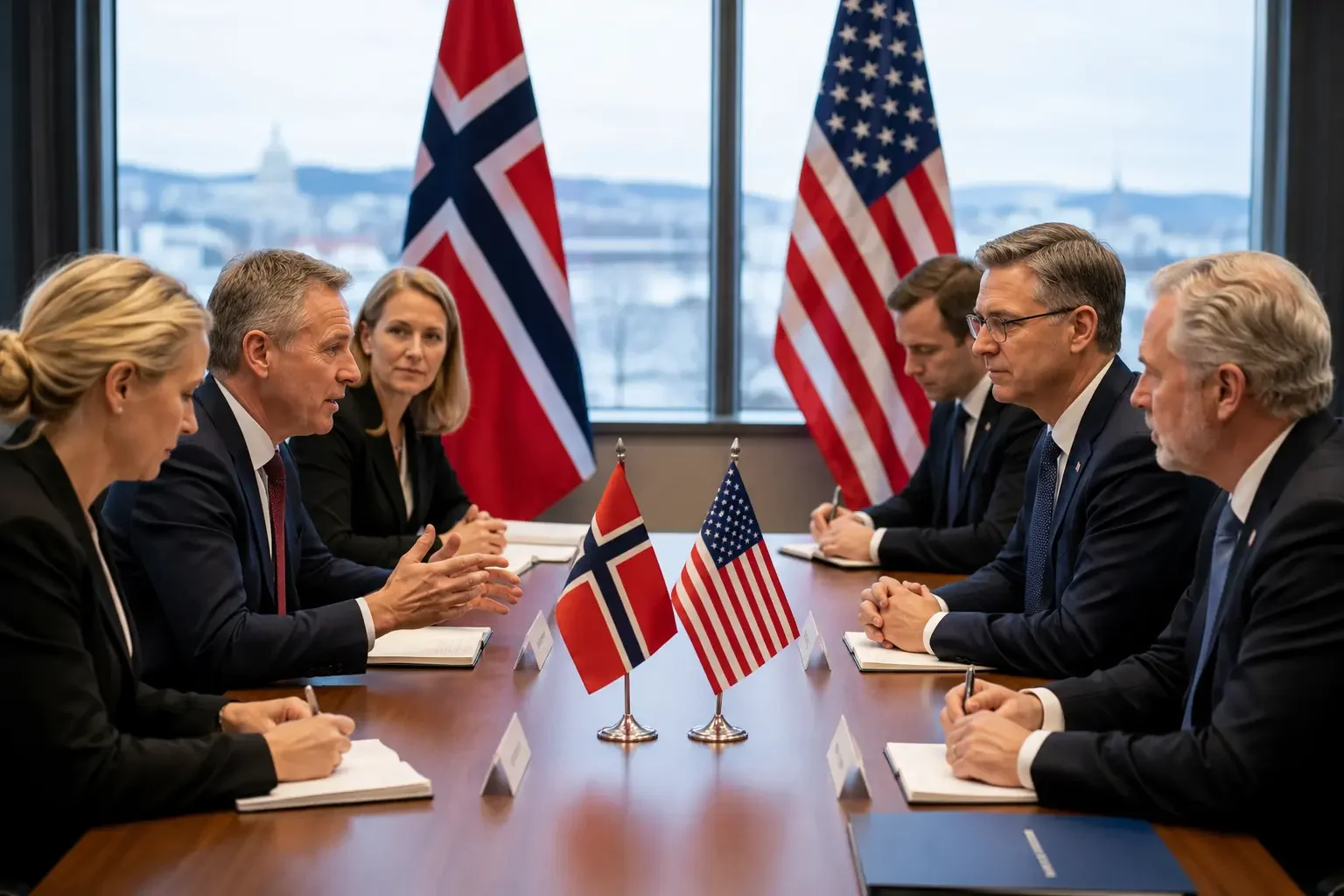
Illustration by AI/S&P
Norway without a trade agreement with the Trump administration
On what was referred to as "Liberation Day," 2 April 2025, Donald Trump announced tariffs on exports to the U.S. The tariffs were established to offset the U.S. trade deficit, and individual tariff rates were announced for trading partners. The rates could be negotiated until 31 July 2025; if a trade agreement was not concluded, the announced tariff would apply.
The Labour government did not succeed in concluding a trade agreement with the Trump administration by the deadline, and Norway was consequently subjected to a general tariff of 15 percent. First under the authority of IEEPA, then 10% under Section 122. The authority under Section 122 is temporary and expires in 11 days, on 24 July 2026.
Under a permanent tariff authority, Section 232, Norway is additionally subjected to tariffs on steel, aluminium and copper (as well as derivatives). Put simply, the tariffs range from 10 to 50 percent depending on the metal content of the product. Section 232 also applies to other products that affect Norway to a lesser degree. Tariffs under Section 232 last until an agreement has been concluded on the products in question, or the U.S. decides otherwise.
New tariffs that may be imposed on Norway
It can be expected that Norway will face higher tariffs than the EU and other countries with a trade agreement when the US most likely imposes new tariffs on the 24th under Section 301 authority. Through a statutory investigation, the U.S. has given notice that Norway may be subjected to a 12.5 percent tariff on products whose value chain has involved forced labour (for example raw materials and components from China).
Next, later this year, tariffs (rate unknown) for overproduction; oil exports, seafood and the oil fund are industries that the U.S. has investigated this spring. Other industries may also be investigated.
The Trump administration can impose tariffs under Section 301 if it holds that the investigations have shown that the conditions for tariffs have been met. The authorities can be challenged in court through American importers bringing suit in the Court of International Trade, with a possible appeal route via the Federal Circuit to the Supreme Court — but the review will primarily concern whether the process has been followed, not the overcapacity assessment itself. Section 301 can never be struck down the way IEEPA was by the Supreme Court in February.
Proclamation 11001 may lead to major consequences for Norway
In January this year, Trump signed the Proclamation 11001, which directs the administration to negotiate mineral agreements and consider a price floor for minerals within 180 days; this deadline expires today, July 13. According to the order, the members of the administration are now to provide a status report to Trump. If the negotiations have not succeeded, the proclamation provides authority for tariffs, import restrictions and minimum prices linked to the 60 critical minerals that the U.S. has defined as a matter of national security.
Proclamation 11001 will have major consequences for Norway, as the country has the third-largest deposits of rare earths in the world. The consequences may include tariffs on the production of goods containing critical minerals, which in addition to hitting Norwegian industry would also affect the nation's military security.
The Store government broke mineral promises
On October 1 2024, the Store government announced that it had concluded a historic cooperation agreement with the Biden administration on critical minerals.
On November 7 the same year, Prime Minister Jonas Gahr Store wrote a letter of congratulation to Donald Trump when he was re-elected as president; in this letter, Store promises future deliveries of critical minerals and rare earths to the U.S.
In January 2025, just days before Donald Trump was inaugurated as president for the second time, a report came that advanced the mineral cooperation between the U.S. and Norway. The cooperation was at the level of intent, not legally binding, which is normal diplomatic progress.
On March 28 2026, the Labour government issued a press release announcing that it is working to implement Norway into the EU's mineral legislation, the CRMA. This was a premature press release that can be interpreted as a signal to the U.S. that Norway will not conclude a mineral agreement with the U.S., despite earlier promises and established cooperation.
On April 24, Jonas Gahr Store and Jens Stoltenberg visited Washington, where they met with Donald Trump. It is likely that they were invited to discuss minerals, but very little has been communicated about the meeting. Stoltenberg has, however, stated that minerals were discussed.
During the trade negotiations with the US, ahead of the 31 July 2025 deadline, Minister of Trade and Industry Cecilie Myrseth stated that intense negotiations were under way, with minerals among the topics. But no trade agreement with the US was reached, and this has not been accounted for.
Implementation of the EU's mineral legislation
The Labour government broke mineral promises to the U.S. in favor of the EU and the minerals regulation CRMA (Critical Raw Materials Act). However, the work to implement the CRMA into the EEA Agreement has stalled. The topic was not on the agenda during the EEA committee meeting a few days ago, and no public releases or statements have been made about the current status.
On June 2, the Norwegian Parliament voted to require the government to carry out a study of the mineral industry, a state mineral company, and how the conditions in the CRMA are to be met.
The process has probably stalled as a result of Norway being central to the ongoing mineral conflict between the EU and the U.S.
Read in detail about the minerals regulation, the CRMA, and the major consequences for Norway in the Mineral Petition.
A window of eleven days
Today the Trump administration's evaluation of Proclamation 11001 begins, which provides authority for tariffs, import restrictions and minimum prices linked to 60 critical minerals if no mineral agreement has been concluded. Norway can thus expect measures from the U.S., not only in relation to the general tariff rate under Section 122, which expires on July 24, but also relating to minerals.
Seen in light of the threats against Greenland, which are also related to minerals, the coming days may prove decisive for both Norway's and the EU's future relationship with the U.S.
SOURCES
The article is based on a significant number of sources, which you will find at the bottom of the related articles linked above. New sources for this article;
Dagens Næringsliv
Høyre mener avtale haster, krever tollsvarNHO
Finansavisen
Nye toller mot Norge – skylder på tvangsarbeidRegjeringen
EØS-komiteens beslutninger i 2026Regjeringen
Statsminister Jonas Gahr Støres gratulasjonsbrev til Donald TrumpRegjeringen
Pressemelding fra regjeringen om innlemme EU CRMA i norsk lovverk 28. mars 2025
Content on Society and Politics is based on reliable sources and actual events, providing a news-oriented perspective intented for further debate. To access the article’s author and the related debate, membership on Hudd is required.