

Trump repeats Greenland threats loaded with new legal authority
At the NATO Summit in Turkey, the US president once again states that Greenland must be controlled by the US, while expressing dissatisfaction with NATO and repeating that the US will withdraw forces. The US is better equipped to act against the EU now than it was in January.
July 8, 2026
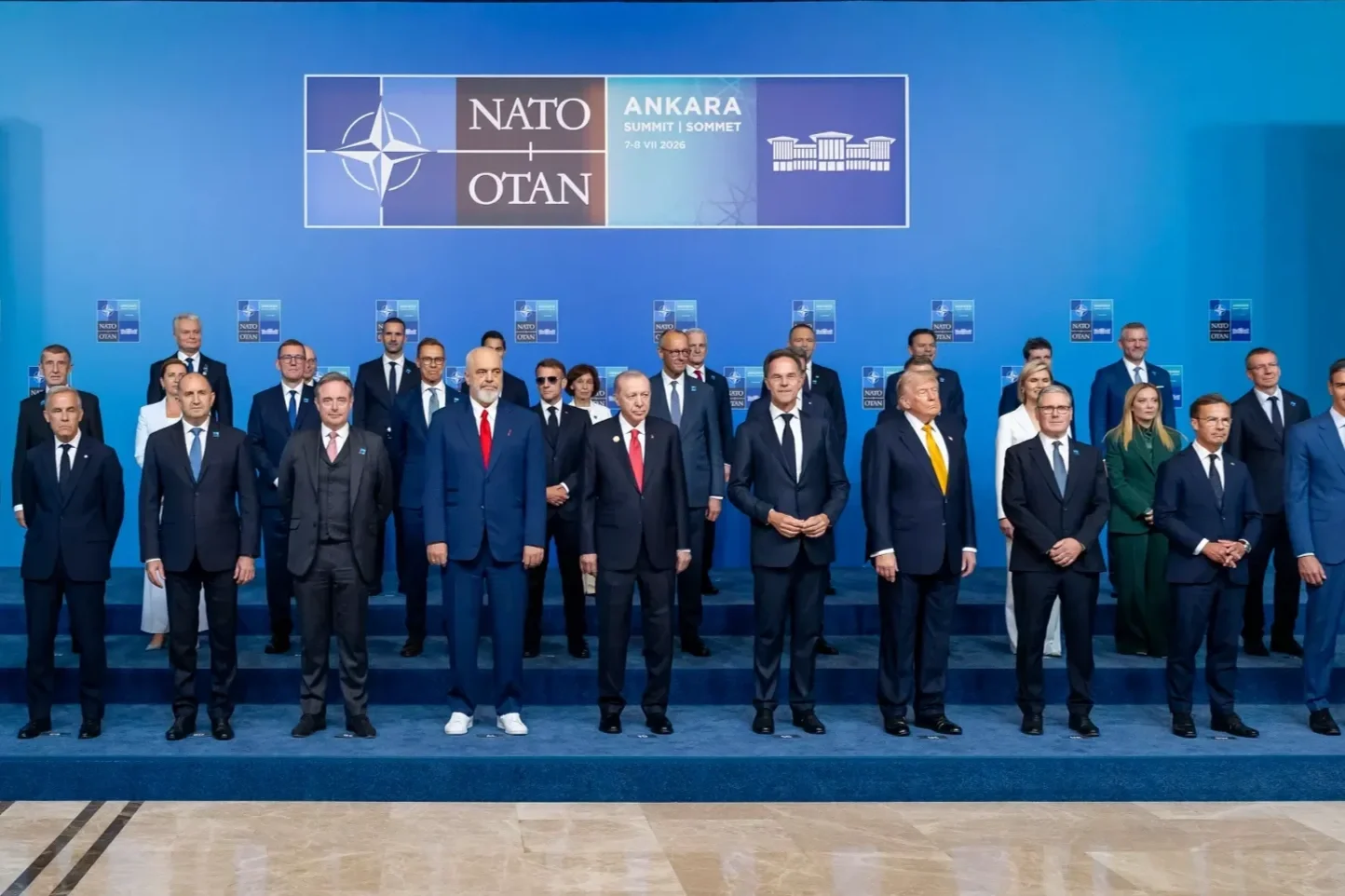
NATO Summit Ankara 2026, photo by NATO
The background to the Greenland threats makes it serious
The new threats from Trump against Greenland should not come as a surprise; they follow from prolonged strategic groundwork by the United States. There is reason to take the American president seriously.
Society and Politics (S&P) has warned of the situation now unfolding in several earlier articles. European media coverage of the conflict between the US and the EU has focused on tariffs and the trade agreement between the two parties. The trade agreement was concluded at Turnberry in July last year, but the EU was reluctant to implement the deal, which was finally approved in early this summer, read more.
Several media outlets claim the EU halted implementation of the Turnberry agreement at the start of this year in response to Trump's threats against Greenland, but S&P has reported the opposite — that Trump withdrew the threats over Greenland (temporarily) because the EU gave way by entering into a commitment to a memorandum of understanding on critical minerals on 4 February this year. The EU has still not followed up with a binding minerals agreement despite also entering into an Action Plan for concluding a deal in April, read more.
The security dimension of critical minerals
When the Trump administration emphasizes security in the Arctic, this includes mineral resources. The US has defined 60 critical minerals as a matter of national security. The US and the EU have adopted mineral strategies that cannot be reconciled; the EU will not give way, despite having very limited mineral resources within its own territory. Access to critical minerals is central to the geopolitical power struggle, as China has controlled the minerals market for several decades. Learn more about the geopolitical situation by reading the mineral strategies of China, the US and the EU.
Norway is central to the conflict
It is less well known that Norway is also central to the conflict. Norway, which is not an EU member but an EEA member, has the world's third-largest deposits of rare earth elements after China and Brazil. The US and the EU are competing over these.
The Norwegian Labour government announced as early as March last year — a few weeks before Prime Minister Store and Finance Minister Stoltenberg met Donald Trump in Washington — that it would implement the EU's minerals legislation, CRMA, into the EEA Agreement. The announcement came through a premature press release that can be read as strategic and intended to send a message to the Trump administration. Only months earlier, in a letter congratulating Trump on winning the presidency for a second time, Prime Minister Store had written that Norway would supply the US with critical minerals, read more.
Norway did not conclude a trade agreement with the Trump administration before the deadline expired on July 31 last year. Norway still has not concluded a trade agreement with the US as a result of the minerals conflict and is subject to tariffs under what the US first based on IEEPA, but which was changed to Section 122 in February after the US Supreme Court declared IEEPA invalid.
The tariff authority under Section 122 is temporary and expires on July 24, at which point it will be replaced by Section 301, which provides permanent tariff authority. The hearing tied to 301 began in Washington yesterday and continues until Thursday.
The US tariff authorities must be seen in connection with Trump's presidential order from January, Proclamation 11001. The investigations and mineral negotiations with other countries tied to this order are to be completed by July 13. The order means the US can then impose tariffs, import restrictions and minimum prices on critical minerals.
The US tariffs are applied on top of the ordinary tariff (MFN). Countries and the EU that have a trade agreement have an upper ceiling on total general tariffs; for the EU, 15%. Norway has no tariff ceiling, since no agreement is in place. It is therefore on the cards that Norway will be hit by higher tariffs than the EU, read more.
But the EU too can expect new tariffs if it does not conclude a minerals agreement. At the same time, the EU is pressing Norway to implement the CRMA minerals legislation. In a few days, on 10 July, the EEA Joint Committee meets. Norway is then to implement 63 new legal acts, but the CRMA is not among them. The agenda ahead of the meeting has not been made public, whether implementation will be discussed is not yet known. For that matter, the Norwegian Storting voted on 2 June for a study of a state-owned minerals company and a study of the consequences of CRMA, but the Storting has not voted on CRMA, read in detail about the situation.
US intentions and a possible confrontation
Through several statements from the Trump administration, the US has invited the EU and Greenland into minerals cooperation; despite letters of intent, no binding agreements have been concluded. We know considerably less about the negotiations between the US and Norway; the situation appears deadlocked, as Norway has not succeeded in concluding a trade agreement with the Trump administration. A minerals agreement appears out of the question, as the government has made clear that it will implement the EU's minerals legislation and therefore aligns itself with the EU's mineral negotiations with the US. Prime Minister Store stated today to Norwegian TV2 that Norway fully supports Greenland and Denmark following the new threats from Trump. Anyhow, the Norwegian government has taken a distinctly passive role in a conflict that could prove catastrophic for Norway's future, read more.
The Trump administration stands stronger domestically than it did during the Greenland conflict at the start of this year, because it now has the legal authority to impose tariffs, import restrictions and minimum prices on critical minerals. The US made its new strength clear in May by warning of a possible confrontation with the EU, read more.
There are several signals from the US suggesting such a confrontation could come this summer. Whether the EU will let itself be pressed into a minerals agreement with the US remains to be seen; it also remains to be seen what Trump means when he claims "control" over Greenland. Does it mean a takeover of Greenland, or is a minerals agreement enough? This is of great significance for Norway as well.
Greenland and Norway in position to conclude minerals agreements with the US
Both Greenland and Norway, which are not EU members, can conclude bilateral minerals agreements with the US. It is unlikely this would mean a break with the EU as the EU is entirely dependent on Norway for oil and gas — and, in the future, mineral supplies. Another element worth mentioning is that Iceland, which is not an EU member and lies between Norway and Greenland in the North Atlantic, is to vote in August on whether to enter EU negotiations. Iceland already has a bilateral defense agreement with the US, in addition to being a NATO member and EEA-member as Norway.
The US is positioning itself militarily
The US has repeatedly warned that it will withdraw from NATO. It is pulling 5,000 personnel out of Germany and has announced further withdrawals without it being known which countries are affected, though Spain and Italy could be candidates. Through the Iran war, the US has secured control over transport routes to Europe.
The Trump administration has stated several times that Norway and Poland are strategically important militarily; over the past year the US has increased its presence in both Norway and Poland. During the NATO meeting in Turkey this week, Trump entered into closer cooperation with the latter.
It is likely that the US will very soon involve itself militarily in controlling Russia's shadow fleet via the Black Sea and the North Atlantic, and further in monitoring infrastructure and Russian activity in the North Sea. A larger military presence will place additional pressure on the EU.
SOURCES
This article is based on a range of sources listed at the bottom of the articles linked within it. New sources for this exact article;
Content on Society and Politics is based on reliable sources and actual events, providing a news-oriented perspective intented for further debate. To access the article’s author and the related debate, membership on Hudd is required.