
New developments in the mineral conflict between the EU and the U.S.
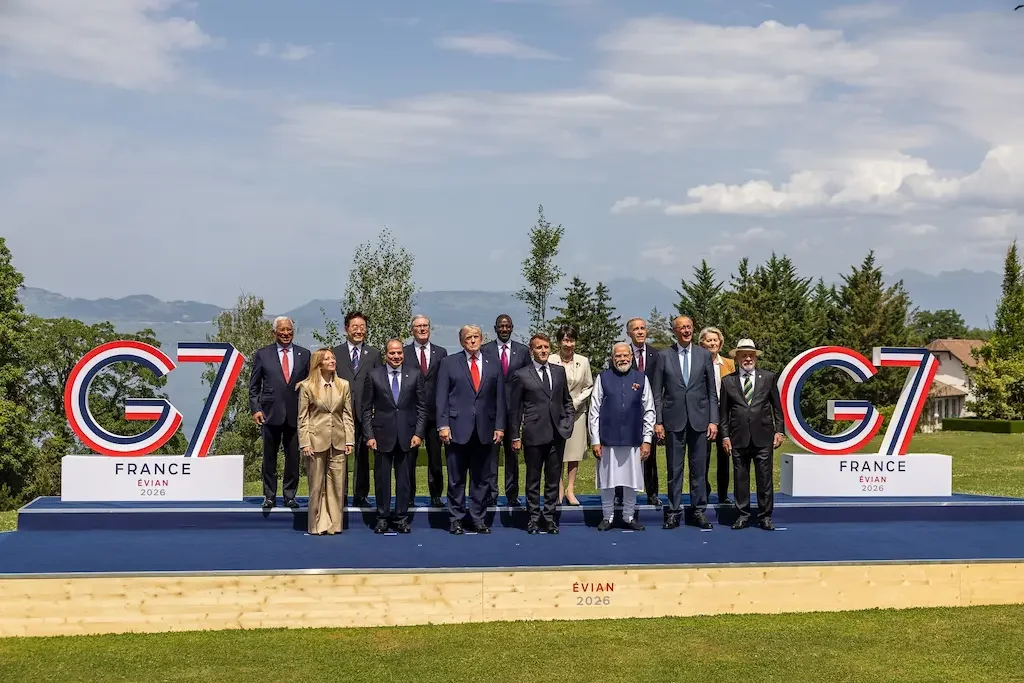
The European Parliament has finally approved the trade agreement with the U.S., but on the same day it emerged during the G7 meeting in Evian that the conflict between the EU and the U.S. remains deadlocked. The underlying cause of the conflict lies in the governance of critical minerals.
June 17, 2026 | SOURCES | INTERNATIONAL POLITICS
Mineral conflict on the agenda in Evian
On Tuesday, the trade agreement concluded by von der Leyen and Trump in Turnberry in July last year was approved by the European Parliament. The EU accepts tariffs of 15% to the United States while G7 leaders met for negotiations in Evian. The underlying conflict that has characterized the parties over the past year became evident when they discussed critical minerals. The issue includes the entire value chain for minerals defined as critical, from extraction, to processing, to components, and ultimately to finished products. How this value chain is to be governed is at the core of the conflict between the United States and the EU.
The approved Turnberry agreement is vulnerable, as products containing critical minerals will be subject to higher tariffs if the EU does not enter into a minerals agreement. To put this into context, threats from the United States of tariffs on automobiles stem from the fact that vehicle batteries contain critical minerals from China.
Canada has challenged the United States
The EU operates under mineral legislation from 2023, the Critical Raw Materials Act (CRMA). It is worth noting that this legislation has not been revised since, despite a lack of progress and changing geopolitical conditions. Read more about the EU's mineral strategy here.
Last year, Canada took the initiative for what it refers to as The Buyer's Club; the G7 Critical Minerals Production Alliance. This is an alliance in which member countries make joint purchases and build storage capacity. At the G7 this week, it was announced that partnerships with suppliers have been concluded. The Buyer's Club is being carried forward by France, which holds this year's presidency.
The United States has further developed a model from 2022, the Mineral Security Partnership, and established FORGE; the Forum of Resource and Geostrategic Engagement, in February. A number of countries have signed memoranda of understanding, and some countries have concluded bilateral minerals agreements with the US, read more here.
Negotiations on critical minerals have been central through several channels, including in connection with the NATO conflict and threats directed at Greenland. Read more here.
The conflict is now visible at the highest level, as Trump has officially rejected the Buyer's Club at the G7 meeting in Evian.
Different strategies
The Buyer's Club is adapted to the EU's mineral legislation, CRMA. It does not interfere with the authority that the EU obtains through CRMA over mineral resources and value chains covered by CRMA. All EU member states are automatically included in CRMA, and the EEA countries are planning incorporation into CRMA. In addition, the EU can obtain authority over third-country mineral resources through CRMA.
The EU has very limited mineral resources within its own territory and is therefore on the purchasing side. The Buyer's Club cannot provide price guarantees, but it is assumed that members, through joint purchasing and storage capacity, can reduce prices and thereby improve their competitive position relative to China. As Canada is a resource owner, it may be difficult to identify the Canadian benefit, but Canada is not an EU member and will not be affected by CRMA legislation. Furthermore, the model entails continued free trade with China, and Canada has over the past year established close trade relations with China. The EU's strategy is to maintain free trade with China, which contributes to the conflict with the United States.
The American model differs substantially, and the Trump administration intends to create a Western minerals market that can make itself independent of mineral supplies from China. The US wants to establish a price floor for critical minerals in order to secure a sustainable Western minerals industry and attract investors to new mineral extraction projects on Western territory. Over the past year, the US has built up a substantial mineral stockpile, launched new mineral projects on its own continent, and concluded bilateral minerals agreements with other countries. The US is laying the groundwork for a Western market large enough to bear the costs of establishing a price floor.
The EU's challenges are primarily a lack of resources within its own territory, as well as the internal market that is too small to absorb the transformation costs associated with becoming independent of raw materials from China. Neither Norway nor Greenland, both of which possess large mineral resources, have full EU membership, making these countries central to the conflict.
The United States moves forward
Trump is not waiting for the G7. Having officially rejected the Buyer's Club, the next step will be to offer bilateral agreements, with the goal of presenting offers to the EU and Japan during June. This is a planned progression by the United States described in Proclamation 11001 of 14 January this year. Initially, the offer will apply to five to ten minerals that China has subjected to export restrictions.
Through the aforementioned proclamation, Trump instructed his administration to negotiate mineral agreements and assess price floors, with a deadline of 13 July for a status report to the President.
If negotiations do not produce results by the deadline, the proclamation provides authority to impose tariffs, import restrictions, and minimum prices. Read more here.
Tariffs serve two functions in this context: they protect American mineral-related industry and help finance the price floor that the US has set out to implement. The message the US is sending with this is: join a protected Western mineral market where the cost of a price floor is shared among the allies, or pay the cost through tariffs.
Norway is the paralyzed resource owner
Norway possesses Europe's largest deposits of rare earth elements, the third largest in the world after China and Brazil.
The Norwegian government moved from having given commitments to Trump regarding mineral supplies to making a U-turn by prematurely announcing incorporation into the EU's mineral legislation, CRMA. The Labour Party government committed itself to the EU's mineral strategy as early as March 2025 and has since awaited the outcome of the conflict between the United States and the EU. This has, among other things, resulted in the Norwegian government failing to conclude a new trade agreement with the United States before the deadline of 31 July 2025. Furthermore, Norway has not joined FORGE, but did join Pax Silica in May; these, however, represent only a commitment to political cooperation, not legally binding agreements. Read in detail about the Norwegian situation here.
It is worth noting that under CRMA, a state-owned mineral company cannot operate under conditions known from Statoil/Equinor. Furthermore, Norway cannot freely invest through the sovereign wealth fund. Under CRMA, Norway must operate in the same mineral market as China, without price guarantees.
Alternatively, should Norway choose to veto the CRMA and conclude a bilateral minerals agreement with the US, Norway would be able both to run a state minerals company with investments from the oil fund, and to obtain bankruptcy protection through guaranteed price floors under a plurilateral agreement. Such a framework would have implications for every link in the supply chain; for example, the battery factory Morrow, which went bankrupt earlier this year, would have had better terms.
If Norway does not conclude a minerals agreement with the US, it is likely that Norwegian products containing minerals will be subject to tariffs under the two US sections, 232 and 301.
The Store government has not demonstrated leadership commensurate with the enormous mineral resources Norway possesses, resources that provide significant geopolitical power. Norway is a resource owner, but the government pursues a policy determined by the EU, which is on the purchasing side. The Norwegian people own Norway's mineral resources, and the government is failing in its management of those resources on behalf of the population. This could prove fatal for future Norwegian ownership, Norwegian welfare, and Norwegian sovereignty.
The United States is prepared for confrontation
If the situation develops further, the United States could move in a direction where it seeks control over Norwegian mineral resources, justified by the fact that the United States has defined both the Arctic and critical minerals as matters of national security. It is worth mentioning that the United States secured a mineral agreement with Ukraine last year through significant pressure and has directed threats toward Greenland. How such a scenario would unfold remains speculative, but over the past year the United States has both demonstrated military power and expressed dissatisfaction with NATO.
At the beginning of 2026, the United States carried out an operation against Venezuela that gave it control over Venezuelan natural resources. At the end of February, the United States and Israel launched an attack on Iran, resulting in the United States securing control over transportation routes in the Middle East. This is reinforced through an alliance with Egypt, providing control over the Suez Canal, and cooperation with Morocco, where the United States is establishing a drone station near the Strait of Gibraltar. Furthermore, the United States maintains a good relationship with Turkey, which is not an EU member. This means the United States is positioned to cut off transportation to the EU via the southern flank.
The conflict within NATO has led the United States to withdraw forces from Germany while also announcing further reductions, though these have not been specifically addressed. However, the United States has increased its military presence in Norway over the past year and has announced an increased presence in Poland. This presence means that the United States has largely positioned itself to control the EU via the northern flank and the maritime route through Skagerrak.
It is also relatively likely that the United States will increase activity in the North Sea and Skagerrak in the near future due to two factors: Russian intelligence activity directed at seabed infrastructure and the Russian shadow fleet (illegal transportation of oil). Consequently, the capability to cut off oil, gas, and electricity supplies from Norway to the EU would be in place. Such a situation would also place pressure on Greenland and Iceland, the latter is to vote on EU membership negotiations in August.
Society and Politics has repeatedly argued that Norway has a unique opportunity to resolve the conflict between the United States and the EU by entering into a bilateral mineral agreement with the United States and vetoing CRMA. The EU would nevertheless be able to secure reliable mineral supplies from Norway through trade agreements. Such a solution would require statesmanship that the Norwegian government does not appear to possess.
SOURCES
Federal Register
Proclamation 11001 – Adjusting Imports of Processed Critical MineralsUSTR
Section 301 Investigations Relating to Structural Excess CapacityUSTR
Findings in 60 Section 301 Investigations on Forced LaborÉlysée
7 Leaders' declaration on mutually beneficial international partnershipsConsilium
G7 Leaders' Joint Statements – Evian, 16–17 June 2026Reuters
Trump's critical minerals pricing plan faces skeptical G7, divided industryWhite & Case
USTR Initiates Section 301 Investigations of 16 US Trade PartnersWhite & Case
President Trump Orders Critical Minerals Trade Negotiations in Section 232 ActionDavis Wright Tremaine
USTR Launches Broad Section 301 Investigations Into Excess Supply, Forced LaborPrime Minister of Canada
Prime Minister Carney secures new partnerships in defence and critical minerals at the 2026 G7 Leaders' Summit
Content on Society and Politics is based on reliable sources and actual events, providing a news-oriented perspective intented for further debate. To access the article’s author and the related debate, membership on Hudd is required.