

The Trump administration still holds power after midterm defeat
The Democrats have taken control of Congress, but Trump’s preparations still give him power. The tariff authorities, the minerals strategy and the rapprochement with Russia cannot be stopped by Congress, and the pressure on the EU and Norway will increase.
August 4, 2026
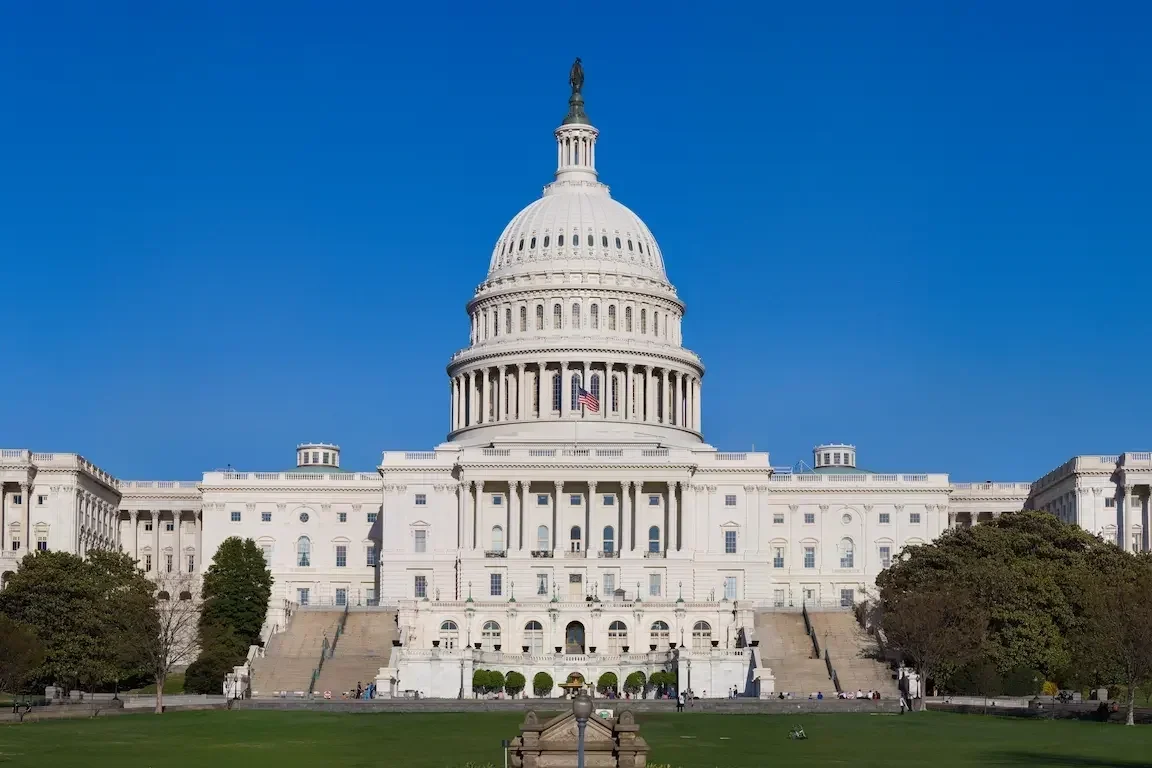
The US Congress, photo: Noclip, Wikipedia Commons

Democrats won the midterm elections
The Democrats took control of both chambers of Congress in the US midterm elections on 3 November. According to AP, the party has won 228 seats in the House of Representatives, more than the 218 needed for a majority, with 68 seats still undecided at the time of writing. In the Senate, the Democrats flipped seven Republican seats and now hold 54 against 44, with two races unresolved. The Democrats also won five governorships from the Republicans and now have 28 governors against 20.
The new Congress takes office on 3 January 2027. Until then, the Republican majority remains in place. The Trump administration thus has 60 days to secure Senate approval of Republican appointments and consolidate control over the administrative apparatus for the last two years of the presidential term. The administration also has a clear incentive to lock in agreements and pass legislation during this period. After that, Trump will govern through proclamations, executive orders and the authorities he already holds.
What the electoral defeat means for the Trump administration
The Democrats gain the power to investigate, block and slow down. They take over the committees in the House of Representatives, with subpoena power and the ability to investigate the administration, Trump’s family and business dealings. A Democratic Senate also makes it easier to stop Trump’s nominations. The Democrats have laid out a plan for their first 100 hours, with bills to remove tariffs, end the Iran war and cut health insurance costs.
But they cannot govern. Even if Congress passes a law requiring congressional approval of tariffs, Trump will veto it, and overriding the veto requires a two-thirds majority in both chambers. The Democrats do not have that.
The tariff regime remains
Since the Supreme Court ruling of 20 February 2026, the tariff architecture has rested on Section 232 and Section 301, authorities that are administrative, durable and largely protected from repeal by Congress. Trump can stop a bill to repeal the tariffs with a veto, and the veto can only be overridden by a two-thirds majority in both chambers.
The US remains in NATO, but its participation can be substantially weakened
A 2023 law establishes that the president cannot withdraw the US from the North Atlantic Treaty without the consent of two-thirds of the Senate or a law passed by Congress. The 2026 defence authorization act also prohibits reducing US forces in Europe below 76,000 troops without a certification to Congress. But Trump does not need to leave NATO to weaken it. Defence Secretary Pete Hegseth has declined to affirm the US commitment to collective defence, and experts point out that this, not the law, is what is decisive.
Continued pressure on the EU and Norway
The tariff tools, the security guarantees and energy and minerals diplomacy remain in the president’s hands. Congress can delay new measures by holding back nominations to the USTR and the Commerce Department, but it cannot take away the tools the administration already has.
How Trump can drive the project forward
The central task of Trump’s project, Make America Great Again, is to secure sufficient and reliable access for American industry to essential natural resources such as oil, gas and critical minerals. In the last category, there is a particular focus on rare earth elements, which are absolutely essential for the US to win the race for technological development, a technology that is decisive not only for industry but also for the arms industry and thus military power.
In January this year, Trump issued Proclamation 11001 following a Section 232 investigation in which the Secretary of Commerce found that imports of processed critical minerals and derivative products threaten US national security. The proclamation gives Trump the right to impose tariffs if the minerals negotiations with allies do not produce the desired result.
In short, the minerals negotiations are about establishing a price floor for critical minerals. The price floor is meant to make the minerals industry viable; Western minerals industry is marked by bankruptcies and a lack of investors, as it is impossible to compete with low prices from China. The US’s Western allies have opposed price floors in order to continue free trade with China, which the Trump administration regards as a security risk. The minerals conflict between the allies has not stopped the administration from establishing price floors in the US market, and tariffs are therefore being introduced to protect the market.
Trump has already built a system in which countries that join the US minerals strategy through agreements receive price floors, investment and access, while countries that stay outside face tariffs. On 6 August, President Donald Trump signed a new proclamation imposing tariffs on polysilicon and products made from it. A week later, on 13 August, he signed a corresponding proclamation on drones and drone components. In both cases the legal basis is Section 232, which gives the president authority to adjust imports when they threaten national security.
Furthermore, the price floor and the government equity stake in MP Materials are already in place, along with government equity stakes in, among others, Lithium Americas, the company behind Thacker Pass.
Proclamation 11001 will continue to give Trump the power to advance the strategy with new measures in the form of tariffs, quotas or minimum prices. This has the potential to hit not only ordinary European industry but also the arms industry - the latter is deeply concerning in light of the war in Ukraine and Europe’s ability to defend itself.
NATO allies should tread carefully
The prospect of a Democratic administration after 2028 may make the US’s allies overconfident. The waiting strategy the allies are pursuing rests on an assumption that Trump will have less power. But Trump has a tool Congress cannot take from him: Russia.
In October, Trump suspended sweeping new Russia sanctions that Congress itself had passed, citing US national interests. The Treasury Department has also suspended sanctions on Russian diesel until April 2027. Russia and the US are now also discussing relief for Russia’s sovereign wealth fund. This shows that even sanctions passed by Congress can be set aside by the president, and a Democratic majority does not change that.
The sanctions regime against Russia, to which Trump has contributed significantly, appears to be left with Europe as its only custodian. At the same time, Europe’s own purchases of Russian liquefied natural gas (LNG) are rising, which undermines Europe’s credibility as guardian of the sanctions. Every dollar Washington lets back into Russia’s state budget, Europe must pay for through increased support for Ukraine.
The US, Russia and Ukraine meet in Abu Dhabi on 10 and 11 November, resuming peace negotiations that were suspended in February because of the Iran war. The Europeans have been relegated to a separate meeting in Brussels on security guarantees, Europe’s post-war security architecture and the reconstruction of Ukraine. The division of roles is clear: the US negotiates peace, Europe pays for the guarantees and the reconstruction.
Norwegian Prime Minister Jonas Gahr Store and Finnish President Alexander Stubb held a telephone conversation with Russian President Vladimir Putin last week that has caused controversy. According to Store and Stubb, the purpose was to share Ukraine’s views ahead of the coming peace negotiations, and to present their own views on behalf of Norway and Finland, which share a border with Russia.
At the heart of the conflict between the US and the EU are Norwegian mineral resources; Norway has the third-largest deposits of rare earth elements in the world after China and Brazil. The conflict has led to Norway not concluding a trade agreement with the US and being subjected to high tariffs, and new high tariffs that hit Norway particularly hard can be expected. The mineral resources are also central to the EU’s engagement with Ukraine. The US has a 50/50 minerals agreement with Ukraine, but large parts of the mineral resources are located in areas occupied by Russia.
Donald Trump still has the power to do the following:
Normalize relations with Russia against Europe’s will
A peace agreement for Ukraine could open the way for US-Russian trade in energy and minerals. Russia has large deposits of rare earth elements, and Putin offered the US minerals from the occupied areas of Ukraine as early as February 2025.
Use Ukraine as leverage
Since the EU, lacking its own rare earth deposits, cannot become militarily autonomous, a US contribution is decisive for a military security guarantee for Ukraine. The EU has three options: 1) surrender Ukraine 2) conclude a minerals agreement with the US that secures a price floor and closes the door on free trade with China 3) continue the war with no, or minimal, support from the US, along with new high tariffs that will hit both European industry and the arms industry hard.
Reduce military contributions to NATO and allies
Trump cannot withdraw the US from NATO, but he can pull forces out of allied countries and reduce support for intelligence and military equipment. This could encourage Russia to attack new countries.
Respond minimally to Article 5 if Russia attacks
Trump can decide on a minimal US military contribution if Russia attacks a NATO country. This could lead to the following options: 1) the EU is forced into a new war against Russia in which it is unlikely to have sufficient resources to hold Russia at bay until a new Democratic administration comes to power in the US in 2029. 2) the NATO country that is attacked must conclude a bilateral defence agreement with the US on US terms, which is in line with the US security strategy.
Norway is particularly exposed
Norway is under heavy pressure. The Norwegian Labour government has worked against trade cooperation with the US while acknowledging its military dependence on the US and expanding military cooperation. Prime Minister Store promised Trump deliveries of critical minerals in a letter of congratulations when the latter won the presidential election in November 2024. In spring 2025, Store went back on his promises and the government announced that Norway will adopt the EU’s minerals legislation CRMA, the Critical Raw Materials Act, which would give the EU control over Norwegian mineral resources. In June 2026, however, the Norwegian Parliament (Stortinget) decided that the government must investigate a state-owned minerals company and how the obligations under CRMA are to be met. Implementation of CRMA, which both the EU and the government wanted to introduce, is therefore on hold.
Society & Politics (S&P) has previously explained why CRMA is a very poor option for Norway, read more.
Rare earth elements are the underlying cause of the very strained relationship between the US and Norway, even though it is better known that Trump believes he should have received the Nobel Peace Prize both last year and this year. Store’s involvement in the Ukraine conflict and his conversation with Putin last week make the relationship worse, read more. Norway is in the same situation Greenland has been in; through the Greenland agreement, Trump has secured indirect control over Greenland’s mineral resources, read more.
Norway has had the opportunity to conclude a minerals agreement with the US that would have served Norway better than incorporating the EU’s minerals legislation CRMA. Put simply, a minerals agreement with the US would provide a price floor for rare earth elements that protects against bankruptcy and thereby brings investors into the minerals industry. The EU’s solution is state support schemes in an industry that must compete with free trade from China, a calculation that is unlikely to add up and leads to heavy spending of public funds (read: taxpayers’ money). The Norwegian battery factory Morrow, which went bankrupt this spring, received NOK 3.3 billion in equity, most of it public money, in addition to state loans of NOK 1.5 billion, read more. Trump’s model would have given Morrow better operating conditions, as the price floor covers the entire supply chain from mine to product. The situation now is that Norway faces tariffs on certain mineral-containing products exported to the US, and more will follow.
The Labour government’s strategy of using the geopolitical situation to lead Norway into the EU without a referendum has put Norway in a very difficult situation that could have been avoided. A veto against the EU’s minerals legislation CRMA would have put Norway in a far stronger negotiating position with the US.
Whether it is still possible for Norway to conclude an advantageous minerals agreement with the US is uncertain; what is more certain is that the US will continue to force a situation in which Norway must conclude an agreement with the US. In reality, Norway now stands between the threat from Russia and an agreement with the US. Trump’s rapprochement with Putin is very challenging, and the pressure on Norway is probably among Trump’s motives for this rapprochement. There is reason to believe that Trump wants a situation in which the pressure on Norway is so threatening that Norway must conclude an agreement with the US that serves the US more than Norway, along the lines of the agreement between Greenland and the US. That would be an outcome the Labour government has led Norway into.
RELATED ARTICLES
SOURCES
The Korea Times
Democratic midterm gains may fuel fresh trade uncertainty for KoreaCBS News
Trump says he may withdraw U.S. from NATO. The law says he can't without Congress.German Marshall Fund
The 2026 National Defense Authorization Act, What Europeans Need to KnowCovington
Trump Administration Announces Results of Critical Minerals Investigation Under Section 232The White House
Adjusting Imports of Polysilicon and its Derivatives into the United StatesNBC News
Trump doubles down after waiving new Russia sanctions, calling it a very good decisionCNN
Russia and US discussing sanctions relief for Moscow's sovereign wealth fundAl Jazeera
Trump eases Russia oil sanctions, but is Europe still buying Moscow's gas?Axios
U.S., Russia and Ukraine to resume peace talks in Abu Dhabi next week, Witkoff saysThe Moscow Times
Putin Says Ready for U.S. Investment in Strategic Minerals in Occupied UkraineThe Norwegian Government
Press release on the incorporation of CRMAThe Norwegian Government
Store's letter of congratulations to Donald Trump
Content on Society and Politics is based on reliable sources and actual events, providing a news-oriented perspective.
Learn more about S&P >