

Ice-cold relations between the US and Norway
Relations between Norway and the US are at a historic low. A clear signal came when the US sent an under secretary of state to King Harald's funeral. The background is the transatlantic conflict between the EU and the US over mineral resources — and the Nobel Peace Prize.
September 12, 2026
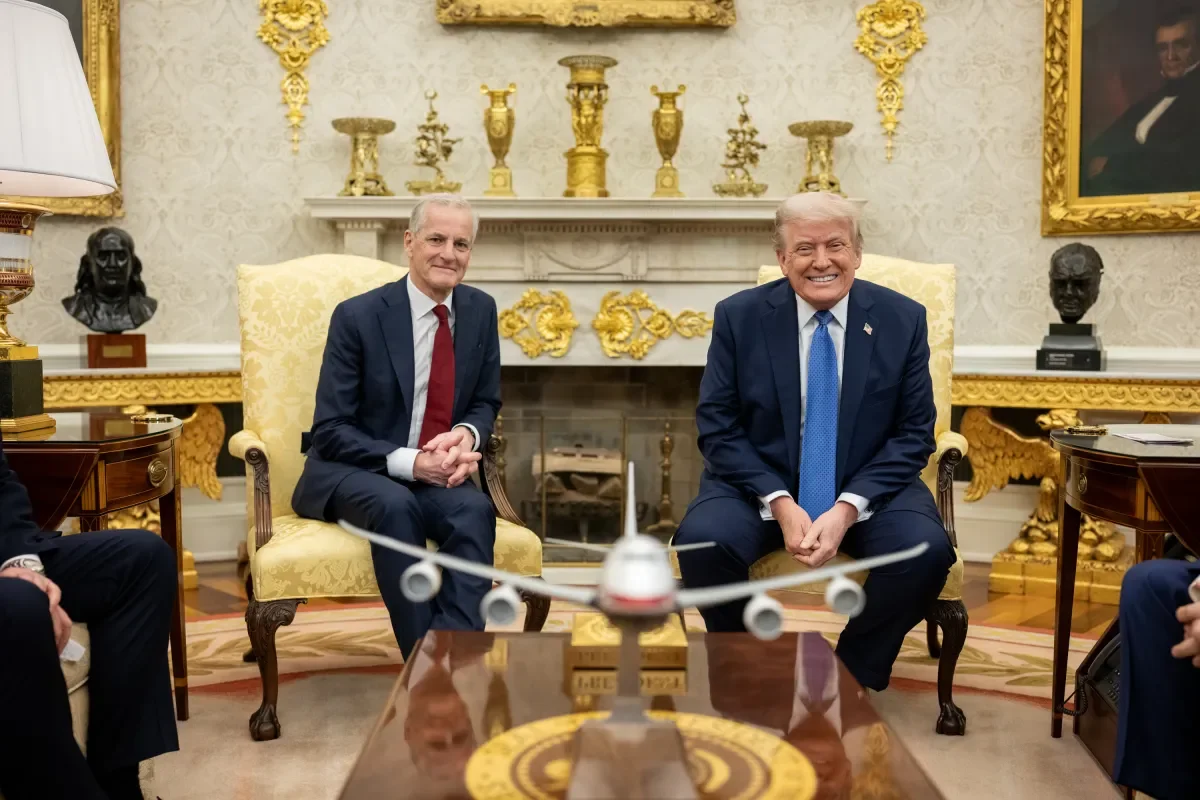
Jonas Gahr Store and Donald Trump at the White House, 24 April 2025. Photo: The White House / Daniel Torok
The US sent a diplomatic signal
When King Harald was buried on 9 September, the US used the occasion to send a diplomatic signal to Norway. While other allies sent monarchs and heads of state, or their deputies, the US sent an under secretary of state. When US President Donald Trump did not come himself, it would have been natural for the vice president or the secretary of state to attend, alternatively their deputies. But the US sent Allison Hooker, Under Secretary of State for Political Affairs, the lowest level they could diplomatically send without it constituting a direct insult.
When King Olav V was buried on 30 January 1991, the US sent Vice President Dan Quayle. The Gulf War had begun thirteen days earlier; the funeral was nonetheless given high priority.
Four weeks until the 2026 Nobel laureate is announced
The announcement of this year's peace prize is approaching, and comes on 9 October. Donald Trump believed he should have received the prize last year, read more. Trump has also been nominated for this year's prize, among others by Congresswoman Claudia Tenney (R).
Trump has stated several times that he believes the Norwegian government has influence over the choice the Nobel Committee makes, this despite the fact that both the committee itself and Norwegian Prime Minister Jonas Gahr Store have stated that the government has no influence over the decision. Trump said most recently last week, during a press briefing at the White House, that "Norway controls the shots".
The Greenland conflict
When the conflict between the US and the EU was at its most critical in January this year, Store and Finnish President Alexander Stubb sent a message to Trump to calm the situation, whereupon Trump replied to Store that he "no longer feels an obligation to think purely of peace, although peace will always be predominant for him".
Greenland's mineral resources were central to the conflict between the EU and the US — read more. The Greenland conflict, and the ongoing NATO crisis, were temporarily resolved when the EU on 5 February signed a declaration to enter into mineral cooperation with the US. The EU later followed up with a letter of intent and an action plan to conclude a binding minerals agreement, but the agreement has still not been concluded — read more. It was therefore not surprising that Donald Trump, in connection with the NATO meeting in Ankara on 7 to 8 July, repeated that the US must control Greenland — read more.
Both the EU and the US have increased their presence in Greenland over the course of the year. The EU militarily through forces from Denmark and NATO, politically through the opening of an office in Greenland, strategically through an investment package that among other things concerns the extraction of critical minerals. The US, which already has a defence agreement with Greenland, is strengthening its military presence and has opened a larger consulate and added more resources. Furthermore, both American private companies and the American state have invested in the extraction of critical minerals in Greenland.
It is less well known that Norway is as central to the conflict between the US and the EU as Greenland is. Norway has, like Greenland, both a strategic location in the Arctic and large deposits of critical minerals, read more.
A possible US confrontation with the EU
Samfunn og Politikk warned in an article, published on 18 April this year, that Norway could be used as a pawn in the conflict between the US and the EU over mineral resources. The article pointed out that a possible US confrontation with the EU could come this summer. This because there was insufficient progress from the EU in mineral cooperation with the US, and further because a presidential order (Proclamation 11001) from January announced measures against countries that do not enter into minerals agreements with the US — read more.
There are several reasons why the US may draw Norway into a confrontation, but first and foremost to put pressure on the EU, because the EU depends on energy deliveries from Norway in the form of electricity, oil and gas. A possible confrontation may therefore play out through the US cutting off energy deliveries through the North Sea and Skagerrak.
The justification from the US will lie in the fact that in November 2025 the US defined 60 critical minerals as a matter of national security. The Norwegian government announced in March 2025 that it will incorporate Norway into the EU's minerals legislation CRMA, which in practice will give the EU control over the large Norwegian mineral deposits — read more. Since the EU refrains from entering into a minerals agreement with the US, and the Norwegian government intends to incorporate the EU's minerals legislation, Norway has become central to the conflict between the EU and the US.
However, no confrontation came this summer, for the following reasons;
The EU approved the Turnberry agreement
The EU finally approved the trade agreement, referred to as the Turnberry agreement, in the European Parliament. The agreement was concluded only a few days before the negotiating deadline expired on 31 July last year. But it took a long time and considerable pressure from the US before the agreement was finally approved; it was approved a few days before the final deadline from the US expired on 4 July this year.
The US established new tariff authorities affecting the EU and Norway
Over the course of the year the US has established the legal basis for new and permanent tariff authorities that could be used from July. On 24 July, a general tariff was introduced under Section 301, Forced Labor — read more.
Further tariffs are coming on products containing critical minerals. On 6 August, tariffs were decided on polysilicon and products thereof, effective from 4 December. On 13 August, tariffs were decided on drones and drone components, effective from 3 September this year and 9 February 2027 respectively. The legal basis in both cases is Section 232, which gives the president authority to adjust imports when they threaten national security — read more.
New tariffs relating to critical minerals may also come, as well as tariffs relating to Excess Capacity under Section 301.
The war against Iran is still ongoing
Should the US decide to cut off energy deliveries to the EU against the background of an escalating conflict over critical minerals, American military vessels must be available.
The naval blockade in the Strait of Hormuz was lifted around 22 June, and American forces in the Middle East were set to be released from mid-July. This opened a window in July in which capacity could have been moved northward. The window never became real. The war continued, and the blockade was reimposed already in mid-July. USS George Washington entered the area around 19 August; USS George H.W. Bush is there enforcing the blockade. USS Abraham Lincoln is on day 295 of its deployment and is approaching the record for the longest deployment. CENTCOM reports over 15,000 personnel and over 200 aircraft and vessels in the blockade. Traffic through the strait is down from normally around 125 large merchant vessels daily before the war to seven transits observed on 10 September.
Norway joined Pax Silica and FORGE
After having refrained from mineral cooperation with the US since March last year, Norway joined the Pax Silica initiative on 6 May this year. On 10 July, Norway was incorporated into FORGE (Forum on Resource Geostrategic Engagement), the American-led mineral cooperation launched on 4 February this year to replace the Minerals Security Partnership. State Secretary Marte Gerhardsen confirmed the FORGE affiliation during Arendalsuka on 10 August, although it has otherwise been quiet from the government about the incorporation — read more.
Pax Silica and FORGE are political cooperation only; neither affiliation is legally binding.
What lies ahead in the relationship between the US and Norway
Jonas Gahr Store and the Norwegian government have placed Norway in a very difficult position vis-à-vis the US. While the government acknowledges dependence on NATO and the US for defence against Russia and cooperates militarily, the government works against the Trump administration politically.
Norway has not concluded a trade agreement with the US
Norway has not concluded a trade agreement with the US — read more. This affects the tariffs Norway is subject to. The tariffs are added on top of ordinary duties (MFN). The EU, and countries with a trade agreement, have an upper tariff ceiling where the sum of the tariff and the MFN duty cannot exceed a set percentage, which for the EU is 15 per cent. Norway currently has tariff rates exceeding 15 per cent on some products, and more will come.
Despite Norway having protested against the tariffs introduced, the protests are not succeeding. The US response is that one must either meet the conditions for lower tariffs or exemption, or have a trade agreement. Norway has not met the US on either point.
The US is examining the oil fund
On 11 March 2026, the US opened a Section 301 investigation of sixteen economies, including Norway, for structural excess capacity in manufacturing sectors. The oil fund may also be affected; the notice states that Norway engages in policies and practices that have the effect of undervaluing its domestic currency, including the use of state-owned or -controlled enterprises to recycle oil revenues into non-domestic currencies.
The accusation is that Norway keeps the krone artificially low by channelling oil revenues out into foreign currency through state-controlled entities — the very mechanics of the fiscal rule.
A new ambassador to Norway
The new US ambassador to Norway, Michael Kavoukjian, was confirmed by the Senate on 7 August by 51 votes to 47. It has not been made public when Kavoukjian arrives in Norway.
At the nomination hearing in the Senate Foreign Relations Committee on 20 May, Kavoukjian stated his priorities: defence cooperation with particular attention to Russian and Chinese activity in the Arctic, as well as critical minerals and energy to diversify the global supply chain.
Increased American presence
At the same time as the political relationship cools, the US is building out military infrastructure in Norway. The supplementary defence cooperation agreement was expanded from four to twelve agreed facilities and areas with effect from 10 June 2024, and now comprises Andoya, Orland, Haakonsvern, Værnes, Bardufoss, Setermoen, the Osmarka mountain facility and the Namsen fuel depot, in addition to Rygge, Evenes, Ramsund and Sola.
At Rygge air station, the US Army Corps of Engineers is erecting five facilities for over 200 million dollars, financed through the European Deterrence Initiative: perimeter security, expanded munitions storage, a facility for quick reaction alert aircraft, a billeting area, and a facility for deployable air base operations. Construction began in late 2024 and was still ongoing in October 2025, when billeting for a further 576 soldiers was put out to tender.
The American investments go to infrastructure on Norwegian soil that the US itself will use: runway, billeting, fuel, mountain facilities. With this, the US is increasing its operational capability in the High North.
A confrontation may still come
Should the measures the US has implemented in connection with Proclamation 11001 fail to succeed, it cannot be ruled out that a confrontation with the EU will occur in which Norway is involved. A first sign of this may be that the US moves military vessels to the North Sea and Skagerrak under the pretext of contributing to surveillance of the Russian shadow fleet and critical infrastructure on the seabed.
Comment from S&P
S&P has pointed out in earlier articles that Jonas Gahr Store has made many mistakes in his handling of the relationship with Donald Trump — read more here. The lack of understanding of the geopolitical game may prove fateful for Norway. Norway is in a particularly exposed position with the threat from Russia and China in the north, and Store has thus led Norway into a dangerous situation.
Behind the policy pursued by the Labour government lies a strategy to bring Norway into the EU. High tariffs may convince the population that Norway must become an EU member, or the government may convince the Storting to bring Norway into the EU without the consent of the people.
The government's justification for the political track towards the US is that Norway will not enter into an agreement at any price. The population is not told which American demands the government has rejected on the people's behalf. As regards the EU, no information is given about what it entails for Norwegian sovereignty, industry and welfare to incorporate the EU's minerals legislation CRMA.
The American intentions are, however, transparent where the European Union's intentions are not. The US wants to free the West from Chinese dominance over the supply chains for critical minerals by establishing a Western mineral market — read more. To attract investors to the mineral industry, the US will establish a price floor for critical minerals to provide protection against bankruptcy in the competition against China. The EU opposes this because EU industry is a major consumer of critical minerals, while there are few mineral deposits within the EU's own territories. EU policy is to a high degree driven by the fact that the EU is a resource consumer, not a resource owner.
The EU's trade policy is generally a threat to Norway as a resource-rich country, but particularly so in relation to minerals, since the EU's minerals legislation CRMA is the strictest and most intrusive ever — read the situation in detail in The Mineral Petition, Control over Norwegian Mineral Resources.
S&P has on several occasions argued that Norway can, and should, resolve the transatlantic minerals conflict between the US on one side and Europe on the other. Norway is in a unique position to resolve the conflict by entering into a minerals agreement with the US while retaining control over Norwegian mineral resources. The EU is in any case dependent on the geographically close natural resources from Norway; there is no reason for Norway to let the EU set the terms for Norwegian resource and trade policy.
S&P will furthermore point out that it is very serious that the Norwegian government is breaching the democratic principles of the people's right to insight and influence in a matter concerning Norway's military security, sovereignty and welfare.
SOURCES
House Foreign Affairs Committee
Allison Hooker, Under Secretary of State for Political AffairsU.S. Code
§5314. Positions at level IIICaliber.Az
Media: Trump to skip funeral of late Norwegian King Harald VDagbladet
The US sends "unknown" Allison Hooker to King Harald's funeral: Experts reactNobelPrize.org
Prize announcement datesNorwegian Nobel Institute
NominationClaudia Tenney
ICYMI: Congresswoman Tenney Nominates President Trump for Nobel Peace Prize for Third TimeNBC News
Trump again says "Norway controls the Nobel Prize," but an independent panel doesRegjeringen (Norwegian Government)
Statement from the Prime MinisterNPR
Norway says Trump cited Nobel loss when discussing GreenlandForsvaret (Danish Armed Forces)
The Armed Forces' increased presence and exercise activity in Greenland 2026Forsvaret (Danish Armed Forces)
New Danish-led exercise activity in and around Greenland becomes part of NATO's Arctic SentryEuropean Commission
EU and Greenland strengthen partnership and engagement, backed by €200 million in EU investmentThe Spokesman-Review
US opens Greenland consulate as unease grows over Trump pushStars and Stripes
US seeks to expand Greenland military presence in 3 areasCritical Metals Corp
Greenland Government Approves Transfer of Final 50.5% of Tanbreez, Taking Critical Metals Corp. to 92.5% OwnershipFederal Register
Adjusting Imports of Processed Critical Minerals and Their Derivative Products Into The United StatesFederal Register
Final 2025 List of Critical MineralsFederal Register
Notice of Actions in Section 301 InvestigationsGlobalSecurity.org
Iran War Operations ReportThe War Zone
Where Are The Aircraft Carriers: September 9, 2026Regjeringen (Norwegian Government)
Norway Joins the Pax Silica InitiativeUSTR
Section 301 – Structural Excess Capacity and Production in Manufacturing SectorsSenate Foreign Relations Committee
NominationsSenate Foreign Relations Committee
Statement of Michael KavoukjianRegjeringen
SDCA: Avtale om flere omforente områder trer i kraftStars and Stripes
Build up to bed down: US eyes project to give 500-plus troops Norway airfield digsEuropean Commission
Critical Raw Materials Act
Content on Society and Politics is based on reliable sources and actual events, providing a news-oriented perspective.
Learn more about S&P >