

What the parties got in the Greenland agreement
The agreement between the US, Denmark and Greenland was signed and made public in New York on 22 September. The agreement contains nine new elements, two of which affect who can extract critical minerals on the island.
September 23, 2026
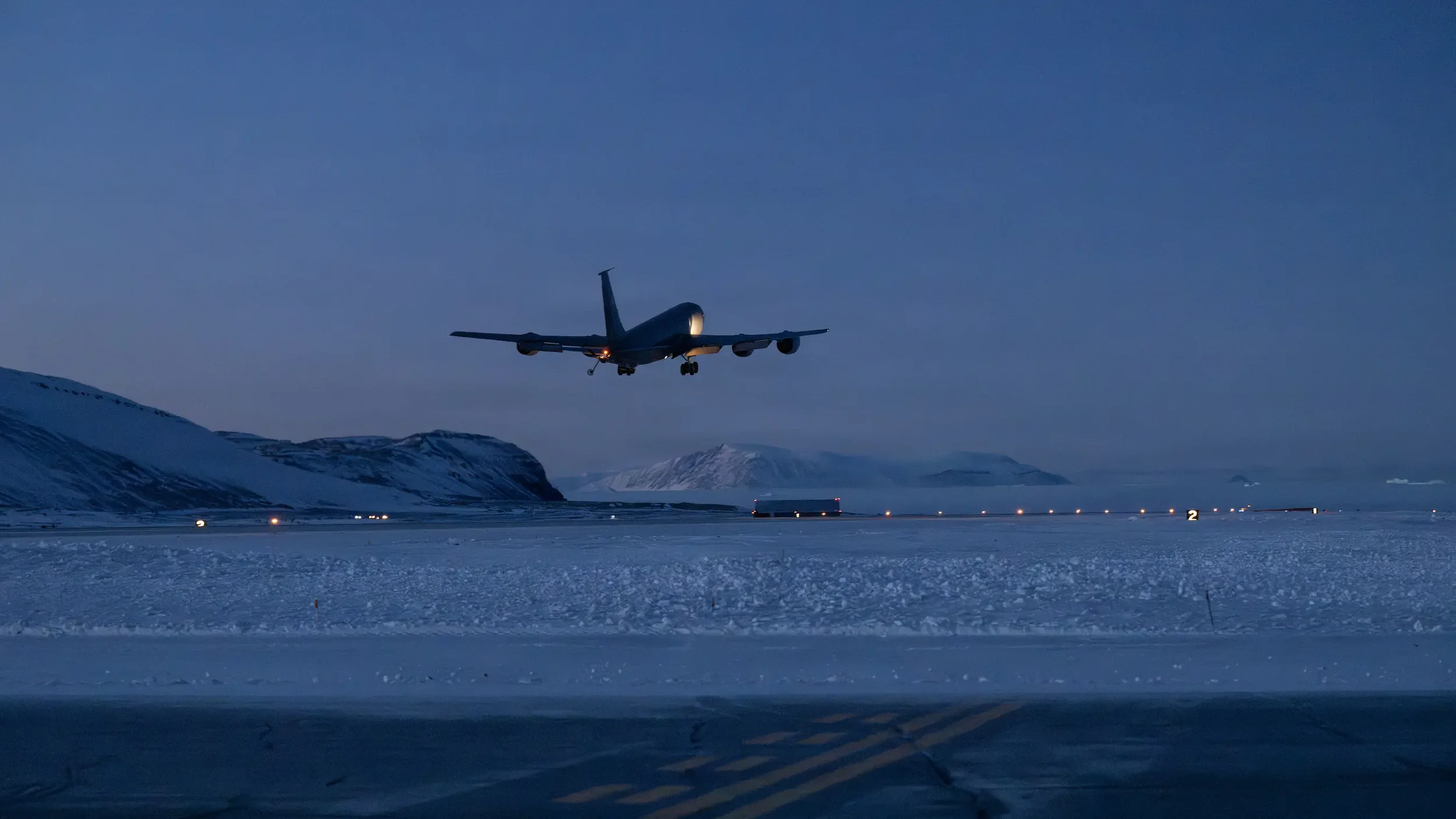
A KC-135 Stratotanker refuelling aircraft takes off from Pituffik Space Base in Greenland. Photo: Master Corporal Bélynda Casse, 3 Wing Bagotville, via DVIDS
New agreement supplements previous agreements
The agreement signed in New York on 22 September amends and supplements the 1951 Defence Agreement. At the signing, Danish Prime Minister Mette Frederiksen emphasised that the agreement recognises the sovereignty of the Kingdom and the Greenlandic people's right to self-determination. Greenland's Premier Jens-Frederik Nielsen stated that it safeguards the people's rights, livelihoods and the development of the country. US President Donald Trump stated that the agreement is fantastic for the parties and that it will protect Europe. When Trump announced on Truth Social on Friday that an agreement had been reached, he wrote that it would give the US permanent control over security and all other needs in Greenland.
The agreement covers nine new elements
The agreement builds on the 1951 Defence Agreement, the 1968 exchange of notes, the 1991 Memorandum of Understanding, the 2003 Dundas Memorandum, the 2004 Igaliku Agreement and the 2020 exchange of notes. Nine elements have been added in the new agreement.
The agreement cannot be terminated
Article XI establishes that the agreement has no end date, and it can only be amended by mutual consent. The 1951 agreement was tied to the duration of the North Atlantic Treaty and would have lapsed with it. The new agreement has no such link.
An independent Greenland inherits the obligations
Article XI obliges Denmark and Greenland jointly to ensure that any independent Greenlandic state remains in NATO, if necessary by applying for membership, and expressly assumes all rights and obligations under the agreement from the day of independence.
The preamble recognises that the people of Greenland have the right to self-determination under international law, and refers to section 21 of the Self-Government Act. Article XI nevertheless sets conditions on what a yes to independence would mean. Greenland can choose to become independent, but cannot opt out of NATO membership or the US defence presence.
Two new defence areas
Article IV gives the US access to modernise and expand Pituffik, and to establish defence areas at Narsarsuaq and Mestersvig. After 2004, Pituffik was the only active defence area. Narsarsuaq was a US base during and after the Second World War, and Mestersvig is today a Danish military outpost.
Narsarsuaq is located in South Greenland, about 40 kilometres from Kvanefjeld and close to Tanbreez, where the two largest known rare earth deposits on the island are located. Mestersvig in the northeast is a former mining site, where the Blyklippen lead and zinc mine operated from 1956 to 1963.
Time limit on processing new defence areas
Article IV (iii) allows the US to establish further defence areas beyond the two mentioned above. If the parties do not reach agreement within 90 days in the Permanent Committee where this is to be handled, the matter is escalated to deputy minister level and then to ministerial level.
Previously, negotiations had no deadline; now a disagreement can be escalated up through the system. The deadline moves a dispute from the civil service to the political level within three months.
Unmanned installations outside the defence areas
Article V requires Denmark and Greenland to process requests for unmanned military installations outside the defence areas under expedited approval procedures. This did not exist in previous agreements. Sensors and unmanned facilities can thus be set up without anything having to be redefined as a base.
Right of movement in Greenland
Article VI gives the US the right of free access and movement between the defence areas throughout Greenland, including its territorial waters, on land, in the air and at sea. US aircraft may overfly and land on any territory, and US vessels may have unrestricted underwater access to territorial waters unless the parties agree otherwise.
Two points are new compared with the 1951 agreement. US state vessels gain underwater access to and movement within territorial waters. The reservation in the 1951 agreement that access was to be exercised in accordance with general rules agreed and issued by the competent Danish authority in Greenland has not been carried over.
Investment screening as a treaty obligation
Article X prohibits states and investors from countries outside NATO, NATO partners and the EU from having control, significant influence or access to non-public information in particularly sensitive sectors in Greenland. Exceptions require agreement between the parties, that is, US consent.
The definition of particularly sensitive sectors includes critical infrastructure and resource extraction, among others, without an exhaustive list. Danish authorities are also required to consult US authorities in such matters, under modalities determined by the authorities themselves.
This did not exist in any previous agreement. Since any exception requires US consent, the provision will in practice function as a veto over non-Western capital in Greenlandic minerals and infrastructure.
Security around the bases, regardless of ownership
Article VII establishes that territory in the vicinity of a defence area shall not be used in a way that threatens security in the area. It gives the US the right to raise concerns about any building, facility or installation in the vicinity. The parties shall then jointly determine the necessary measures.
No previous agreement has had a corresponding provision on the use of areas outside the defence areas.
The provision is location-based, not investor-based. It applies regardless of who owns the building, facility or installation in question - the exception for EU investors in Article X does not apply here. Where the actual physical boundaries of the defence areas and "in the vicinity" lie is not defined in the text.
Golden Dome and counter-espionage
The preamble expressly mentions the establishment of a Golden Dome defence system as part of the purpose of US military access. Article VII also requires Danish authorities to cooperate with US authorities to counter espionage in Greenland. Neither was included in previous texts.
What Greenland has gained
Greenland had its self-determination confirmed, received assurances regarding nature and way of life, a promise of contracts for local suppliers, but no right to withdraw from the arrangement, either now or as an independent state.
Article IV (iv) obliges the US to award contracts related to the establishment, maintenance and operation of the defence areas to Greenlandic suppliers to the greatest extent possible, taking into account the suppliers' capacity and ability to carry them out. The parties shall update the 2020 notes to ensure this. The capacity reservation is significant; Greenlandic businesses currently have limited ability to take on large construction contracts, and how much will actually end up locally depends on how the reservation is applied.
The preamble also confirms the sovereignty and territorial integrity of the Kingdom of Denmark, recognises that the people of Greenland have the right to self-determination, and refers to the need to protect Greenland's nature and to Greenlanders' rights to land, hunting and fishing. Article VI establishes that US access rights must be exercised in a manner that respects Greenlandic society and way of life to the greatest extent possible.
Although it may have appeared that the US demanded sovereignty, the US has not formally made this demand. Since August 2019, Donald Trump has expressed a desire to buy Greenland, and the conflict escalated on 6 January this year when the White House press secretary stated that use of the US military was an option. On 8 January, Trump stated that he needed all of Greenland for security reasons, not merely to exercise the long-standing treaty that gives the US authority to use the island militarily. At the same time, however, it was made clear that the US respects the Greenlandic people's right to determine their own future, and Trump addressed the inhabitants directly and asked them to choose the US. The sovereignty question was thus directed at Denmark, which holds sovereignty over Greenland, not at the Greenlanders themselves. The formal US demand was access and defence control over the island and the US defence installations, which included who operates on the island for commercial reasons. The US demand triggered a NATO crisis that led NATO Secretary General Mark Rutte to lead the negotiations initially, read more.
The confirmation of sovereignty and self-determination in the preamble is therefore not perceived as a loss in Washington; the course of events was rather a rhetorical negotiating move. Either way, Frederiksen and Nielsen can present it as a victory.
What the US has gained
The US has obtained the access and defence control it asked for, without the cost of taking over responsibility for the island and its 56,000 inhabitants.
The difficult point in the negotiations concerned the critical mineral deposits. The US does not gain ownership of Greenlandic minerals, nor any right of first refusal. But two mechanisms in the agreement will nevertheless ensure that the US largely controls who extracts minerals in Greenland.
The first is nationality-based. Article X shuts out investors from countries outside NATO, NATO partner countries and the EU from particularly sensitive sectors, of which resource extraction is expressly mentioned. Exceptions require agreement between the parties, which means the US can block an investment that breaches the conditions. This is specifically aimed at China, without the country being named in the agreement. China has previously held ownership interests in mineral projects on the island, including Kvanefjeld and Isua, none of which have been realised.
Although investors from NATO and the EU fall outside the investment ban, the US can control investments through another article in the agreement.
Article VII is location-based and applies regardless of ownership. Any building, facility or installation in the vicinity of a defence area is covered by Article VII, and this gives the US the right to give notice when the security of the defence installation is threatened. What "in the vicinity" means is unclear, as neither the boundaries of the defence area nor a security zone are defined in the agreement.
Although Article VII is a weaker article, it grants a right of notification that will trigger a process in which the parties must jointly find solutions. Unlike the time-limited process for establishing new defence bases on the island, Article VII has no deadlines, no escalation mechanism and no rule for dispute resolution. In practice, it will be difficult to find investors for mineral projects with unclear and lengthy licensing processes.
This means that the US can in practice stop or delay investments from both NATO and EU countries near its bases. The two mechanisms each cover their own ground: Article X covers who, Article VII covers where.
In November 2025, the US defined critical minerals as a matter of national security. The need to control minerals stems from supply chains being critical not only for ordinary industry but also for the arms industry.
Where the bases are and where the minerals are
Narsarsuaq is located in South Greenland, in the middle of the most mineral-rich part of the island. Kvanefjeld lies six kilometres from the town of Narsaq and around 40 kilometres from Narsarsuaq, with rare earths, uranium and zinc. Tanbreez in Killavaat Alannguat, which also has rare earths, lies close by. Both are among the largest known rare earth deposits outside China. Narsarsuaq is also the logistics hub for the entire area, with an airstrip and fjord access, the infrastructure any mining project in the south must use.
Mestersvig in Northeast Greenland is a former mining site. The Blyklippen lead and zinc mine operated from 1956 to 1963. Jameson Land and the Karrat basin have known lead, zinc and copper deposits.
Pituffik in the northwest lies furthest from the known economically viable deposits. There are ilmenite and heavy mineral sands, including the Dundas project at Moriusaq. The base's significance there is strategic, not geological.
Two of the three defence areas are thus located on or near the most important mineral provinces.
The agreement enters into force when Denmark and Greenland have completed the necessary parliamentary procedures. Whether the Danish Parliament, the Folketing, and Greenland's Parliament, Inatsisartut, will know the boundaries of the defence installations and security zones before they vote is unknown.
RELATED ARTICLES
SOURCES
The Avalon Project, Yale Law School
Defense of Greenland: Agreement Between the United States and the Kingdom of Denmark, April 27, 1951U.S. Government Publishing Office
Defense: Greenland, Agreement Between the United States of America and Denmark Amending and Supplementing the Agreement of April 27, 1951, Signed at Igaliku, August 6, 2004, with Joint DeclarationsU.S. Department of State
Denmark (03-220), Memorandum of Understanding Concerning the Dundas AreaU.S. Government Publishing Office
Defense: Cooperation, Memorandum of Understanding Between the United States of America and Denmark, Signed at Nuuk, February 20, 2003, with Related Exchange of NotesDanish Defence
About Joint Arctic CommandTanbreez
Mine Location / Area
Content on Society and Politics is based on reliable sources and actual events, providing a news-oriented perspective.
Learn more about S&P >