

What Does the Greenland Agreement Mean for Europe?
On Friday evening, Donald Trump announced that the US has entered into an agreement with Denmark and Greenland that gives the US permanent control over security in Greenland, as well as a veto over sensitive investments. This has consequences for Europe.
September 19, 2026
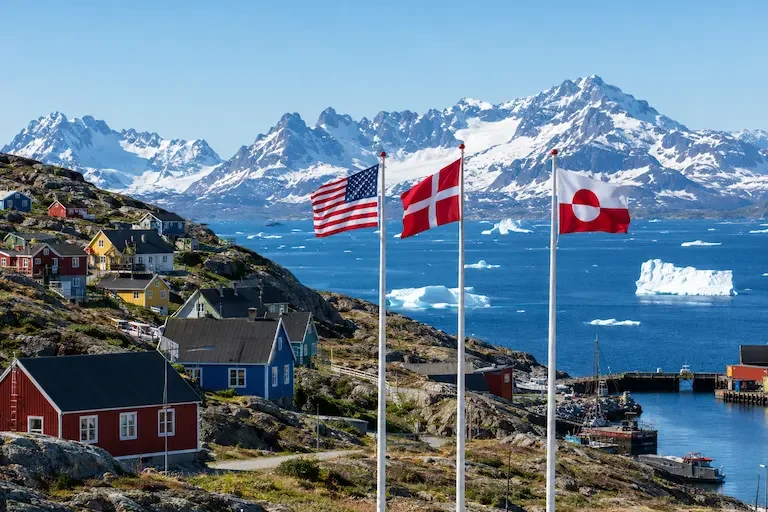
Image by AI/S&P
Gives the US Permanent Control over Security and Investments
The announcement came on Truth Social on Friday evening and is reproduced in full below. The Danish Prime Minister's Office states that an agreement is expected to be signed next week. Fox News reportedly had the content confirmed by a senior US official, as well as by Secretary of State Marco Rubio, who told the network that it is a historic and major victory for the US.
According to the information provided, the agreement will not deprive Greenland of its sovereignty. It does, however, give the US permanent control over security and «all other needs» in Greenland, at no cost to the US according to Trump, who describes it as an «Infinite Life» agreement with no end date. None of the US's adversaries will be able to establish bases, have a military presence or make sensitive investments in Greenland without written approval from the US. The US will immediately begin building up a large military presence on the island.
Fox reports that only the US and its allies will be able to make sensitive investments in Greenland, citing telecommunications infrastructure, subsea cables, ports and critical minerals as examples. The background is that the administration wants to prevent Greenland from becoming a vulnerability in the way the Panama Canal did, where Chinese commercial interests raised concerns that civilian infrastructure could have implications for national security.
Critical Minerals as a National Security Concern
In November 2025, the US defined a list of 60 critical minerals as a national security concern. In January this year, Trump ordered his administration to enter into mineral negotiations with allies with the aim of concluding mineral agreements, the Agreement on Trade in Critical Minerals (ATCM). The order refers to measures such as tariffs and import restrictions if agreements are not reached, on grounds of national security. At the same time, the US has established a legal arsenal that makes it possible to introduce permanent tariffs, and the first two tariffs on mineral-containing products have already been decided, read more here.
The Framework for the Greenland Agreement Dates Back to January
At the start of the World Economic Forum conference in Davos in January, the Greenland conflict was at its most intense. Trump maintained that both American and Western security depended on American control over Greenland. A military conflict, or a split within NATO, was feared in Europe. Trump threatened several European countries with punitive tariffs for taking part in a military exercise in Greenland, and French President Macron argued that the European Union should respond by restricting American access to the EU's single market, referred to as the trade bazooka, read more here.
In his speech at the WEF conference on 21 January, Trump announced that agreement had been reached on a framework for Greenland related to missile defence and American bases. This framework had been negotiated by NATO Secretary General Mark Rutte, who said in an interview with Bloomberg that the framework covered both military and economic matters. Trump also gave an interview to CNBC in which he presented the framework as a concept linked to missile defence (Golden Dome) and mineral rights, read more here.
Greenland's mineral resources are arguably even more important to Europe than to the US, read more about Greenland's mineral deposits and strategic importance in geopolitics here.
The EU followed up on this framework with a joint declaration on mineral cooperation with Japan and the US on 4 February. This was the day the US launched FORGE (Forum on Resource Geostrategic Engagement) at a meeting on critical minerals called the Inaugural Critical Minerals Ministerial. This was the first written signal that an agreement on Greenland had been reached. On 14 February, Secretary of State Marco Rubio gave a conciliatory speech at the Munich Security Conference, where he announced that Norway, another mineral-rich country, is also entering into mineral cooperation with the US. The strained mineral conflict between the US and Europe appeared resolved for the moment, read more here.
However, it has been a long and winding road before the Greenland Agreement came about, if it is indeed signed next week. The story began with a clash between Ukrainian President Zelensky and President Trump in the White House on 27 February 2025, which arose because the former would not sign a minerals agreement without military guarantees from the US. The mineral conflict between the US and Europe has since been closely followed by S&P, and the developments and details can be found in our geopolitical archive.
Greenland, Denmark and the EU Had No Realistic Alternatives
Europe is in such a precarious shortage of resources, both energy and critical minerals, that there were no realistic alternatives. Critical minerals and rare earth elements are essential for weapons production and advanced military equipment. The demand for energy and mineral raw materials in a war is enormous. The EU's actual mineral situation is classified, but it is assumed that the EU only has mineral stockpiles for four months in a war, read more here.
The situation became even more strained for the EU when the US entered into a minerals agreement with Ukraine in April 2025. The agreement established a joint investment fund to which Ukraine contributes 50% of the revenue from new natural resource licences, and the US gained preferential rights to invest in and purchase the resources.
It is difficult to see what the EU has achieved by waiting so long to reach an agreement on Greenland. Under Trump, the EU economy has seen weak growth, inflation has risen from 2.0 to 3.2 percent, unemployment has increased to 6.4 percent and exports to the US have fallen by 26 percent.
At the same time, the population has become politically polarised as European leaders have responded to American conservatism by flirting with communist China, read more here.
The Greenland Agreement is a significant defeat for the EU, which the European mainstream media is unlikely to comment on.
But it may point to a resolution of the mineral conflict between the EU and the US, even though it was the US that unilaterally had its demands met. Even so, there is unlikely to be a permanent solution until the EU itself signs a minerals agreement with the US, read more here.
The latest developments between the EU and Canada, where they will enter into a formal alliance, could become an obstacle to a more stable relationship between the US and the EU. This is because critical minerals are also a central issue in the trade conflict between the US and Canada, read more here.
Minerals from Greenland and Canada are, moreover, of little value to the EU if the US is an enemy, as the transport routes could be cut off.
Norway Is the EU's Last Mineral Straw
Like Greenland, Norway has a strategic location in the Arctic and large deposits of critical minerals. The Fen Complex in Telemark holds Europe's largest known deposit of rare earth elements and is believed to be the third largest in the world after deposits in Brazil and China. The EU's own territories contain only modest mineral resources.
The relationship between Norway and the US is ice-cold, partly because Prime Minister Jonas Gahr Støre has made promises he has not kept. In a congratulatory letter to Trump after he won the presidential election in November 2024, Støre promised deliveries of critical minerals to the US. Just months later, in March 2025, the Norwegian government issued a press release stating that it is working to incorporate the EU's mineral legislation, the CRMA, into Norwegian law, which would give the EU authority over Norwegian mineral resources. Read the details of the very strained situation between Norway and the US here.
More than 17 months after Trump announced the tariffs on the so-called «Liberation Day» on 2 April 2025, Norway has still not concluded a trade agreement with the US. As a result, Norway has no tariff cap and is therefore harder hit than the EU by the tariffs introduced so far. The US has Norway in its sights for several tariffs. In April, S&P warned that the US could use Norway as a pawn in the trade and mineral battle with the EU by declaring Norway an American security concern due to its location in the Arctic and its mineral resources, read more here.
Norway will remain central to the mineral conflict until there is a minerals agreement between the EU and the US, or a minerals agreement between Norway and the US.
It is arguably even harder to see what Norway has gained by delaying an agreement with the US than what the EU gained by delaying for so long. For 17 months, S&P has studied, analysed and reported on the European and American mineral strategies in light of China's mineral dominance. The situation was predictable, as the articles on S&P show, and it is remarkable that thousands of European heads of state, government ministers and diplomats have not found better solutions.
For Norway's future sovereignty, democracy and welfare, the American mineral strategy is far better for Norway than the European one. The Union's trade policy is generally characterised by the fact that where power lies, in Central Europe, industry is dependent on enormous amounts of imported raw materials. When it comes to critical minerals, trade policy is particularly shaped by this phenomenon. The EU's trade policy and single market are hostile to resource owners such as Norway. Iceland has just chosen to refrain from EU membership negotiations for this very reason, read more here.
It is difficult to see any motive for the Labour government's policy other than a decades-long struggle for EU membership, a membership the Norwegian people oppose. If conditions for Norwegian industry become difficult as a result of tariff walls, it will serve the government's case for EU membership, and that is where the motive lies.
As Finance Minister Jens Stoltenberg himself writes in his book On My Watch: «No one has fought as hard for the EU as I have.»
SOURCES
Danish Prime Minister's Office
Expected agreement on strengthened security in the Arctic and the North Atlantic regionFox News
Trump declares victory in historic deal with Greenland as he secures 'permanent' US military rightsThe White House
Adjusting Imports of Processed Critical Minerals and Their Derivative Products into the United StatesU.S. Department of State
2026 Critical Minerals MinisterialEurostat
GDP up by 0.6% and employment up by 0.1% in the euro areaEurostat
Euro area unemployment at 6.4%Eurostat
EU trade with the United States - latest developmentsAllianz Trade
The price of political fragility in EuropeBanco de España
Political polarization in Europe (Working Paper 2533)Norwegian Government
Letter to President-elect Donald J. Trump (Støre's congratulatory letter, 7 November 2024)Norwegian Government
The Government will incorporate the EU's rules on critical raw materials into the EEA Agreement
Donald Trumps message om Truth Social
BREAKING NEWS: I am pleased to announce that the United States of America has entered into an Agreement with The Kingdom of Denmark, and Greenland, that gives the United States permanent control over security, and all other needs, in Greenland, completely addressing ALL of our many U.S. concerns. There will be NO COST to the United States! At my direction, we worked with representatives of Denmark and Greenland to guarantee that the United States will FOREVER have the complete ability to do what is necessary in Greenland in order to secure and defend the security of Greenland, and the United States of America. Additionally, from now on, no U.S. adversary can EVER have a base in Greenland, have a military presence in Greenland, or make sensitive investments in Greenland, without our express written approval. For over 100 years, Presidents have known the strategic importance of Greenland, but NONE of them were able to do anything about it. I am proud to be the President that permanently and conclusively addressed this very important situation. This is an “Infinite Life” Agreement, there is no end! We are very honored and proud of what has just taken place, and everything agreed to today will be cherished by the American People. We will immediately begin the process of developing a large Military presence in the appropriate part of Greenland, of which there are many. We will work with the people of Greenland in its development and construction. This solution is a great one for the United States of America, Denmark, Greenland, and all of our Allies. We look forward to working with the wonderful people of Denmark and Greenland toward a magnificent future with respect to this large, and highly strategic, parcel of land. We will be very protective of it! This is a dream come true for the United States of America, one that is very important, historic, and special. Thank you for your attention to this matter! President DONALD J. TRUMP
Content on Society and Politics is based on reliable sources and actual events, providing a news-oriented perspective.
Learn more about S&P >