

US Intervenes in European Politics
The United States is exerting pressure on Europe through strategic and political interference; Denmark, Iceland and Hungary are affected. The result is steadily increasing polarization that European leaders are unable to contain, but instead contribute to.
April 7, 2026 | INTERNATIONAL POLITICS
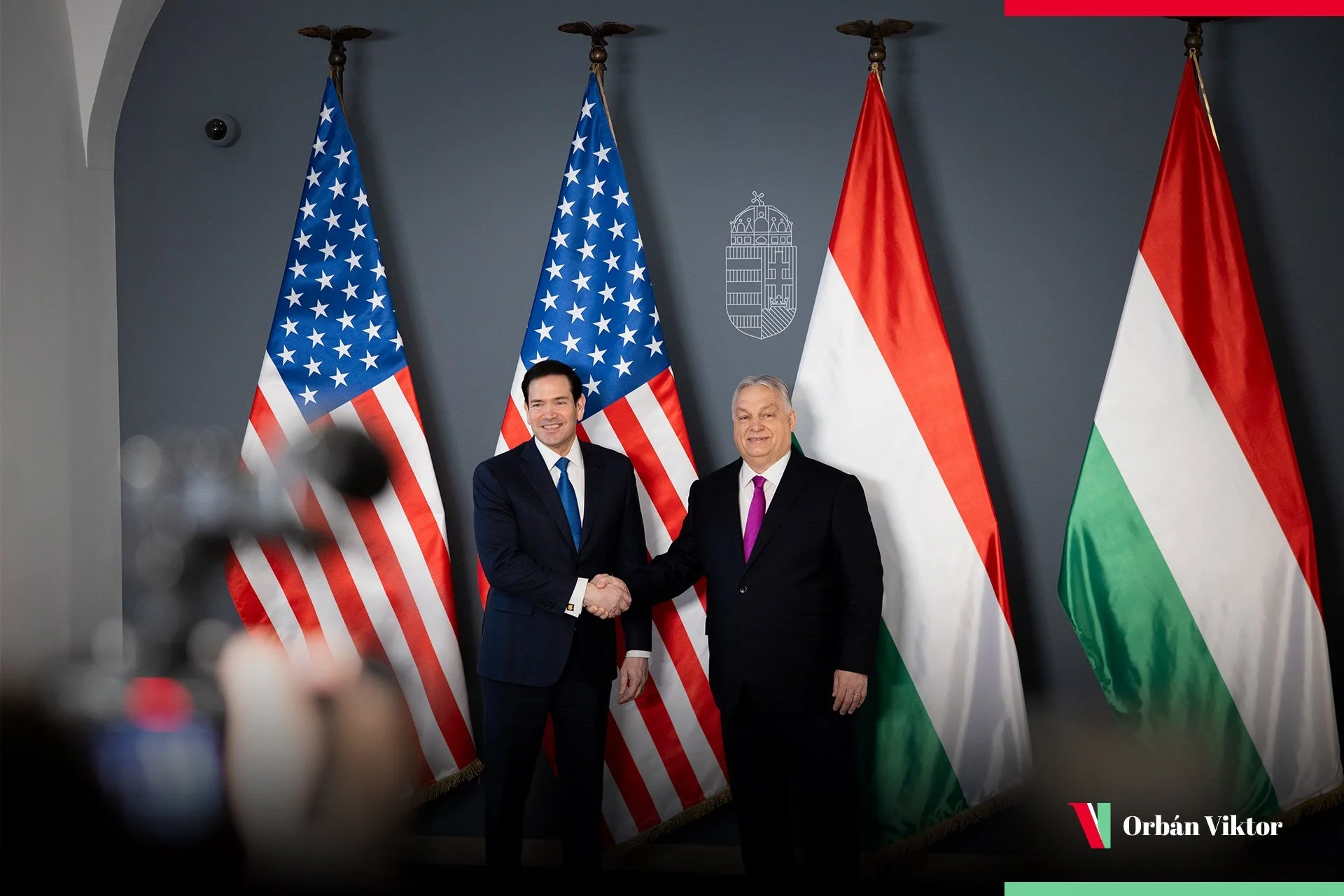
The American Security Strategy
We are now beginning to see the effects of the American security strategy launched by President Donald Trump in November last year. The Trump administration aims to redefine the balance of power in Europe and has shifted tactics from traditional diplomacy to active intervention. Through various methods, European politics is being influenced, and we are already seeing concrete results in the form of increased polarization.
Washington intervenes in the election in Hungary
Vice President JD Vance visits Budapest today, marking the most explicit American involvement in a European election in recent times. The visit takes place just five days before the parliamentary election on April 12, where Prime Minister Viktor Orbán faces his most decisive challenge since 2010. Current opinion polls show that the opposition party Tisza, led by Péter Magyar, has built support of around 48%, compared to Orbán’s party Fidesz at 39%.
The discontent is primarily driven by economic stagnation, but JD Vance functions here as a political guarantor for Orbán. By framing the election as a struggle between national sovereignty and “liberal elites” in Brussels, Washington positions Orbán as a necessary tool for the United States to maintain a divided European front. For the American administration, it is more important to preserve an illiberal foothold in Central Europe than to consider the diplomatic costs of intervening in an allied state’s democratic processes.
If Orbán were to lose the election, this would hardly affect U.S. strategy, but would instead be used as propaganda against the influence the EU has on Hungary.
Influenced the election in Denmark through Arctic strategy
The election result in Denmark on March 24 demonstrates how American pressure can trigger political fragmentation even in stable democracies. The election resulted in the worst outcome for the Social Democrats in more than one hundred years, while the traditional governing party the Liberal Party was reduced to just over 10%. This voter shift away from the political center toward the flanks is a direct consequence of U.S. foreign policy, particularly related to tariffs and threats to annex Greenland.
The national-conservative party the Danish People’s Party exploited the situation by turning its previous pro-American rhetoric into a defensive nationalist rhetoric, in which it defended Greenland’s sovereignty. This significantly increased its share of mandates, from 5 to 16. As of the time of writing, government power in Denmark remains unresolved.
The polarization has weakened Denmark’s political cohesion, which aligns with Washington’s objectives of breaking through to form bilateral rather than multilateral agreements.
Supports Icelandic opposition to the EU
In Iceland, American efforts are specifically aimed at preventing a “yes” victory in the upcoming referendum on EU negotiations; the vote has been brought forward to August due to the geopolitical situation. The United States views Iceland as a strategic outpost in the Arctic and uses economic instruments such as tariffs and incentives for free trade to tie Iceland more closely to itself.
Furthermore, the U.S. casts doubt on the country’s security if it seeks closer ties with Brussels. Iceland does not have its own army, but is a member of NATO and has a bilateral defense agreement with the United States. If the U.S. were to leave NATO, as Trump repeatedly threatens, Iceland’s sovereignty could be in immediate danger. American diplomatic envoys are now actively working on the island to undermine the “yes” side, with a message that Brussels will “steal the fish” and Washington will “save the nation.” It is likely that U.S. influence will also lead to polarization in Iceland.
The U.S. may succeed through European polarization
Polarization in Europe increased after Donald Trump launched his presidential candidacy for the first time in 2015, and has continued to rise since then. Polarization can be described as a decline in support for centrist politics, with both politics and voters moving further toward the left or right.
Donald Trump’s entry into global politics has brought the Western world back to a more confrontational ideological dynamic, with increased use of authority. Trump implements measures without having them approved by Congress, while the European Parliament introduces faster decision-making processes through the 28th regime and expresses a need to restrict veto rights.
The American administration views European fragmentation as a prerequisite for its own strategic dominance. The U.S. seeks to divide the EU in order to enter into bilateral trade and defense agreements with individual nations. The EU has responded by moving closer to regimes on the opposite pole, communist China and ultra-democratic India. This is good news for the United States, which benefits more from a polarized EU than from what was a liberalist EU.
How far Donald Trump is willing to go to achieve his vision for the United States and the Western world remains to be seen. The only thing that appears capable of slowing American aggression is if the Democrats gain a majority over the Republicans in Congress after the U.S. midterm elections in November.
RELATED ARTICLES
Democracy in Iceland under pressure from the EU and the US ahead of referendum
The European Union moves into its next battle after the NATO crisis is put on hold
Kallas reveals an EU strategy with several logical flaws and seeks to limit the veto right
Everyone recognizes polarization, but few acknowledge their own, it fuels its escalation
Greenland is the EU’s mineral lifeline amid China’s monopoly and US global deals
SOURCES
Reuters/The Hindu
U.S. Vice President Vance visits Hungary to boost Orban ahead of pivotal electionThe Washington Examiner
Vance to travel to Hungary for state visit with Viktor OrbanThe Guardian
Danish PM’s leftwing bloc wins most votes but fails to secure majority – Europe liveThe Guardian
Danish PM’s leftwing bloc wins most votes but fails to secure majority – Europe liveThe Copenhagen Post
Far-right politician Morten Messerschmidt beats Frederiksen’s personal vote tallyEuractiv
Trump’s ambitions in Greenland push Iceland closer to the EUAtlas Institute for International Affairs
Crisis in the Arctic – Does Iceland’s Decision to Reopen the EU Membership Debate Signal a Shift in Politician Sentiment, or Wholesale Change?Centre for Eastern studies
The new US National Security Strategy: a manifesto for a sovereign America in a multipolar worldGovernment of Iceland
National SecurityThe European Money and Finance Forum
Political Polarization and Gridlock in Europe: New Evidence from High Frequency Indices
Content on Society and Politics is based on reliable sources and actual events, providing a news-oriented perspective intented for further debate. To access the article’s author and the related debate, membership on Hudd is required.