

Greenland represents Europe’s mineral lifeline in the shadow of US
China holds ~90 million tonnes of rare earths, compared with ~10 million in the United States and ~3 million in Europe. In this context, Greenland’s ~38.5 million tonnes carry significant strategic value for Europe’s industrial and defense security.
Updated below!
January 19, 2026 | INTERNATIONAL POLITICS
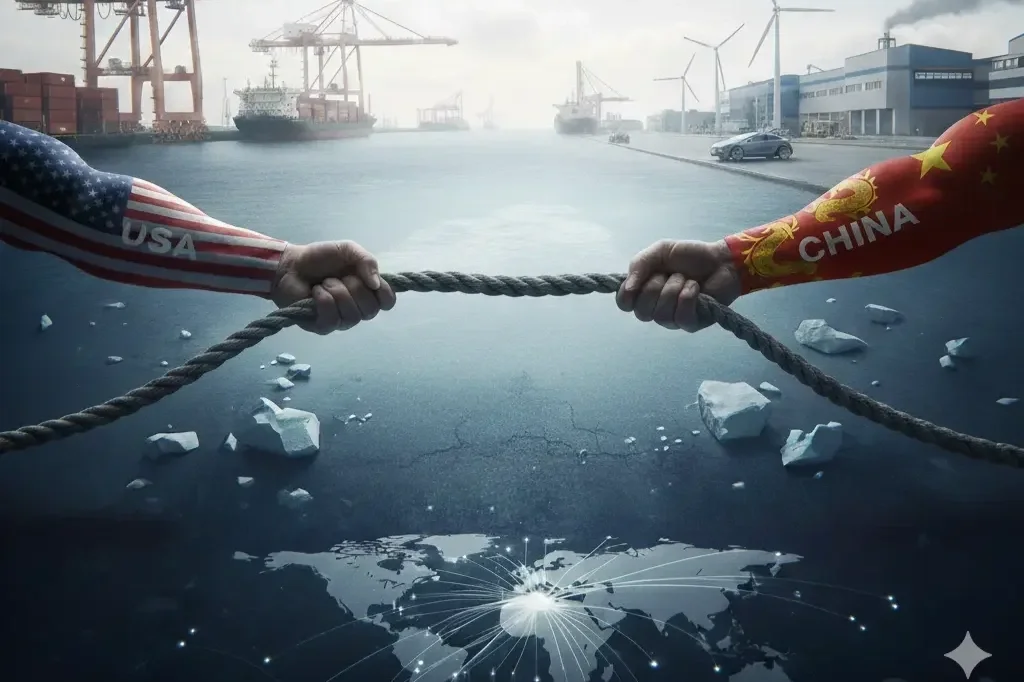
Image by AI/S&P
The minerals in Greenland are more important to the EU than to the US
While the USA sits on significant mineral reserves on its own mainland, the situation for Europe is entirely different. For the EU, access to Greenland is a matter of industrial survival and defense security. Let us take a closer look at why this Arctic island is far more critical for Brussels than for Washington.
In the global race for critical raw materials, the USA and Europe have chosen two vastly different strategies. The USA, led by an administration that in 2026 has ramped up efforts for full national self-sufficiency, views Greenland as a strategic extension of its already rich resource base to seize global power from China. For Europe, however, Greenland is the very key to even being able to implement the green transition and the goal of military autonomy.
The USA in a stronger position than the EU
Today, the USA holds a significant geological head start. Through projects like Mountain Pass in California and major new discoveries in Wyoming—bringing the country’s total resources up to 10 million tonnes—the USA already has operational mineral sources that Europe lacks on its own mainland. When the USA shows interest in Greenland, it is to cement its position as a global energy superpower and ensure military dominance in the Arctic.
For the USA, Greenland’s minerals are a "bonus" that strengthens their national security. They can better afford for projects in Greenland to take time because they have substantial resources in their own backyard.
Europe’s dependence on China
For the EU, the picture is reversed. According to the Critical Raw Materials Act (CRMA), Europe is currently nearly 100% dependent on imports for the most critical rare earth elements. While the USA can build its own value chain on its own continent, Europe’s geology is more fragmented. The entire European continent has only 2–3 million tonnes in scattered deposits (such as in Sweden and Norway), and the regulatory hurdles for new mines are extensive and time-consuming.
This is where Greenland emerges as Europe’s most logical and necessary partner:
Geological Match: 25 of the 34 raw materials defined by the EU as critical are found in large quantities in Greenland. With 38.5 million tonnes in the ground, the potential is enormous.
Strategic Partnership: While the USA often focuses on ownership and control, the EU has been forced to enter into deep, strategic partnerships to ensure that raw materials actually flow toward European factories.
Security of Supply: For the European automotive industry and wind turbine manufacturers, Greenland is the only realistic source of rare earths that can be transported safely and is not controlled by China.
Differences in strategy
An analysis of the strategic situation in 2026 clearly shows the gap in approach. The USA utilizes massive direct government funding and loans to secure resources and build out its own industry. The EU, by contrast, attempts to coordinate procurement and build stockpiles through joint initiatives.
Without Greenland, Europe must choose between China or the USA
The geopolitical reality is brutal for Europe: As of today, the EU does not have enough available mineral resources on its own continent to achieve real self-sufficiency. This creates a fundamental dependency that forces Brussels into a difficult choice.
Without success in Greenland, Europe must choose between continued vulnerable dependence on China or placing its industrial fate entirely in the hands of the USA. While the USA can retreat into a "Fortress America" supported by its own raw materials, a resource-poor Europe risks becoming a pawn between two superpowers—or, in the worst case, being annexed by one of them. Greenland is therefore not just a mining project; it is Europe’s chance to maintain its sovereignty.
Read about Norway’s mineral resources and how they can secure Norway’s defense security and sovereignty in the Mineral Petition.
Rare Earths: Strategic Value in 2026
| Region | Strategic quantity (million tonnes) |
Brief description |
|---|---|---|
| China | ~90 | High strategic value. The combination of extensive deposits, large investments, established extraction, and an integrated value chain provides high practical availability. |
| Greenland | ~38.5 | Long-term strategic significance. Large mapped deposits with low realization by 2026, but a substantial role in strategic assessments over time. |
| USA | ~10 | Established position. Domestic deposits, completed investments, and ongoing extraction provide a real, but more limited, strategic contribution. |
| Europe (EU) | ~3 | Limited strategic value in 2026. Fragmented deposits, long time horizons, regulatory conditions, and limited investments result in low practical availability. |
On the assessment basis
The assessment combines mapped deposits, completed investments, technical and regulatory feasibility, as well as the expected start-up and pace of any potential production. The figures are intended to show how the availability of rare earth elements in each region relates to the needs of industry, the green transition, and defense-related equipment.
Updated!
Norwegian mineral resources are not addressed above. Norway is not an EU member, but an EEA member. When this article was written, it was known that Norway has deposits of rare earth elements at Fen in Telemark, estimated at 8.8 tonnes. A few weeks later, on 3 March 2026, it became publicly known that the deposits are almost twice as large, with the new estimate at 15.9 million tonnes. This is the largest individual find of rare earth elements in the world after China and Brazil. Rare earth elements have also been found on the seabed within Norwegian territory. It is likely that further mineral deposits will be found in Norway once exploration is intensified.
Norwegian mineral resources have been central to the mineral conflict between the US and the EU. The Norwegian government intends to grant control over Norwegian minerals to the EU through the EEA Agreement in a legislation called the CRMA (Critical Raw Materials Act).
Read more about the consequences for Norway in the Mineral Petition.
SOURCES
Mining.com
News and analysis article on the United States’ strategy for critical minerals supply chainsMining.com
News article on Greenland urging the United States and Europe to invest in its mineral resourcesEuropean Commission / Government of Greenland
Official memorandum of understanding on cooperation in raw materialsThink Europa
Policy analysis of Greenland’s importance for the EU’s green transitionCalifornia Curated
Journalistic article on the Mountain Pass mine and U.S. rare earth productionCarnegie Endowment for International Peace
Research-based policy analysis on U.S. access to critical mineralsArgus Media
Industry analysis of challenges related to mineral extraction in GreenlandNewsweek
Popular science article with maps and comparisons of rare earths in GreenlandEurostat
Official EU statistics on international trade in critical raw materialsU.S. Geological Survey (USGS)
Annual overviews of global mineral marketsGEUS (Geological Survey of Denmark and Greenland)
Professional overview of Greenland’s mineral resources from the geological surveyLKAB
Press release on rare earth element deposits in the Kiruna areaMining.com
News article on LKAB’s Per Geijer mine and Europe’s rare earth supplyGEUS (Geological Survey of Denmark and Greenland)
Fact sheets on documented mineral deposits in GreenlandEuroGeoSurveys
EU professional platform on mineral resources in EuropeU.S. Geological Survey (USGS)
Statistics and background information on rare earth elementsEuroGeoSurveys
Information on a professional event on Europe’s mineral raw materialsDiscovery Alert
Analytical article on strategies for resource independence in critical mineralsLKAB
Press release on increased resource estimates for rare earth oxides
Content on Society and Politics is based on reliable sources and actual events, providing a news-oriented perspective intented for further debate. To access the article’s author and the related debate, membership on Hudd is required.
