
US won the mineral battle against Europe
At last the mineral battle is over; the EU had to bite the bullet and allow Norway to enter a mineral partnership with America. Europe has in reality gained nothing and new battles remain, but NATO endures and military security has been restored.
Updated below!
February 15, 2026 | INTERNATIONAL POLITICS
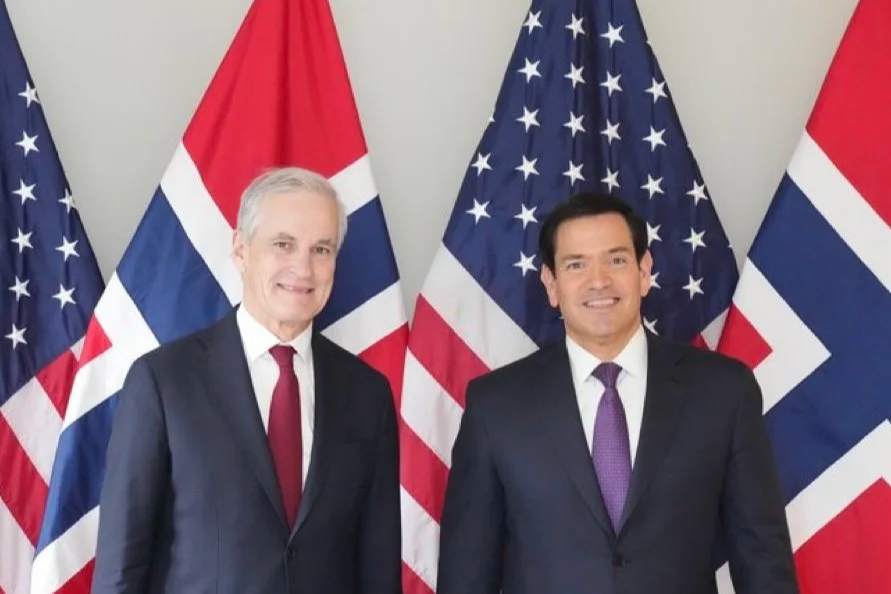
Prime Minister Jonas Gahr Store and Secretary Marco Rubio, photo from Rubio’s X post linked below
Norway enter into a mineral partnership with US
Late Saturday evening came the news that Norway and the USA are entering a partnership to secure supply chains and critical minerals. The news was shared on the American Secretary of State Marco Rubio’s X account and reads:
“Partnership with Norway. In my meeting with Norwegian Prime Minister Jonas Gahr Store, we discussed Norway’s vital role in Arctic security and the strategic importance of Greenland. We look forward to partnering with Norway on supply chain security, including on critical minerals.”
On Saturday morning, Rubio delivered a speech at the Munich Security Conference in which the tone was more diplomatic than before regarding relations with Europe, without departing from the U.S. position as expressed in the U.S. National Security Strategy published in November. Shortly after the speech, Prime Minister Jonas Gahr Støre told TV2 News that Norway should cooperate with the United States in certain areas, such as supply chains and critical minerals. A few hours later, Marco posted the news on his X account.
This comes ten days after the EU entered into a declaration of cooperation with the United States and Japan on minerals cooperation. The declaration came during a ministerial meeting in Washington on 4 February, known as the Inaugural Critical Minerals Ministerial. The meeting was chaired by Rubio and brought together representatives from 54 nations, including the European Commission. Norway attended this meeting as an observer.
The trade war was triggered by China’s mineral monopoly
A large part of Europe has not realized that the trade war was triggered by the American president Donald Trump because China for decades has held a monopoly position in the supply chain of critical minerals. China has both imposed restrictions and sanctions at its own discretion to control this market. Critical minerals are, as the term suggests, critical raw materials for ordinary industry, renewable energy and the defense industry. They are not necessarily critical because there are few of them, but because of the continent where the resources are located or the amount that is extracted. Included within the term critical minerals are also rare earths, which are both rare and important for the production of modern technology and weapons. We will not go into more detail here, but mention that Europe is in a precarious mineral shortage that directly affects defense capability, hence the “battle” for Greenland, read more here.
Norway has mineral resources both on land and on the seabed; in 2024 the largest deposit of rare earths in Europe was found at the Fen field in Telemark. These are not very large in a global context, but significant for Europe because there are few resources on the European continent. Ukraine also has large mineral resources, but a large share of these are in Russian-occupied areas. We all remember the drama when the Ukrainian president Zelenskyj was thrown out of the Oval Office because he would not sign a mineral agreement with the USA without security guarantees. At the end of April Ukraine nevertheless had to give in and an agreement was signed without a security guarantee. This hit the EU hard since the USA now controls 50% of the minerals in Ukraine, which explains why the EU will not give up occupied areas in Ukraine.
The USA had the advantage due to the EU’s mineral shortage
The message from Marco Rubio about a mineral partnership with Norway, reproduced above, indicates that a similar partnership will also be entered into with Greenland.
The USA has had the upper hand over Europe in this matter, but European heads of state and mass media have given a mixed impression that Europe is, or could become, capable of defending itself. In practice this would have been impossible because there are few mineral resources on the continent and because establishing mining is a long and extensive process. There is still no production of rare earths in Europe, only one project is approaching start-up. Europe lacks both resources and expertise; if environmental considerations are also added to the equation this becomes a large and complex picture. Both the current NATO chief Mark Rutte and the former Jens Stoltenberg have stated that it is unrealistic that Europe can become capable of defending itself without the USA, read more here. Furthermore, mineral deliveries from both China, Greenland and other continents would have been cut off by the USA if we were to enter a military conflict with them.
Society and Politics (S&P) was established precisely because of this situation; the first post was published on 5 March last year as a direct result of Zelenskyj being thrown out of the Oval Office and is titled Minerals trump Trump, read it here. Over the past year S&P, which is Norwegian, has published a long series of articles documenting how this has unfolded.
EU+ created the chaos itself and Norway lacked backbone
It is completely incomprehensible that EU+ (in total the 44 heads of state in the European Union and other European countries) have handled this situation in such a reprehensible way. One year after Donald Trump triggered the trade war it appears that EU+ has finally received the message (but perhaps not the French president Macron). Although it is early in the process, S&P can assume that the Norwegian prime minister would not have entered a partnership with the USA without having the EU behind him. This is because the Norwegian government wants EU membership despite the Norwegian population twice voting no to the EU. The Labour government also prevents a new referendum out of fear of another defeat; democracy is not as strong in Norway as its reputation suggests. The government has used every small part of the past year’s events to promote its own case and will probably also collect unjustified gains this time – one can only hope that the Norwegian population is more vigilant than that.
Norwegian Prime Minister Jonas Gahr Store could have solved this matter for all of Europe long ago if he had had the population’s interest at heart — but it would also have required a courage he does not have to stand up to misguided European leaders. Instead he has been a nodding puppet for the EU; it is embarrassing, it is reprehensible and it is regrettable. He personally made a series of mistakes after in November 2024 sending a letter of congratulations to Donald Trump with a promise of mineral deliveries. Store then allowed himself to become involved in the EU’s chaos which led to ever new mistakes that put Norway’s security at risk. Norway is particularly exposed as the EU’s largest energy supplier; oil and hydropower. Among Store’s mistakes was also a government press release only days before he was to meet Donald Trump in April last year. The press release stated that the government would implement the EU’s mineral regulation CRMA into the EEA agreement. There is reason to believe this was perceived as a breach of promise by the American administration. Furthermore the government delayed tariff negotiations and did not enter a new trade agreement with the USA before the deadline 31 July. There is now reason to believe a new trade agreement between the USA and Norway will soon be presented. Read about more mistakes Jonas Gahr Store made here.
The USA won the mineral battle, new battles remain
Despite the American administration’s reprehensible and aggressive behavior, which S&P in no way defends, it now appears that the USA has won the mineral battle with Europe. For the European population it may always look as if it was about democracy; it depends entirely on what European mass media choose to convey, read more about the misleading journalism here.
The democratic struggle concerns other matters and will be played out on another level. In his speech to the Security Conference in Munich yesterday the American Secretary of State Marco Rubio made it completely clear that the USA is faithful to the security strategy published in November. The only real difference on Saturday was that Rubio, on behalf of the American administration, spoke at an acceptable diplomatic level. In that way he helped his European colleagues meet the USA without completely losing face.
But new conflicts with the USA will probably come; they are now dormant because of the midterm election in November. Even though the USA has now won the mineral battle, other battles remain. The trade battle is not over; the EU has announced trade negotiations with China — if they expand the trade agreement with China it may lead to a new conflict. The migration battle also lies ahead; some European countries have introduced stricter immigration rules over the past year, including Norway. This may be an actual recognition of failed policy, but it may also be a strategic approach to the conservative wave sweeping Europe to stem voter flight.
According to the American security strategy the American administration will support politicians and countries that share their vision for the Western Hemisphere, read more here. Whether other battles will come — about freedom of religion, sexual orientation, abortion and other liberal positions — remains to be seen.
But right now Europe can breathe a sigh of relief and rejoice that NATO endures; the danger is over for this time. Europe is safe!
Update!
As of June 2026, neither Norway nor the European Union has yet concluded a minerals agreement with the United States. The situation remains at a standstill. Read more here.
The engagement for sovereignty over Norwegian minerals led S&P to publish the mineral petition in April last year; it provides detailed information about the mineral situation and the EU’s mineral regulation CRMA, find the petition here.
For the record S&P wishes to inform that the articles are written from a libertarian, not conservative and not socialist standpoint. S&P calls for realism in the politics and journalism of our time.
RELATED ARTICLES
Stoltenberg: We must not create illusions about what Europe can achieve on its own
Trump’s Peace Committee could be decisive for Europe, and Norway could save it
Greenland represents Europe’s mineral lifeline in the shadow of US
Through nine incidents, Store has put Norway’s security at risk
Dictatorial, authoritarian, or democratic rule in Venezuela?
The EU runs out of minerals for weapons after only four months
EU Introduces tariffs on EEA-member Norway despite tariff ban
SOURCES
This article is based on several dozen articles from S&P, many of which are listed above. The articles are based on a total of hundreds of reliable sources, which you can find listed at the bottom of each article. The sources are therefore not reproduced in this article, which is a summary of previous articles.
Secretary Marco Rubio on X
Partnership with NorwayTV 2 News
Jonas Gahr Støre comments on the US Vice President’s Munich speech (14 February, 10:13)
Content on Society and Politics is based on reliable sources and actual events, providing a news-oriented perspective intented for further debate. To access the article’s author and the related debate, membership on Hudd is required.
