
Canada turns to China, will the EU follow?
Canada seeks closer cooperation with China amid pressure from the United States. A crossroads is approaching where the EU must also choose a side.
January 24, 2026 | INTERNATIONAL POLITICS
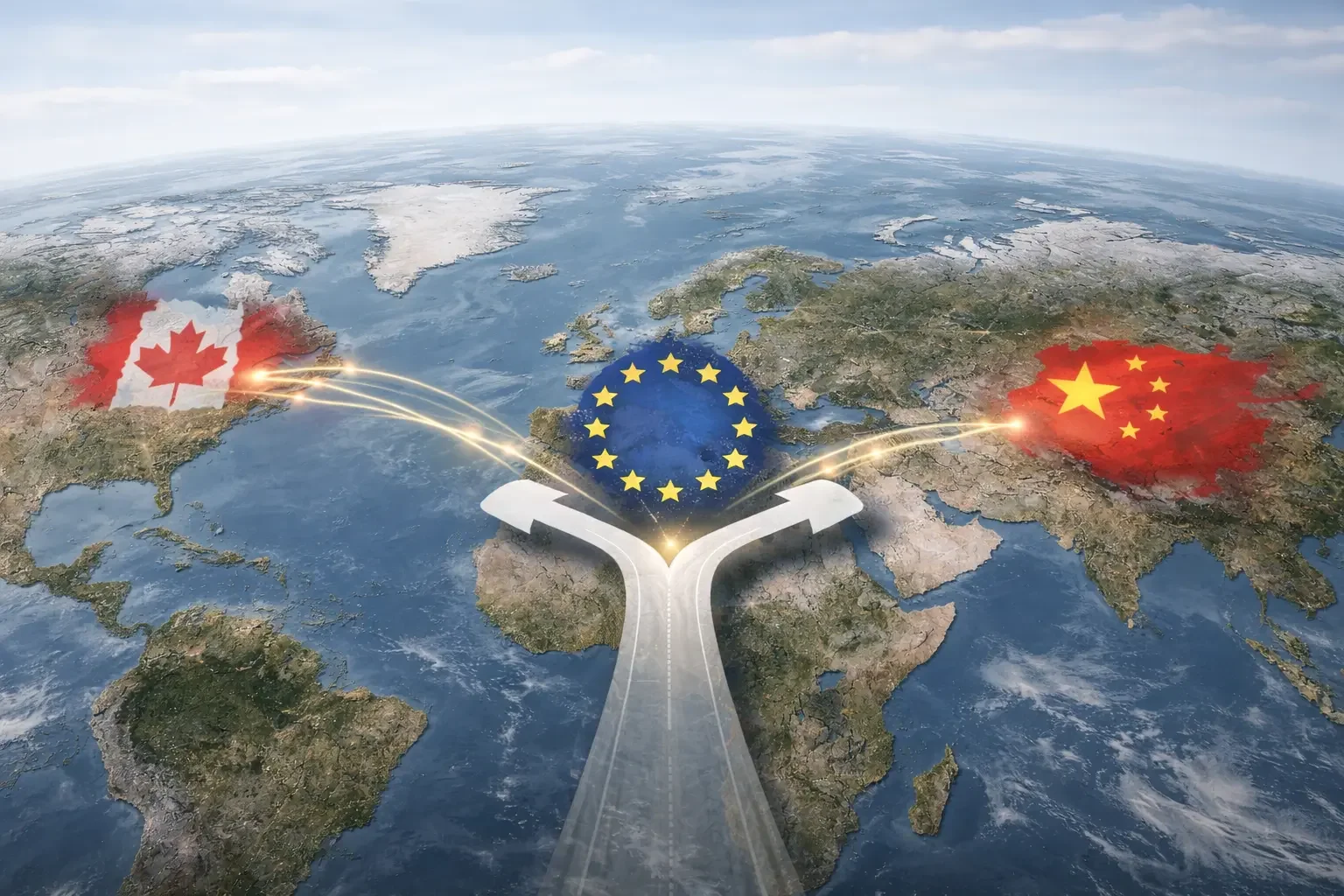
Image by AI/S&P
Has Trump given up on Greenland?
Over the past week, a new development has taken place in geopolitics that European experts and commentators are overlooking, as focus and sympathy are directed toward the EU+ (EU, EEA, the United Kingdom, among others), which they believe has secured a victory because Donald Trump has seemingly abandoned his demand to take over Greenland. Several media outlets have described this as the American president backing down (TACO – Trump Always Chickens Out).
Society and Politics, however, sees it as possible that Trump obtained a concession from the EU tied to a framework negotiated by NATO Secretary General Mark Rutte, as communicated during the World Trade Forum meeting in Davos earlier this week. It may also be connected to Trump having launched The Board of Peace.
Canada turns to China
Donald Trump has expressed a desire to incorporate Canada as a state of the United States, and the Canadian Prime Minister, Mark Carney, has offered consistent resistance to the U.S. since it initiated the tariff war in April last year.
Last week, Carney visited China to enter into a strategic cooperation agreement, despite a previously strained relationship. Chinese President Xi Jinping stated that China is willing to strengthen cooperation to meet global challenges.
Through Western trade, China has experienced extraordinary growth since the 1970s, which made it the world’s leading trading nation in 2008. In 2020, China reached 14.7 percent of the global market, compared with the United States’ 8.1 percent and Germany’s 7.8 percent, with Canada in 13th place at 2.2 percent. Readers are encouraged to take a closer look at the animated graph from the United Nations linked at the bottom.
Despite the United Nations’ 17-point action plan for development goals in China, related to, among other things, human rights and environmental protection, the lack of such measures has not led to consequences for the Chinese regime. This is a double standard that all democracies trading with China have been guilty of. China is, in practice, the world’s most powerful country, and Trump aims to take this power back from China through trade. Canada, which has had a strained relationship with China precisely because of human rights concerns, has now entered into a cooperation agreement with China to shield itself from the United States.
The Board of Peace
Donald Trump has established a peace committee, referred to as The Board of Peace, with the official name National Committee for the Administration of Gaza (NCAG). Although the committee was originally created for peace mediation in Gaza, Donald Trump has signaled that the organization is intended to contribute to a new world order. Some interpret this as Trump seeking to replace the United Nations, which he is highly critical of. It is also worth noting that Trump likely has several motives behind the peace committee; Alfred Nobel pointed to individuals who had taken the initiative for or mediated peace between nations in his will establishing the Peace Prize.
Both Russia and China have been invited to the peace committee. Despite reports in some media that Putin has accepted the invitation, Society and Politics has not found official confirmation of this. Through participation, Russia would likely be able to resume normal trade with the other participating countries, including the United States. China likely views the peace committee as a threat to its position in the global market; therefore, China’s choice may be decisive for the world order. If China joins, the geopolitical situation could stabilize. If it does not, the situation may escalate to a new level.
Will the EU turn to China?
The EU+ (EU, EEA, the United Kingdom and European others) has declined membership in The Peace Board, with the exception of Hungary and Bulgaria. If the current political line is to be maintained, the EU+ will need an external ally, similar to Canada. This would mean closer cooperation with China, but this is a highly risky strategy, as both Canada and Europe depend on mineral supplies from abroad to be able to defend themselves militarily. Mineral supplies from China could be cut off by an adversary in a war. If Trump succeeds with his peace committee, there may be many such adversaries, in addition to the United States.
It is, however, difficult to envision how the EU+ can maintain its policy toward the United States now that Trump has officially withdrawn the demand for control over Greenland, even the details are still not known. This will likely lead to internal conflicts within the EU, and several countries may choose to enter into bilateral trade and defense agreements with the United States.
At the same time, Donald Trump has limited time to leave lasting marks before the U.S. midterm elections in November 2026. If the balance of power in Congress changes, a new composition could slow or halt key elements of his trade and foreign policy agenda.
Society and Politics has previously argued that Norway should take the lead in a new direction in European politics by entering into a bilateral agreement with the United States that could safeguard both Norway and Europe from war—read more here.
Updated! January 24 at 5:50 PM
After this article was published, Trump has, according to Reuters, threatened Canada with a 100% tariff as a result of the agreement with China.
Donald Trump writes on The White House X account; “The last thing the World needs is to have China take over Canada. It’s NOT going to happen, or even come closet to happening! Thank you for your attention on this matter.”
SOURCES
Reuters
Trump launches a Board of Peace that critics fear could rival the United NationsCNN
Explainer on who joined Trump’s proposed “Board of Peace”The Guardian
Trump says Canada should be grateful for what he calls US “freebies”NBC
Canada turns to China as Trump’s tariffs and threats reshape alliancesPOLITICO
How Trump is forcing a rewrite of Canada’s trade strategyPrime Minister of Canada
Prime Minister Carney announces measures to protect and transform Canada’s steel and lumber industriesBBC
Carney tells the BBC Canada will deal with Trump “on our terms”NPR
Carney told Trump Canada is not for sale, Trump responds “never say never”The New Your Times
How Trump’s talk of Canada as a “51st state” came to be seen as deadly seriousPrime Minister of Canada
Statement by Prime Minister Carney on Canada–US tradeUnited States Mission to the United Nations
Joint statement on the human rights situation in ChinaReuters
Report on China and Russia repeatedly trying to defund UN human rights workUnited Nations
Overview of the Sustainable Development Goals in ChinaUnited Nations
Chart showing the evolution of the world’s 25 top trading nationsThe White House
Comprehensive plan to end the Gaza conflict
Content on Society and Politics is based on reliable sources and actual events, providing a news-oriented perspective intented for further debate. To access the article’s author and the related debate, membership on Hudd is required.
