

Stoltenberg: We must not create illusions about what Europe can achieve on its own
This statement by former NATO Secretary General Jens Stoltenberg supports NATO chief Mark Rutte’s assertion that those who believe Europe can defend itself can keep dreaming.
January 28, 2026 | INTERNATIONAL POLITICS
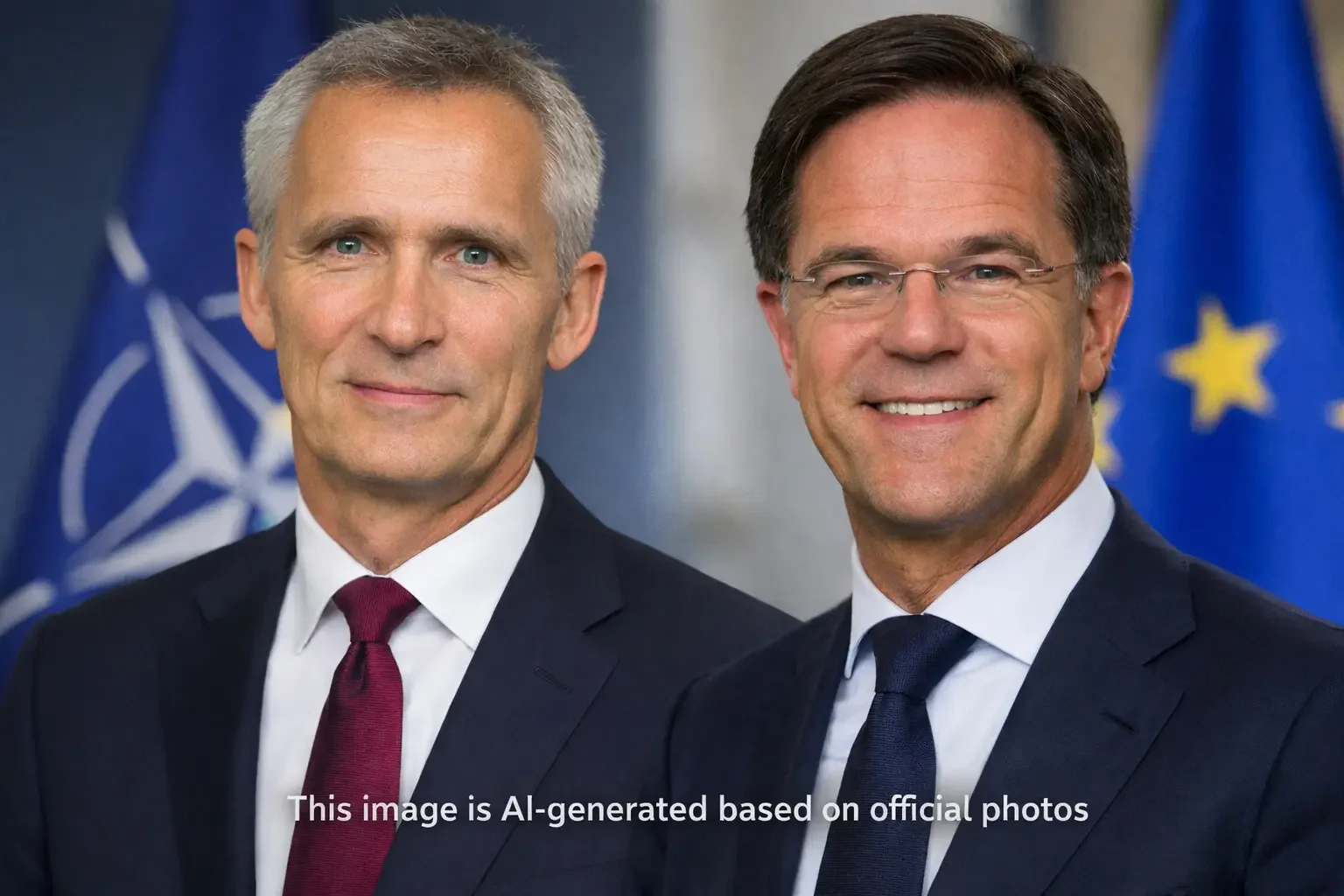
Image by AI/S&P
Stoltenberg agrees with Rutte
This statement, “We must not create illusions about what Europe can accomplish on its own,” is quoted from former NATO Secretary General Jens Stoltenberg’s book On My Watch, published last year. The book makes it clear that Stoltenberg shares the views expressed by the current NATO chief, Mark Rutte. The latter has attracted significant attention after stating at a meeting of the European Parliament this week: “Those who believe that Europe can defend itself on its own can continue to dream.”
Stoltenberg served as NATO Secretary General from 2014 to 2024, when Mark Rutte took over. He is now Norway’s Minister of Finance. Much of Stoltenberg’s book focuses on how he worked to prevent the United States from leaving NATO, while at the same time seeking to prevent the EU from forming an independent defence alliance, as he did not consider this feasible; see the book review here.
Macron wanted a European defence alliance
Stoltenberg describes how France, under President Emmanuel Macron, led calls to leave NATO in order to form an autonomous European defence alliance. This took place at the same time as resistance from several EU countries to increasing their GDP contributions to NATO to 2 per cent, as demanded by Trump. For the sake of accuracy, it should be noted that NATO decided last November to reach a 5 per cent target by 2035.
On Monday, Rutte delivered an opening address to the European Parliament, in which he among other things reminded members that Europe is dependent on the United States in the war in Ukraine against Russia. Representatives from EU countries were given two minutes to respond and pose questions to Mark Rutte, who then delivered a collective response at the end. It was in this response that the statement appeared: “Those who believe that Europe can defend itself on its own can continue to dream.” Rutte went on to say that an independent defence would require annual contributions of 10 per cent, in addition to billions in investments in nuclear weapons. This came on top of remarks he had already made in his opening address that an independent European defence would require substantial military personnel and large military stockpiles. He also pointed to limitations in the supply chain (access to raw materials for production, production facilities and weapons stockpiles) and referred to the United States’ significant contributions in the war in Ukraine.
In his book, Jens Stoltenberg writes the following about the background to France’s desire for an independent European defence:’
“My impression was that Macron wanted to appear strong and independent in order to stem the rise of the right and Marine Le Pen, a motive I could understand.”
This observation is equally relevant in 2026. Europe is fighting as social democracy against the conservative wave sweeping the Western world, read more here.
Stoltenberg's admiration for China and the old Soviet Union
The book also repeatedly makes clear that Jens Stoltenberg has strong faith in social democracy and large unions, including barely concealed admiration for China and the former Soviet Union. He also writes that he has emphasised to other EU leaders that no one has fought harder for the EU than he has, referring to the fact that he was on the losing side in two Norwegian referendums on EU membership. Stoltenberg is a declared supporter of the EU and is now working to bring Norway into the EU through tactics rather than a referendum. In light of Stoltenberg’s personal EU ambitions, and the fact that the struggle being waged against NATO has materialised as a struggle against conservatism, it remains to be seen whether Stoltenberg will stand by the positions he presents in his book.
It is also worth noting that EU policy has been strongly shaped by protectionism toward its own natural resources and industry, and that an extensive legal framework imposed on member states significantly limits their sovereignty. Taken together, the development of the European Union is not far removed from either the Soviet Union or imperialist thinking. This is further reinforced as the discussion increasingly turns toward a federal EU, meaning that all power is transferred from the member states to the EU.
Opposition to the United States must be seen in light of the above. Fear of the Russian and Chinese regimes has weakened in step with the rise in opposition to conservatism.
SOURCES
Content on Society and Politics is based on reliable sources and actual events, providing a news-oriented perspective intented for further debate. To access the article’s author and the related debate, membership on Hudd is required.
