

One-sided media coverage increases security risk
In professional terminology, it is referred to as collective misperception and has led to wars before. We are now in the midst of it, and few recognize it.
January 17, 2026 | SOCIETY
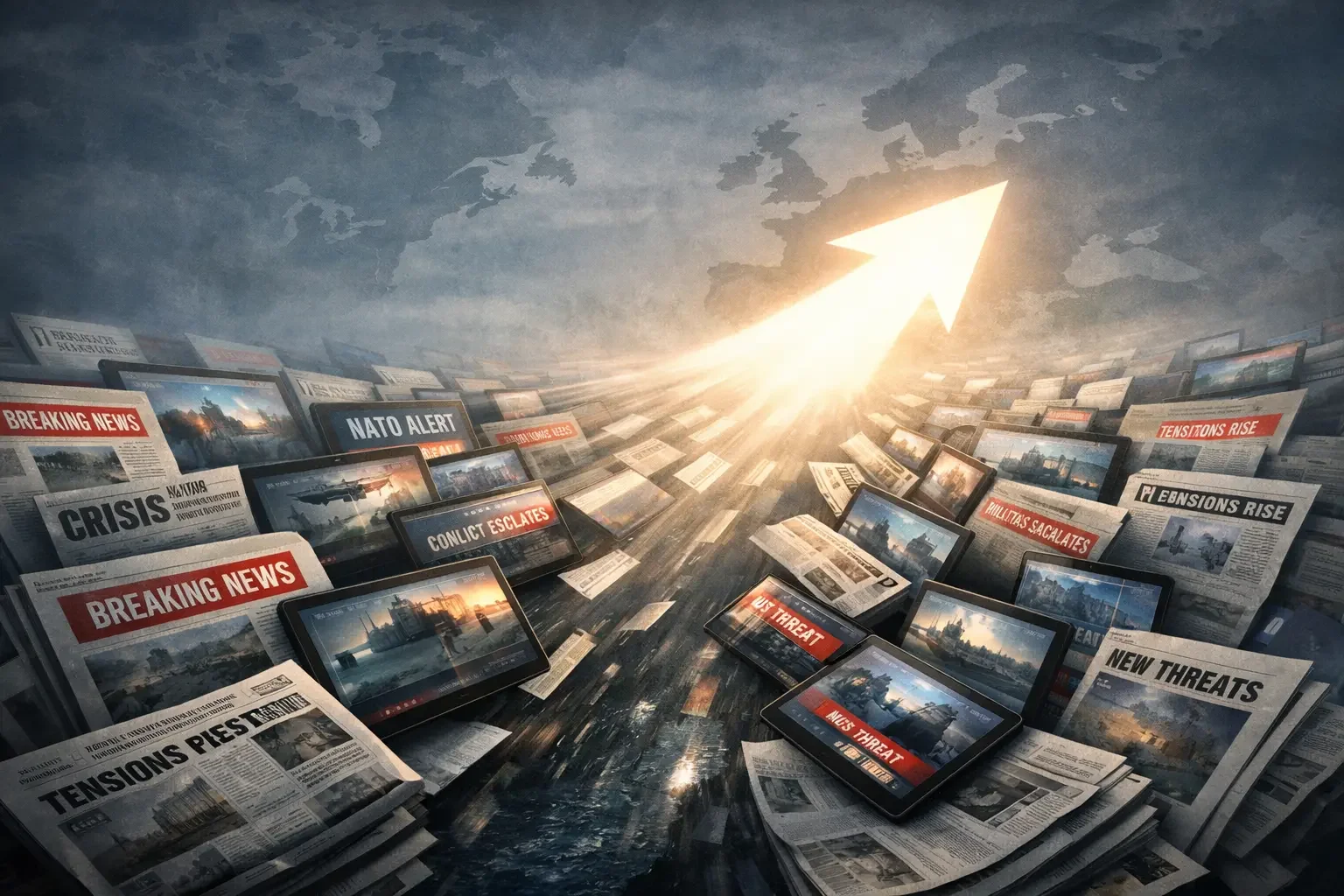
Image by AI/S&P
Collective misconception
We are in the midst of what is professionally referred to as collective misperception, which in the worst case can lead to war. It has happened before and it can happen again. We will return to the academic aspects of this, but let us first describe the current situation.
From neutral reporting to opinioted journalism
Norwegian mass media largely report factual events correctly, even though we increasingly see journalists and reporters not only describing what has actually happened, but also commenting on events. This moves journalism away from neutrality and toward opinion-bearing content. Furthermore, the use of "expert commentators" has exploded over the past couple of years, often in a way where the "expert's" perspective is left unchallenged. An expert statement may of course be professionally documented, but an analysis or assessment is nevertheless an opinion-bearing commentary. We will take a closer look at how this puts Norway at greater risk.
The media frequently use retired "experts", which may include retired professionals, politicians, and diplomats. In addition, active politicians, individuals holding positions in organizations, and political advisers are used. The latter may be employed by the news organization itself, affiliated with political parties, communication agencies, or think tanks. None of these represent objectivity. The true experts are fewer in number; those who actually hold relevant academic positions and provide professionally documented statements, such as professors.
Constructed narratives in media coverage during the past week
On Tuesday this week, NRK's Dagsnytt 18 aired a segment on Greenland, discussing to what extent the United States and Donald Trump could realistically take over the island, by peaceful or military means. A former Member of Parliament from the Conservative Party was one of the participants. He stated that it is highly unlikely that the United States would take over the island peacefully and that it is unlikely the US would use military force; he claimed that it will not happen. These are opinions we have heard from a large number of expert commentators over the past year. We have heard statements such as: "it is not possible", "it will not happen", "NATO will prevent it", "Denmark and the EU will prevent it", "the US Congress will not allow it", "it CANNOT happen". In far too many cases, these statements are left unchallenged, even though the media's societal responsibility is to obtain commentary that also represents opposing views.
On Friday, TV 2 used an adviser from a think tank and a retired diplomat as "expert commentators" in connection with peace prize laureate Machado giving his Nobel Peace Prize medal to Donald Trump. The Nobel Committee's selection of Machado was defended, and the statements were left unchallenged. The adviser from the think tank further stated that Donald Trump is a narcissist, that Trump is unpredictable, and that he does not care whether Venezuela is a democracy or a dictatorship. It is possible that some of this may turn out to be correct, but this commentator has no factual documentation to support these claims. He is not a psychiatrist and should absolutely not make psychiatric diagnoses. Furthermore, actual events show that Donald Trump is not unpredictable; Trump states what he intends to do and then does it. Let us note that he announced tariffs and implemented them; he announced that Maduro had little time left and then took action. It is far too early to conclude whether the American president cares about democracy in Venezuela. The methods are striking, but we do not yet know whether democracy will emerge in Venezuela. This adviser has been given significant airtime on both NRK and TV 2 over the past couple of years, and in the vast majority of cases his "expert commentary" is left unchallenged, despite the fact that history now shows that this "expert" has been wrong on several occasions.
Society and Politics wishes to highlight two expert commentators who provide reality-based and realistic assessments;
Janne Haaland Matlary, Professor of International Politics at the University of Oslo, and Tom Roseth, principal instructor in intelligence at the Norwegian Defence University College.
Media responisbility, editorial responisbility, and political responsibility
The experts in question are not named in this article, but links to the referenced NRK and TV 2 broadcasts are provided at the bottom. Samfunn og Politikk does not wish to single them out; responsibility for this situation lies with the media themselves. Norwegian media both use expert commentary uncritically and fail in their societal mandate when they do not seek out experts who represent differing views (Code of Ethics of the Norwegian Press, section 1.2). Broadcasting Director Vibeke Furst Haugen is the head of NRK, and Olav T. Sandnes of TV 2 are responsible for this situation. I would also like to mention Nettavisen's outgoing editor Gunnar Stavrum, Aftenposten's editor Trine Eilertsen, and VG's editor Gard Steiro. The politicians responsible for the collective misperception are first and foremost Prime Minister Jonas Gahr Store, Minister of Foreign Affairs Espen Barth Eide, Minister of Finance Jens Stoltenberg, and Minister of Trade and Industry Cecilie Myrseth. However, it is largely correct to say that all politicians who claim that Norway is safer closer to the EU contribute to the collective misperception.
The consequences for democracy and Norway’s security
Let us now look at how this brings Norway into greater danger. In a democracy, the public has the right to insight and influence. When we are presented with a one-sided portrayal of factual events, we are led to believe in a narrative that may not be real. This affects both how the population collectively perceives a situation and how the situation itself is influenced. Over the past year, leading actors in the Norwegian press have downplayed the real danger Norway faces. The actions of the American president have placed Norway in a highly exposed position, where Russia and China represent a greater threat than before, and where we additionally face a new potential threat from the United States. As if this were not enough, Norwegian media have uncritically conveyed politicians' narrative that Europe has sufficient defense capability. It is by now well documented from several public sources that the European continent has only enough mineral resources for short-term warfare.
Collective misperception is particularly dangerous because it prevents realistic countermeasures, strategies, and political decisions from being identified, assessed, and implemented in time. As a result, a conflict that could have been prevented may escalate and end in war.
Research on collective misperception in media and politics
Research shows that collective misperception usually does not arise because the media report incorrect facts, but because of how information is selected, emphasized, and explained. Academically, this is described through concepts such as agenda-setting (what the public perceives as important), framing (how events are interpreted), and indexing (the tendency for media debate to largely follow the views of political and institutional elites). When the same experts and assessments dominate over time, this can lead to what research refers to as information cascades, where early interpretations take hold and are reinforced, and pluralistic ignorance, where many privately doubt the prevailing view but believe that "everyone else" agrees. Research in international politics shows that such collective misperceptions can lead to serious misjudgments and increased security risk, even in democratic societies with free media.
Historical examples of collective misperception with serious consequences
History provides several clear examples of collective misperception with serious consequences. Prior to the First World War in 1914, there was broad political and media consensus in Europe that a major war would be short-lived, which proved to be a grave misjudgment. In 1938, the Munich Agreement created a widespread belief in the United Kingdom and France that appeasement of Hitler had secured peace, based on incorrect assumptions about the opponent's intentions. During the Vietnam War in the 1960s, the public was largely presented with a picture of progress that contrasted sharply with internal assessments, something later research has explained through close alignment between political elites and media coverage. In the lead-up to the Iraq War in 2003, there was widespread public belief that Iraq possessed weapons of mass destruction, a belief that was presented as near certain despite weak documentation. These examples show that collective misperception can arise and persist even in societies with free media, when dominant narratives are not sufficiently challenged.
SOURCES
Janne Haaland Matlary
WebsitePressens Faglige Utvalg (The Norwegian Press Complaints Commission)
The Code of Ethics of the Norwegian Press (Vær Varsom Code)McCombs & Shaw
Agenda-setting: a foundational study on how news media influence what the public perceives as importantEntman
Framing: a key article explaining how media framing shapes interpretation of eventsBikhchandani, Hirshleifer & Welch
Informational cascades: how early interpretations can spread and become self-reinforcingPrentice & Miller
Pluralistic ignorance: when many individuals privately doubt a dominant view but assume others accept itJervis
Misperception in international politics: klassisk analyse av feilvurderinger før krigThe Guardian
Iraq war and weapons of mass destruction: gjennomgang av feilaktige premisser før 2003BBC
Munich Agreement explained: historisk bakgrunn og ettertidens vurderingThe National Archives (UK)
Britain and the outbreak of the First World War
Content on Society and Politics is based on reliable sources and actual events, providing a news-oriented perspective intented for further debate. To access the article’s author and the related debate, membership on Hudd is required.
