
The negotiating window with the United States is closing
These days may mark the point at which negotiating with the United States is no longer possible. The flow of migration through Morocco into Spanish Ceuta may be the end of the Trump administration's negotiating window due to the military significance of the Strait of Gibraltar.
August 3, 2026
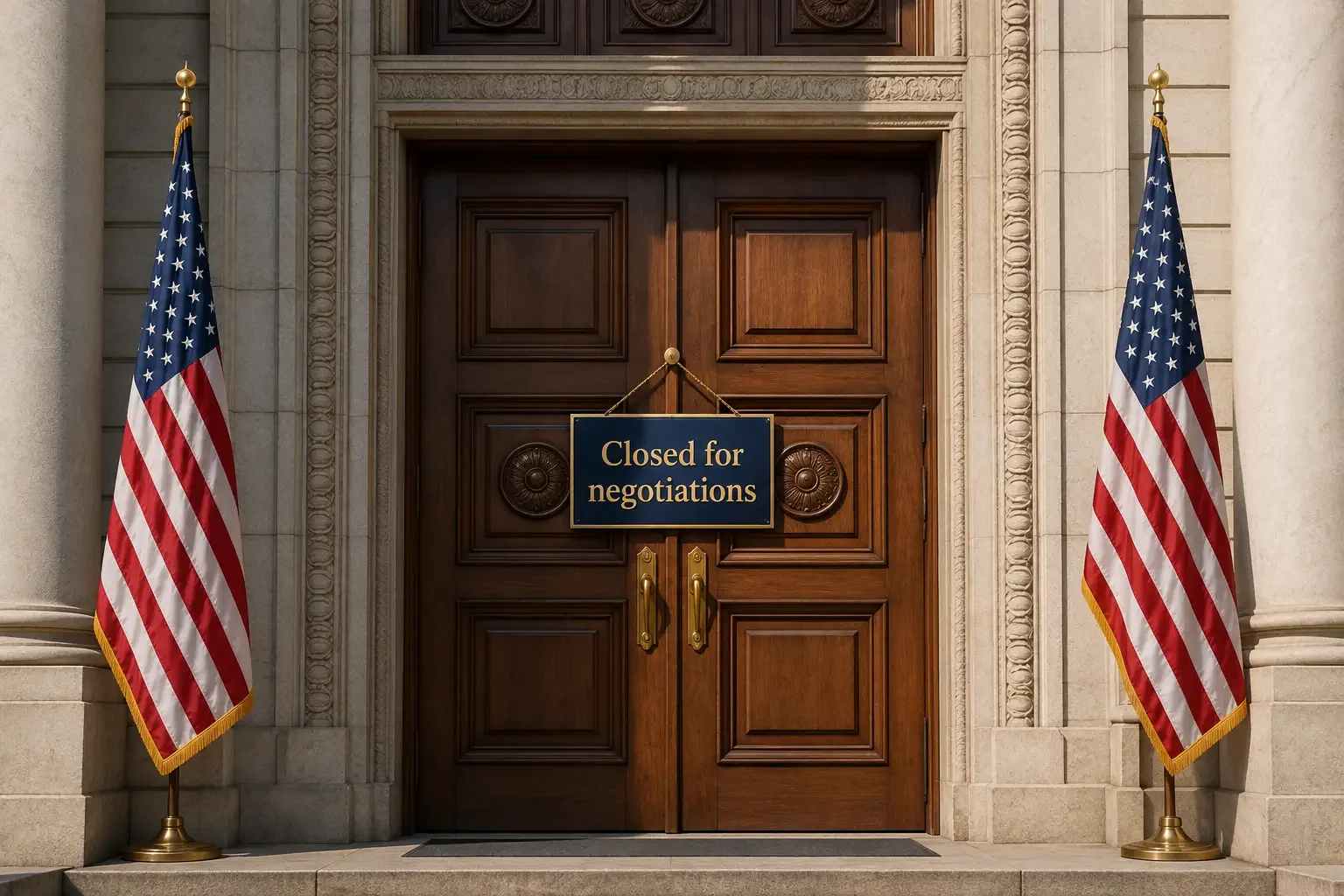
Image by AI/S&P
The basis for negotiations
To understand why the situation in Ceuta may be a turning point, one needs to know the background.
When Trump announced tariffs on April 2 last year, he made it clear that the United States was inviting negotiations. Some countries have concluded agreements that, put briefly, give them a tariff ceiling.
At the base lies an ordinary tariff to the United States (MFN), which is generally very low. New tariffs are placed on top of the MFN tariff. On July 24 this year, the temporary tariff to the US that had applied from August 7 last year was replaced by a tariff linked to forced labor, which is 10 or 12.5 per cent depending on the country.
A new tariff for overcapacity is likely coming soon. For countries without a trade agreement and tariff ceiling this will hit hard, Norway is among them. The EU, which has a trade agreement, has a tariff ceiling of 15 per cent.
The core of the dispute
In short: the US wants to secure safe mineral supplies for the West from Western sources so that China's grip on the West comes to an end.
Although several countries have concluded trade agreements, the US also wants mineral agreements with Western countries. This is in order to build a Western mineral alliance in line with the American strategy — read more. Some countries have concluded an agreement, such as Ukraine and Australia. But the EU, Norway and Canada have not concluded a mineral agreement. The EU has a mineral strategy that cannot be reconciled with the American one, among other reasons because the EU wants to continue free trade with China — read more.
Through Proclamation 11001 (January this year), Trump has established the basis for imposing tariffs and sanctions on countries that do not have a mineral agreement. Greenland and Norway, which have large mineral deposits, are central to the conflict, even though Norway's role is less well known than Greenland's — read more.
Military control
The US controls the Strait of Hormuz (Iran) and the Suez Canal (Egypt) with its allies in the Middle East (the Abraham Accords). In this way the US controls the transport routes from China to Europe. This is entirely essential because the EU is wholly dependent on critical minerals from China. It is far more serious than a matter for industry alone, since the EU has very limited mineral stockpiles for weapons production in the event of war — read more.
Wants to control the Strait of Gibraltar
In 2020 the US recognized Morocco and later entered into military cooperation with the country. Morocco is a member of the Abraham Accords and Trump's Board of Peace.
The Strait of Gibraltar is one of two transport arteries into the Mediterranean. Controlling the traffic through the Strait of Gibraltar is of just as great importance to the United States as controlling Hormuz and Suez.
Sánchez gives Trump a pretext
In April, Spanish President Sánchez refused the United States the use of the country's air bases during the war in Iran and came out strongly against both the United States and Israel. At the same time, Sánchez launched a new movement under the political banner of Progressive Socialism and entered into new cooperation agreements with China. Sánchez criticized conservative migration policy and declared Spain the Mother of Migration; furthermore, illegal immigrants in Spain were granted amnesty on certain conditions.
In this way Sánchez has paved the way for a conflict over Gibraltar, something that could be foreseen as early as April — read more. The EU did not intervene against Sánchez in April, which is one of the factors behind the negotiating window with the US closing.
At the time of writing we do not know enough about who was behind the migration situation in Gibraltar; in any case it is a result of the geopolitical situation, and it serves the US.
Heads of state who give Trump a pretext
Germany's Merz gave Trump a pretext to withdraw 5,000 soldiers from Germany when Merz stated that the US had been humiliated in the war in Iran - read more. Italy's Meloni gave Trump a pretext when she refused the US the use of Italy's air bases in the war against Iran, as well as through a conflict over a photograph that was not taken - read more. The consequences for Italy remain to be seen. Several other EU leaders have given Trump a pretext through their more or less unwise statements, among them France's Macron and Denmark's Frederiksen.
The European Union is handing Trump a pretext by failing to follow up on a memorandum of understanding, as well as an action plan for a binding minerals agreement. The EU was forced to the negotiating table after the threats against Greenland in January this year, and on 4 February this year it committed to minerals negotiations.
Norway has given Trump a long series of pretexts. Norwegian Prime Minister Jonas Gahr Store first promised Trump deliveries of critical minerals, before the government abruptly reversed course in March 2025 and declared that it would hand control over Norwegian minerals to the EU in a regulation called the CRMA. There then followed a series of events leading up to the new year of 2026 which, taken together, hardly make Trump regard Norway as an ally — read more.
A new dispute arose between Store and Trump after Store sent Trump a text message about Greenland in January, whereupon Trump replied:
"Considering that your Country decided not to give me the Nobel Peace Prize for stopping eight Wars PLUS, I no longer feel any obligation to think solely about peace."
Norway has negotiated on minerals this year and has given a little by joining Pax Silica, but this is only a declaration of political cooperation on technological development; it is neither intrusive nor binding.
The Norwegian government has a strategy for taking Norway into the EU: 1) through the CRMA, the EU is to be given control over Norwegian minerals; 2) by rejecting a trade agreement with the US, Norway will face tariffs so high that the government gains an alibi for taking Norway into the EU.
Society and Politics has repeatedly argued that Norway should use its unique position arising from natural resources (oil and minerals), as well as its strategic position in the Arctic, to build a bridge between the US and the EU. That could have resolved the conflict between the US and the EU, and secured both Norwegian sovereignty and resource ownership from the EU and the US respectively.
Control over the Skagerrak strait between Norway and Denmark
Seen in light of the latest developments in Gibraltar, it is likely that the negotiating window for the EU, Greenland and Norway is closing entirely.
If the US gains control over the Strait of Gibraltar, only the Skagerrak remains in order to control the EU. By choking off energy supplies from Norway to the European continent, Trump can force Europe to its knees without attacking EU territory. The US would then leave NATO and redeploy its European forces to Europe's southern flank with support from Turkey and its northern flank with support from Poland. The latter would have no choice, given the threat from Russia. Read more about the various scenarios that may arise in Europe here.
The situation is now so serious that it could trigger a third world war.
Society and Politics has analysed and reported on the geopolitical situation since 5 March 2025. S&P informs for the present and documents for posterity. Today's geopolitical situation could be foreseen, which is documented through S&P's articles.
Read everything about the struggle over Norway's mineral resources in the Mineral Petition.
Content on Society and Politics is based on reliable sources and actual events, providing a news-oriented perspective intented for further debate. To access the article’s author and the related debate, membership on Hudd is required.